From the Scrub Sink

From the Scrub Sink

Video Podcast
por Frank Opelka
Temporada 1

Reclaiming the Clinician's Payer Scoreboard: From Encounter to Episodes
IA
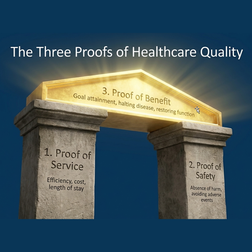
Are we measuring healthcare quality, or are we just checking administrative boxes? Every day, clinicians at major academic medical centers face a profound paradox: they deliver world-class, complex care to highly vulnerable patients, only to be told by administrative "league tables" that their performance sits in the lower third. In this episode, we pull back the curtain on why standard payer-derived metrics are failing both doctors and patients. We deconstruct the mathematics of measurement science to prove that rare-event league tables are often statistical noise—and how a simple shift to a Funnel Plot reveals the clinical truth [multimodal_35]. But we don’t just expose what is broken; we build the alternative. We lay out an elegant, clinically driven model to transition healthcare "from encounter to episode to arc" [multimodal_27, 78f92191]. Using the real-world clinical journey of a woman newly diagnosed with endometrial cancer, we walk through how we can replace rigid, academic Patient-Reported Outcomes (PROs) with a dynamic, peer-governed Outcome Goal Library and Goal Attainment Scaling (G.A.S.) [multimodal_10]. You will learn how to measure and balance the Three Proofs of Quality [multimodal_8, multimodal_25]: Proof of Service: Automatically grouping longitudinal costs using open-standard PACES groupers to protect physicians from billing burdens. Proof of Safety: Implementing a binary gate for Zero Major Complications (ZMC) that acts as a real-time boundary rather than a retrospective stick. Proof of Benefit: Utilizing customized G.A.S. scoring to measure whether the patient actually reclaimed their functional daily life and goals [multimodal_10]. Finally, we discuss how team-based quality governance and shared facility-level scoring bind surgeons, oncologists, and primary care physicians into a unified circle of care—aligning the clinical mission with the strategic needs of health systems [multimodal_28, multimodal_31]. If you are a clinician, healthcare executive, or policy leader who is ready to move past compliance-driven box-checking and reclaim the true calling of medicine, this episode is your blueprint [multimodal_1].

Secure Private Inference for Episode Intelligence (AI) for Health Systems

IA
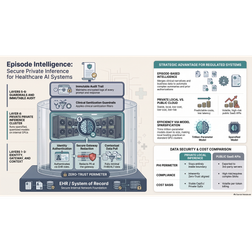
Let's explore AI and securing PHI for enhancing healthcare. This involves the strategic implementation of sparsified, open-weight language models within the secure internal infrastructure of healthcare organizations. By deploying these efficient models directly above Electronic Health Records (EHR), institutions can provide clinicians with advanced tools while ensuring protected health information (PHI) never leaves their private network. This localized approach utilizes data minimization and zero-trust principles to satisfy strict regulatory requirements like HIPAA more effectively than external cloud services. Furthermore, techniques such as quantization and sparsification lower the necessary computational power, making private hardware clusters a financially and operationally viable alternative to public APIs. The architecture emphasizes human-in-the-loop oversight and rigorous audit trails to maintain safety and accuracy in clinical settings. Ultimately, the text advocates for this model as a way to balance cutting-edge AI utility with the non-negotiable demands of patient privacy and institutional security.

Episode Intelligence for Health Systems
Video
IA
A video slide deck to introduces episode intelligence, a healthcare technology. It is designed to transition from fee for service, encounter-based medicine and its fragmented data silos to a unified, patient-centered care journey. By utilizing artificial intelligence and sophisticated grouper logic, the system organizes medical records into "arcs" that track specific health conditions over time rather than isolated visits. These tools provide clinicians with real-time insights into patient stages, treatment gaps, and predictive outcomes, fostering better decision-making at both the individual and population levels. The platform emphasizes transparency and governance, ensuring that every clinical recommendation is traceable and reviewable by medical staff. Ultimately, the architecture aims to lower costs and improve health outcomes by aligning the goals of patients, providers, and healthcare systems within a single, cohesive digital environment.

Prioritizng Patient Goals

IA
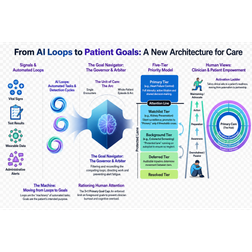
AI co-engineering with physicians as a transition in healthcare from fragmented encounters to patient drive, goal directed episodes of care. Care moves for single, visit-based encounters to goal-oriented care managed across a patient’s entire clinical journey. While AI engineered-loops can automate tasks like titration and monitoring, the author warns that an overabundance of these cycles causes alerts and alert fatigue overwhelms clinicians. To solve this, the instrument introduces the goal navigator, a system that prioritizes a limited number of primary goals based on patient values while managing secondary tasks in the background. This transition requires moving accountability toward the care episode and the long-term patient arc rather than individual billable events. Success ultimately depends on a cultural shift from medical paternalism to a partnership where patient activation is nurtured through small wins and visible agency. Ultimately, the framework aims to ensure that governed attention remains focused on what matters most to the individual patient.

Multi-agent natural language prompts are defining episodes of care !
IA
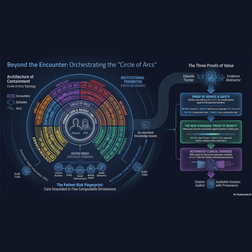
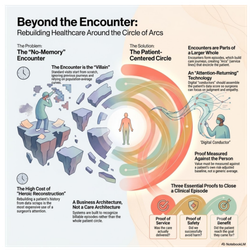
Imagine dictating in natural language to an AI prompt to write python code outside HIPAA boundary, then ship the code into the HIPAA security so that it securely pulls clinical data and helps design care plans fit to patient's goals. Bring the LLM's code to the HIPAA secured data. Episodes of Care Solutions, a clinical architecture designed to bridge the gap between medical knowledge and actual care delivery by moving beyond isolated patient encounters. This model organizes a patient’s health journey into a Circle of Arcs, where primary care physicians manage the central journey and specialists coordinate on outer rings to ensure continuous, goal-directed care. Central to this system is the Patient Risk Fingerprint, which uses five computable dimensions to establish a personalized baseline for every individual. Each segment of care, or episode, is validated through the Three Proofs, which measure the service rendered, the safety of the delivery, and the actual benefit to the patient. To maintain this structure, the sources propose a knowledge orchestration layer that uses governed, multi-agent AI instruments within a HIPAA-compliant boundary to assist clinicians. Ultimately, the framework treats clinical AI prompts like a pharmacy formulary, ensuring that technology serves to return a physician's attention to the patient rather than replacing human judgment.

Rethink a clinical patient centered framework

IA
A visionary patient-centered care architecture that moves away from fragmented medical encounters toward a unified Circle of Arcs. The current healthcare system is criticized for its transactional design, which treats patients as isolated billable events and forces clinicians to heroically reconstruct a patient’s history from memory and scraps of data. To resolve this, the model introduces a shared digital notation—semantics and ontology—that allows data to flow seamlessly across care journeys and clinical domains. By establishing a risk-adjusted baseline for each individual rather than relying on population averages, the system can provide objective proof of service, safety, and benefit. Ultimately, this framework aims to return precious attention to primary care, and specialists: surgeons and others by automating the assembly of information, allowing them to focus on the person rather than the paperwork. This shift ensures that PCPs & specialists own their specific inner and outer-ring arcs while remaining synchronized the patient & primary physician at the center of the patient’s care.

The Blueprint for Valued Episodes

IA
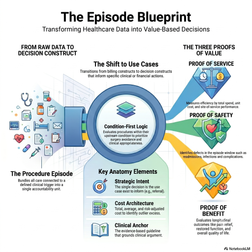
A blueprint for translating Service Line Use Cases into Valued Episodes This blueprint serves as a strategic manual for healthcare leaders to transform raw procedure data into actionable value-based use cases. By grouping related medical services into episodes of care, the guide enables systems to measure performance through the lenses of efficiency, safety, and patient benefit. It emphasizes starting with the broader clinical condition rather than just the surgical event to address the crucial question of procedural appropriateness. The script shares examples from its detailed sixteen distinct use case profiles, ranging from cardiac surgery to maternity care, providing specific clinical anchors and decision-making frameworks for each. Ultimately, the methodology aims to shift the focus from mere volume to high-quality, longitudinal outcomes while identifying opportunities for cost reduction and equitable care.

Turn EHRs into orchestrated knowledge assets and care pathways

IA
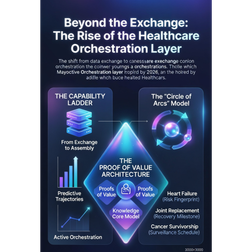
A 2026 vision for advancing American healthcare infrastructure in informatoin exchanges to move from simple data exchange to a sophisticated orchestration layer. It argues that while existing networks like QHINs and Health Data Utilities have successfully built the "pipes" for moving information, they must now evolve into intelligence hubs that synthesize fragmented data into longitudinal patient records. This transition is framed as a five-rung capability ladder, moving from basic document exchange to predictive trajectories and accountable, routed actions. By focusing on the episode of care rather than isolated clinical encounters, these networks can ensure the three proofs of value: service, safety, and benefit. Ultimately, the paper advocates for a policy and investment shift toward digital knowledge assets that proactively guide care journeys through a unified "Circle of Arcs."

The Landing Zone: A Roadmap for American Healthcare Reform

IA
Dr. Frank G. Opelka argues that the American healthcare system is a fragmented collection of four competing models that prioritize administrative billing over patient outcomes. Rather than a total overhaul, he proposes a "landing zone" strategy that transitions the country toward single-stream public financing paired with private, integrated delivery networks. This decade-long roadmap involves shifting from fee-for-service payments to risk-adjusted capitation and utilizing real-time clinical informatics to measure actual health benefits. Success depends on retraining the administrative workforce, leveraging antitrust regulations to manage regional monopolies, and following the lead of large employers seeking lower costs. Ultimately, the text positions rural America as the ideal testing ground for these reforms because the current system has already failed there. This phased approach aims to preserve private innovation while creating a more stable and predictable social contract for all citizens.

Coordinating Care in Nederlands: Het Loom

IA
Het Loom-model is een conceptueel model dat is ontworpen om de zorgcoördinatie voor patiënten met meerdere complexe gezondheidsproblemen te automatiseren en te verbeteren. In plaats van te vertrouwen op overbelaste patiënten om hun eigen medische gegevens te integreren, maakt het systeem gebruik van een multi-agent softwarearchitectuur om diverse klinische processen gelijktijdig te beheren. Dit raamwerk maakt gebruik van een aandoeningenbibliotheek en een virtueel 'weefgetouw' met gedeelde interfaces – zoals tijdlijnen en budgetten – om conflicten te identificeren en taken te ordenen zonder verschillende behandelplannen samen te voegen tot één onbeheersbaar geheel. Cruciaal is dat het model benadrukt dat, hoewel softwareagenten het logistieke weven uitvoeren, een menselijke dirigent de uiteindelijke autoriteit blijft voor klinische beslissingen en verantwoording. Door de onzichtbare arbeid van coördinatie te structureren en meetbaar te maken, wil het voorstel de huidige systeemlacunes vervangen door een zichtbaar en gereguleerd zorgproces.
1 de 2