Beyond Ether Dome: The History of Modern Medicine

Beyond Ether Dome: The History of Modern Medicine

por Robert Lane, MD and Bart Patenaude, MD
Temporada 1
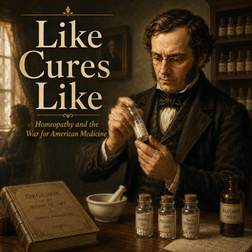
Like Cures Like: Homeopathy and the War for American Medicine
Homeopathy is often dismissed as one of history's great medical mistakes. But if it was so obviously wrong, why did so many intelligent physicians embrace it, and why did so many patients insist it worked? At the turn of the twentieth century, roughly one in ten American physicians practiced homeopathy. They founded medical schools, built hospitals, published scientific journals, and competed directly with conventional medicine. So why did millions of patients trust them, and why did the movement ultimately fail? In this episode, Dr. Robert Lane and Dr. Bart Patenaude explore the remarkable history of homeopathy, from Samuel Hahnemann's revolutionary idea that "like cures like" to the bizarre world of serial dilutions, succussion, vital forces, and remedies so diluted that not a single molecule of the original substance remained. Along the way, they examine a real 1910 migraine case from a homeopathic journal, discuss why homeopathic physicians often achieved surprisingly good results despite ineffective remedies, and explain the very real power of placebo, empathy, and simply listening to patients. But this episode is about much more than sugar pills. It is the story of a bitter professional war between homeopaths and conventional physicians, fought over science, philosophy, prestige, and patients. It is also a reminder that the "regular" medicine of the day was still prescribing mercury, strychnine, and other treatments we now recognize as ineffective or dangerous. Ultimately, homeopathy did not disappear because of a conspiracy or a single report. It lost because scientific medicine began delivering something no competing theory could match: treatments that consistently worked. Yet homeopathy leaves behind an important lesson. Compassion, careful listening, and treating patients as individuals were not magical remedies, but they remain essential parts of good medicine today. In this episode: The surprising rise of homeopathy in nineteenth-century America Samuel Hahnemann and the birth of "like cures like" Provings, the Materia Medica, and the Repertory Why homeopathic remedies became more diluted instead of stronger The bizarre mathematics of a 30C dilution The placebo effect Why homeopathy sometimes outperformed conventional medicine during epidemics The medical war between homeopaths and the regular profession Why science, not politics, ultimately decided the outcome What every modern physician can still learn from homeopathy
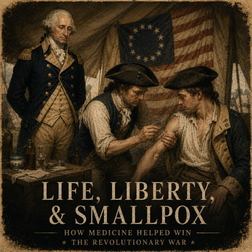
Life, Liberty, and Smallpox: How Medicine Helped Win the Revolutionary War
The British weren’t the deadliest enemy facing George Washington’s army. Disease was. And one controversial medical decision may have helped save the American Revolution. In this special Independence Day episode of Beyond Ether Dome, Dr. Robert Lane and Dr. Bart Patenaude explore the Revolutionary War through the eyes of its soldiers, surgeons, and patients. More American servicemen died from disease and imprisonment than on the battlefield. Dysentery swept through unsanitary camps. Typhus followed lice, hunger, and overcrowding. Smallpox devastated military units, discouraged enlistment, and helped cripple the American campaign in Canada. We examine what medicine could—and could not—do for the ordinary soldier. We follow a country doctor who happened upon James Monroe on the road to Trenton and then saved the future president’s life after a musket ball severed an artery. We look at the bloodletting of George Washington during his final illness and reconstruct, step by step, the brutal reality of a Revolutionary-era battlefield amputation: the tourniquet, the knife, the saw, the tenaculum, and the race to control hemorrhage without anesthesia or modern resuscitation. Finally, we turn to smallpox. Long before vaccination, physicians deliberately infected healthy people through a dangerous procedure called inoculation. George Washington initially prohibited the practice in the Continental Army. Then the evidence changed—and Washington changed his mind. His decision led to one of the largest organized medical interventions of the eighteenth century. Soldiers were inoculated in stages, quarantined, and returned to service with immunity to a disease that had threatened the survival of the army itself. The American Revolution was won with muskets, artillery, endurance, and French assistance. But medicine had a role too. In this episode: Why disease killed more American soldiers than combat The horrors of British prison ships and military prisons Dysentery, typhus, malaria, and smallpox in the Continental Army Starvation, exposure, and disease at Valley Forge What Revolutionary War doctors actually did for sick soldiers How Dr. John Riker saved the wounded James Monroe George Washington’s final illness and massive bloodletting Which battlefield wounds were survivable in the eighteenth century A step-by-step reconstruction of a battlefield amputation without anesthesia The difference between smallpox inoculation and vaccination Why inoculated patients could spread smallpox Why Washington initially banned inoculation How the Canadian campaign changed his thinking How the Continental Army carried out inoculation without incapacitating the entire force Why Washington’s willingness to change his mind mattered to the war Beyond Ether Dome is a podcast about the history of modern medicine and healthcare: the discoveries, disasters, personalities, institutions, and ideas that made medicine what it is today.
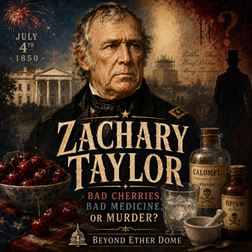
Zachary Taylor: Bad Cherries, Bad Medicine, or Murder?
Episode 2: The Death of President Zachary Taylor — Cholera, Poison, or His Doctors? On July 9, 1850, President Zachary Taylor died after only sixteen months in office. Almost immediately, rumors began to spread. Had the president been poisoned? Did his opposition to the expansion of slavery make him the victim of an assassination? More than a century later, Taylor's body was exhumed and tested for arsenic. The results seemed to settle the question—but did they? In this episode, we examine the evidence surrounding one of the most famous medical mysteries in American history. We explore what Taylor ate, the symptoms he developed, the treatments prescribed by his physicians, and the state of medical knowledge in 1850. Along the way, we ask a broader question: if a patient dies because of the standard medical care of the day, is that simply bad luck—or can medicine itself become the cause of death? In this episode The final illness of President Zachary Taylor The political conspiracy theories surrounding his death Cholera morbus and nineteenth-century medicine Bloodletting, calomel, opium, blistering, and other common treatments The 1991 exhumation and arsenic testing Why the poison theory persists What modern medicine can—and cannot—tell us about Taylor's death If you enjoy the show, please follow, rate, and share Beyond Ether Dome. It helps other listeners discover the history of modern medicine and healthcare.
Introducing Beyond Ether Dome: The History of Modern Medicine
Trailer
Medicine as we know it—the hospitals, the drugs, the science, and the healthcare system—did not appear overnight. Beyond Ether Dome explores the history of modern medicine and healthcare through the discoveries, controversies, personalities, and institutions that transformed medicine from an uncertain art into one of the most powerful forces in modern society. Hosted by Dr. Robert Lane and joined by Master Professor Doctor Patenaude, the podcast examines the breakthroughs, disasters, scandals, reforms, and rivalries that shaped the modern medical world. From anesthesia and germ theory to medical education, hospitals, antibiotics, public health, and healthcare policy, we'll explore how we got here—and why it matters. Subscribe now and join us for the journey.