The Zero Doctrine™ Podcast

The Zero Doctrine™ Podcast

di Manuel W. Lloyd
Stagione 3
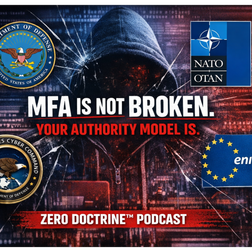
MFA Is Not Broken — Your Authority Model Is
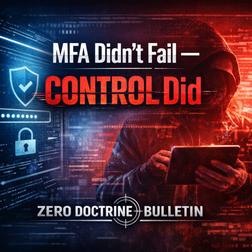
A recent global adversary-in-the-middle (AiTM) campaign exposed a critical flaw in modern cybersecurity: Authentication success does not guarantee operational control. In April 2026, attackers compromised tens of thousands of users across multiple countries—not by breaking MFA, but by intercepting authenticated sessions and stealing session tokens. This episode breaks down why that matters—and why it represents a systemic failure across enterprise, government, and coalition environments. --- 🚨 What You’ll Learn Why MFA is not broken—and why that matters How attackers take control after authentication completes What session hijacking and token theft mean operationally Why traditional detection fails in this scenario What this means for NATO and coalition cyber environments --- 🧠 Core Insight Modern security assumes: If authentication succeeds, the user is trusted. That assumption is now invalid. Attackers are no longer breaking in— they are inheriting authority inside valid sessions. This creates a new failure condition: Post-Authentication Authority Compromise (PAAC) Identity is valid. Session is valid. Authority is not. --- 🌐 Why This Matters for NATO Coalition environments rely on: Federated identity Shared systems Delegated access These models assume authority follows identity. But current threats show: Authority can transfer after login—without detection. That leads to: Ambiguous operational control Contested authority across nations Breakdown in command integrity --- ⚠️ The Shift Happening Now Cybersecurity is moving: From access control → to authority control From login security → to post-login governance From entry prevention → to control after entry This is the start of: Session-Level Warfare --- 🛡️ Zero Doctrine™ Position Zero Doctrine™ does not try to fix MFA or phishing. It addresses what happens when those systems succeed— and control is still lost. Because the real flaw is this: Authority is being derived from authentication. --- ⚙️ What Must Change Authority ≠ Authentication Control must be validated beyond login events Sessions Must Be Contained Never trusted by default—always inspected Sovereign Control Layers Authority must exist in controlled environments, not in identity systems --- 🔥 Bottom Line MFA didn’t fail. Your assumption did. If your model equates authentication with authority: you do not control your environment. --- 🎯 For Leaders In national security, critical infrastructure, and coalition operations: The question is no longer: “How do we secure login?” The question now is: “Who has authority after login—and how do we prove it?”
MFA Didn’t Fail — Control Did: How Adversaries Take Authority After Authentication
In May 2026, a large-scale adversary-in-the-middle (AiTM) campaign demonstrated a critical reality most organizations are not prepared for: authentication can succeed — and control can still be lost. This episode breaks down how attackers are no longer focused on stealing credentials alone. Instead, they are intercepting authenticated sessions in real time, capturing tokens, and operating under fully trusted identities — effectively bypassing multi-factor authentication (MFA) without “breaking” it. This is not a failure of security controls. This is a failure of control after access is granted. --- What’s Covered How AiTM attacks bypass MFA without stealing passwords Why session tokens — not credentials — are now the real target The difference between access security and authority control How attackers operate under legitimate identity without raising immediate alarms Why detection and visibility do not equal control during compromise The critical gap between authentication and decision authority --- Key Insight Most cybersecurity strategies are designed to answer: “Who is allowed in?” But modern attacks operate at a different layer: “Who is actually in control once they are inside?” --- Why This Matters for Leaders For organizations responsible for national security, public safety, and critical infrastructure: Identity compromise is no longer the primary risk Authority compromise is Once an adversary operates under a trusted identity, they can: Issue commands Move laterally Trigger operational decisions At that point, the system may still appear functional — but control has already shifted. --- Doctrine Perspective This episode reflects a core principle: Cybersecurity measures access. Adversaries take control. Understanding this distinction is the difference between: Detecting a breach And maintaining authority during one --- Executive Briefing Invitation If this resonates, request a 20-minute executive session: “What Is InterOpsis™ — and Why Most Organizations Lose Control After Compromise” This is not a product conversation. This is a focused discussion on operating with authority under compromised conditions. --- Episode Context Based on a real adversary-in-the-middle campaign affecting 35,000+ users across 13,000 organizations, where attackers intercepted authenticated sessions and bypassed MFA controls through token capture. --- Final Takeaway The industry is still optimizing authentication. Adversaries are already operating beyond it. The real question is no longer: “Can they get in?” The real question is: “Who is actually in control once they do?”

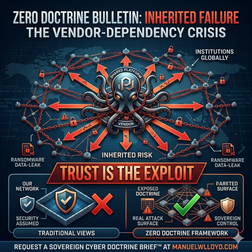
Zero Doctrine™ Bulletin-007: One Vendor. Thousands of Victims
Episode Notes A major ransomware attack on a shared platform impacted thousands of institutions globally, exposing a critical failure in dependency-based cybersecurity. This Zero Doctrine Bulletin breaks down what actually happened: A single vendor was compromised, and every organization connected to that vendor inherited the failure. This wasn’t a failure of tools. This wasn’t a failure of compliance. This was a failure of trust. Traditional cybersecurity assumes: “We secure our environment.” But reality is: You inherit your vendors’ risk. Zero Doctrine™ reframes this completely. Instead of asking: “Is the vendor secure?” We ask: “Does the vendor control my mission?” If the answer is yes — you have already lost authority. This episode introduces the real issue: The attack surface is no longer just your network. It is your dependencies. And if your operations depend on systems you do not control: Your survivability depends on decisions you do not make. To eliminate vendor-dependent failure from your security posture, request a Sovereign Cyber Doctrine Brief™ @ manuelwlloyd.com
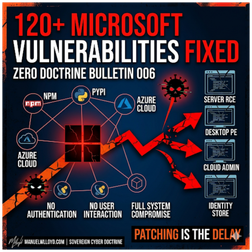
Zero Doctrine™ Bulletin 006 — Enterprise Security Is One Patch Away From Collapse
Microsoft has released fixes for over 120 vulnerabilities across identity systems, cloud platforms, and core enterprise applications — including critical remote code execution flaws. These vulnerabilities enable: • Remote code execution • Privilege escalation • Full system compromise Without: • Authentication • User interaction • Prior access One unpatched system is enough. Modern cybersecurity depends on: • Patching cycles • Vulnerability scans • Exposure reduction But the reality is simple: The vulnerability exists before the patch. The exploit exists before the patch. Attackers move before the patch. Security becomes a race — and you are always behind. Zero Doctrine™ removes the race entirely. We assume: • Vulnerabilities exist • Systems are already compromised • Control will be challenged And we enforce something different: Authority that does not depend on patch state. If a system fails: • It does not take control with it • It does not spread compromise • It does not break the mission Command takeaway: You cannot patch fast enough to outrun compromise. If your strategy depends on patching for safety, you are operating in delay — not control. To understand how to maintain control regardless of vulnerability state, request a Sovereign Cyber Doctrine Brief™ at manuelwlloyd.com
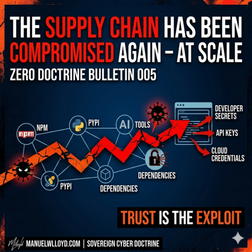
Zero Doctrine™ Bulletin 005 — The Supply Chain Has Been Compromised Again at Scale
🎙️ ZERO DOCTRINE BULLETIN 005 “The Supply Chain Has Been Compromised Again — At Scale” A coordinated cyber attack has compromised hundreds of open‑source packages across NPM and PyPI ecosystems, including widely used frameworks and AI tools. Malicious code was injected directly into trusted software pipelines — turning dependency chains into delivery mechanisms for compromise. This attack did not break into systems. It propagated through: • Trusted package ecosystems • Legitimate update channels • Developer workflows Targets included: • API keys • Cloud credentials • Developer secrets Compromise began before deployment. Traditional security models assume: • Software is trustworthy • Updates are safe • Dependencies are validated But in reality: Trust is the exploit. Organizations do not control: • Third‑party code • Package maintainers • Release pipelines Zero Doctrine™ eliminates this dependency. Under doctrine: • External code is never trusted • Update mechanisms are controlled, not assumed • Dependencies must enter through enforced boundaries Execution occurs only within sovereign enclaves. If it cannot be verified and controlled — it does not execute. Command takeaway: The supply chain is not a vulnerability. It is the delivery mechanism for compromise. If your system depends on trust, it is already inside your environment. To eliminate supply chain dependence from your security model, request a Sovereign Cyber Doctrine Brief™ at manuelwlloyd.com
Stagione 1
You Don’t Need Cyber Hygiene. You Need AegisAI™.
🧠 You Don’t Need Cyber Hygiene. You Need AegisAI™ Manuel W. Lloyd on why defense must be deceptive — and autonomous. In this episode, Manuel W. Lloyd challenges the myth of cyber hygiene. He introduces AegisAI™ — the doctrine-native deception engine from the InterOpsis™ Framework — and shows how it transforms defensive AI into autonomous counter-operations. Includes: Real-world red cell example Doctrine use cases SecureTrain™ briefing
The Problem with Air-Gaps—Why STEALTH™ Enclaves Fix It
Air-gaps aren’t enough. STEALTH™ Enclaves are the next evolution of mission isolation. In this episode of Zero Compromise™, Manuel W. Lloyd exposes the fatal flaw in traditional air-gaps — they isolate, but they don’t operate. He breaks down what a STEALTH™ Enclave actually is, how SovereignLines™ enables secure bridging without internet exposure, and walks through a red-team simulation where doctrine—not tools—stopped the breach. STEALTH™: Secure Tactical Enclave for Air-gapped Logical Threat Handling DNA™: Data Nexus Assignment SovereignLines™: Doctrine-governed enclave bridge 🎯 Want to try the same SecureTrain™ simulation? 📎 Take the Doctrine Readiness Assessment or request an access code at [manuelwlloyd.com]
DNA™ — The Segmentation Protocol That Should’ve Existed in 1995
In this episode, Manuel W. Lloyd breaks down DNA™—the Data Nexus Assignment protocol that redefines cybersecurity segmentation. Learn why encryption isn’t enough, how lineage protects data from the start, and why most orgs are leaking by default. Includes access to a SecureTrain™ simulation used in real briefings.
This Is Not Cybersecurity—It’s Doctrine
The internet was built for openness. That’s why it fails. InterOpsis™ isn’t patching holes—it’s enforcing a digital military doctrine. Content: * Define what a “doctrine” means in cyber (vs tools, vendors, controls) * Introduce the Zero Compromise™ pillars: Zero Internet, Zero Exposure, Zero Cross-Contamination * Explain why trust is dead and segmentation is survival Preview what’s coming: SecureTrain™, TitanAI™, TrustNet™, etc.
Quantum Resilience by Design—How InterOpsis™ Neutralizes Post-Quantum Threats
In this high-stakes episode, cybersecurity strategist Manuel W. Lloyd dives deep into the doctrine, frameworks, and post-quantum architecture behind his newly released whitepaper, “Quantum Resilience by Design.” You’ll learn: What Q-Day is and why it’s closer than you think How InterOpsis™ embeds Zero Doctrine™ into every operational layer Why protocols like DNA™, QuantumGuard™, and TitanOS™ are redefining national defense cybersecurity A four-phase roadmap to post-quantum readiness Hot takes on compliance vs. sovereignty, and why “tools” won’t save you Plus: ✅ Here’s a Tip for You segment 🔥 Exclusive Hot Takes 📄 Live promo for the new whitepaper 🎯 Booking link for 1:1 Readiness Briefings “Quantum won’t kill cybersecurity. It’ll kill lazy architecture.” — Manuel W. Lloyd Resources & Links 📄 Download the whitepaper: https://manuelwlloyd.com/ybersecurity-risk-assessments-audits-zero-compromise-security-0-0 🎙 Listen to more episodes: https://podcasts.apple.com/us/podcast/zero-compromise/id1649201313 📅 Book your 1:1 Readiness Briefing: https://manuelwlloyd.com/ybersecurity-risk-assessments-audits-zero-compromise-security-0-1 🔐 Learn more: https://www.manuelwlloyd.com post-quantum cybersecurity, Zero Trust, Q-Day, InterOpsis, Manuel W. Lloyd, cyber warfare, data sovereignty, quantum computing, national defense cybersecurity, critical infrastructure, Zero Compromise, TitanSeries, QuantumGuard, SecureTrain, zero internet, cyber resilience
1 di 3