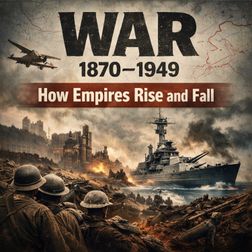
WAR 1870–1949: How Empires Rise and Fall

WAR 1870–1949: How Empires Rise and Fall

di Nik Osterman
Stagione 3
The Economy of War
Hello and welcome back. This is WAR 1870–1949: How Empires Rise and Fall. Today’s episode is The Economy of War—the machinery beneath the speeches, the quiet engine that makes conflict not only possible but increasingly likely. You asked the right questions: who, why, when. And you framed it perfectly: this becomes more and more ardent. It doesn’t stay a background detail. It moves forward until it becomes a kind of gravity. To understand the economy of war after 1918, you have to abandon the comforting idea that war is only a political decision made in a room by a few leaders. War is also an ecosystem. It has supply chains. It has employment. It has credit. It has industrial planning. It has contracts. It has lobbyists and ministries and generals who measure security in steel. It has journalists who translate fear into public appetite. It has workers whose wages depend on production. It has towns where the factory is the town. It has elites who speak about honor while signing procurement schedules. And after the Great War, everyone knows something they did not know so clearly before: modern war is not fought by armies alone. It is fought by entire societies. It is fought by coal and rail and petroleum and nitrates and shipping and machine tools and steel output and electrical grids and food supply and morale. It is fought in factories before it is fought in trenches. So the economy of war is not a sideline—it becomes the main stage. Start with the simplest fact: the Great War invents “total war” as a lived economic reality. Governments learn how to conscript not only men but production. They create ministries, boards, ration systems, emergency powers. They learn how to convert peacetime industry into armaments. They learn how to standardize, quantify, and manage. They learn that bureaucracy can be a weapon. They learn that the home front is part of the front. 2ndrevolution.org
The Victors in Fear: Britain and France Hold the Line
Hello and welcome back. This is WAR 1870–1949: How Empires Rise and Fall. Episode Four of our buildup arc is The Victors in Fear: Britain and France Hold the Line. If you want to understand the interwar period properly, you have to strip away the victory photographs. The leaders look composed. The flags look proud. The map looks controlled. But underneath, Britain and France are not walking into peace—they’re walking into fragility. They have won, and they are terrified. Not theatrically. Structurally. Because they can feel, in their bones, that the old European order has been damaged beyond repair, and they don’t know what will replace it. France has been invaded and scarred. The battlefield has been on its soil. Whole regions have been torn up. A generation of young men is missing. That absence is not poetic; it’s demographic. It’s economic. It’s psychological. You can’t build a stable society on an empty cohort. You can’t replace missing fathers with speeches. You can’t replace missing bodies with monuments. And you can’t forget that the next invasion, if it comes, will come through the same routes again. So France’s victory doesn’t feel like triumph. It feels like a man who survived an attack in his own home and now sleeps lightly, listening for footsteps. The French state is obsessed with security because security is not abstract. It’s the only answer to the memory of German boots on French ground. That obsession shapes everything: diplomacy, alliances, military planning, the demand that Germany remain weak, and the deep fear that words on paper will not stop guns in the future. Britain is a victor too, but Britain’s victory has a different taste. Britain’s empire has held, yes, but the war has revealed its limits. Britain is financially strained. Britain is indebted. Britain has lost men. Britain has managed a total war, and total war has a habit of changing the relationship between rulers and ruled. People who have been asked to sacrifice begin asking questions. Why us? Why again? Why should we accept this arrangement forever? Britain also watches the continent with cold calculation: a weakened Germany is good in one sense, but a permanently humiliated Germany is dangerous. A broken Russia is dangerous. A revolutionary Russia is dangerous. A continent full of grievances is dangerous. Britain wants balance, because Britain’s whole imperial survival logic depends on not being dragged into another continental furnace. So Britain becomes the nation of cautious power: still immense, still global, but cautious in a way that can look like indecision to those who want clarity.
Stagione 2
Russia: Retreat, Revolution, and the New Empire
Hello and welcome back. This is WAR 1870–1949: How Empires Rise and Fall. Episode Three of our buildup arc is Russia: Retreat, Revolution, and the New Empire. If Germany is the story of a crown falling and a republic trying to stand upright in a storm, Russia is something else entirely. Russia is what happens when an empire doesn’t merely lose a war, but loses the right to command reality. It is the moment a state’s voice stops sounding like fate and starts sounding like a weak man pleading. And once that happens, the world changes shape fast. The Russian Empire goes into the Great War carrying old weight—peasants and priests, palaces and poverty, a vast distance between the rulers and the ruled, a tradition of obedience held together by habit, fear, and the aura of the Tsar. But modern war is not polite. It doesn’t care about aura. It doesn’t care about prayers. It doesn’t care about dynastic myths. It cares about shells, supply lines, factories, railroads, and whether your soldiers believe the people sending them to die have any idea what they’re doing. Russia bleeds early, bleeds often, and bleeds in ways that don’t produce “meaning.” That’s crucial. A society can endure suffering if it feels the suffering is purposeful and competent. But when suffering feels pointless and incompetent, it becomes political acid. And in Russia, the war becomes acid.
The Crown Falls-The Republic Bleeds.
Hello and welcome back. This is WAR 1870–1949: How Empires Rise and Fall. Episode Two of our buildup arc is Germany: The Crown Falls, the Republic Bleeds. The most dangerous moment in a collapsing empire is not the day it loses. It’s the day it loses and then must decide what the loss means. Because meaning is power. Meaning determines who is blamed, who is trusted, who is allowed to rule, and what violence is permitted in the name of restoration. Germany in late 1918 is not simply defeated. It is unmade. The Kaiser is gone. Wilhelm II falls out of history like a crown tossed into cold water. The monarchy that once felt like the natural shape of Germany suddenly looks like a costume that has been ripped off in public. And the country does not experience that as a calm transition. It experiences it as a shock. A nation that has lived inside imperial certainty is suddenly handed the unfamiliar problem of being responsible for itself. The war ends, and immediately the war continues inside Germany. The soldiers come home, but they don’t come home into gratitude and stability. They come home into hunger, inflation, unemployment, resentment, street violence, and a sense of moral vertigo. They come home to a political argument that is not polite, because the argument is fueled by grief and humiliation and fear. The argument is this: did we lose because we were beaten, or did we lose because we were betrayed?
1918–1919: The Peace That Continued the War
Hello and welcome back. This is WAR 1870–1949: How Empires Rise and Fall. Episode One of our buildup arc is 1918–1919: The Peace That Continued the War. The first thing to understand about the armistice is that it doesn’t feel like victory in the bodies of the people who survived. It feels like the gun finally stopping after you’ve lived so long with noise that silence itself is suspicious. The world in late 1918 is not a relieved world. It’s a stunned world. A world of men trying to walk on legs that aren’t there. A world of women who have learned to dread the sound of footsteps at the door. A world where influenza moves through weakened populations like a second army. A world of ration books, debt, and cemeteries that become permanent architecture. So when leaders speak of “peace,” they are already lying a little—not out of malice, but because the word is too clean for what exists. What exists is exhaustion. What exists is grief. What exists is fear that the whole structure of society might go down if pressure isn’t released quickly. And then the leaders gather to write the future. They arrive in Paris and they arrive with ghosts behind them. Not poetic ghosts—actual ghosts, in the form of the dead who now sit in every voter’s memory. Every government comes with an invisible crowd standing behind it: widows, parents, the wounded, men who survived and cannot sleep. That crowd is not interested in nuance. That crowd wants the suffering to mean something. That crowd wants the war to be justified after the fact. And this is one of the most dangerous forces in history: the demand that unbearable pain must be explained by a morally satisfying outcome.
The Age of Attrition 1918 — The Armistice and the Peace That Wasn’t Peace
1918 — The Armistice and the Peace That Wasn’t Peace By the time the guns stopped, the war had already done its deepest work. Not only on borders, but on minds. What ended in November 1918 was the shooting. What did not end was the pressure that produced the shooting in the first place. That pressure simply changed form. It moved into treaties, reparations, revolutions, resentments, and the private aftermath carried by millions of damaged people who returned home to countries that no longer felt like the countries they had left. In the autumn of 1918, Germany was collapsing from the inside outward. The Allied advances of the Hundred Days had pushed German forces back toward the Hindenburg Line and beyond. In a purely military sense, the German army was still capable of fighting in places, still capable of inflicting heavy losses, still capable of retreating in order rather than in total rout. But something more important had failed: belief. The soldiers knew the war was lost. The leadership knew it too. And the civilian population—hungry, exhausted, angry—could no longer carry the burden. Germany’s allies were falling away at the same time. Bulgaria sought an armistice in late September. The Ottoman Empire followed at the end of October. Austria-Hungary, internally fractured and militarily weakened, was breaking into national components. When these pillars collapsed, Germany’s strategic position became hopeless. The war that had begun as a contest of alliances ended with one side watching its coalition dissolve.
The Age of Attrition 1918 — The Last Gamble
1918 — The Last Gamble In early 1918 the war reached a strange moment of imbalance. Russia was out. The Eastern Front, which had consumed German divisions for years, had vanished. German leaders believed they finally had what they had been missing since 1914: a temporary window—just a few months—when they could concentrate force in the west before the United States could fully arrive. It was not optimism. It was calculation. A final throw of the dice. The treaty that sealed Russia’s exit, Brest-Litovsk, had freed German troops, but it had not freed Germany from hunger. The British blockade still strangled supplies. Coal was short. Food was rationed brutally. Civilians were malnourished. Soldiers at the front were exhausted. The leadership knew that time itself was now a weapon pointed at Germany. American manpower and industry were mobilizing. If the war lasted into 1919, Germany’s odds shrank dramatically. So 1918 became a race against an opponent that wasn’t yet fully on the field.
The Age of Attrition 1917 — Mutiny, Submarines, and the Breaking Point
1917 — Mutiny, Submarines, and the Breaking Point By 1917, the war had entered a phase no one had planned for and no one could control. The optimism of 1914 was long dead, and even the grim determination of 1916 had begun to rot from within. The armies still faced each other across the Western Front, but beneath the surface, the foundations of the war effort were cracking. This was no longer only a struggle of armies. It was a struggle of societies—of food, morale, discipline, belief, and patience. On the Western Front, the trenches remained largely where they had been for years. From the North Sea to Switzerland, the front lines shifted only in meters and hundreds of meters, never in decisive miles. Soldiers rotated in and out of the front line, but the pattern of life barely changed: weeks in mud-filled trenches, under constant artillery fire, punctuated by raids, patrols, and the occasional large offensive that promised much and delivered mass casualties instead. In France, the year began with hope—and ended in disillusionment. General Robert Nivelle, newly promoted after Verdun, promised a breakthrough that would end the war within forty-eight hours. His plan relied on overwhelming artillery, precise coordination, and rapid infantry advance. In April 1917, the French army launched the Nivelle Offensive along the Aisne River. It was a disaster.
The Age of Attrition 1917: The War Breaks the World
By 1917 the war no longer pretended to be about glory. Whatever illusions survived 1914 had been buried in mud, wire, and arithmetic. This was now a war of exhaustion, and everyone involved knew it, even if they could not yet say it aloud. The question was no longer who would win quickly, but who could endure longer—economically, politically, psychologically. On the Western Front the lines still ran like scars across France and Belgium. Millions of men had rotated through the trenches, but the geography barely moved. The great battles of the previous year—Verdun and the Somme—had proved something terrifyingly clear: industrial war could consume human lives at a rate no society had ever prepared for. Verdun alone had cost roughly 700,000 casualties. The Somme more than a million. And yet neither had delivered decisive victory. Instead, they taught generals and governments the same brutal lesson: modern defenses favored the defender, and breaking them required either overwhelming material superiority or time measured in years.
The Age of Attrition. 1916 — Verdun, The Somme, and the Arithmetic of Endurance.
Hello and welcome to War — 1870 to 1949: How Empires Rise and Fall. Season Two: World War One — The Age of Attrition. Episode Three: 1916 — Verdun, The Somme, and the Arithmetic of Endurance. By 1916, the war has stopped pretending. The speeches can still use the old words—honor, duty, glory—but the battlefield is now speaking a newer language, colder and more precise. It speaks in tonnage, in supply lines, in shell production, in rail schedules, in replacement drafts, in body counts. It speaks in the logic of systems. And the most frightening thing about that logic is that it doesn’t require hatred to function. It only requires momentum. If 1915 taught Europe that modern war could become a trench-bound stalemate, 1916 proved something worse: that the stalemate could be exploited, engineered, and extended on purpose. This is the year of Verdun and the Somme, two names that aren’t merely battles so much as mechanisms—vast machines built to test how long a society can bleed without collapsing.
1 di 3