Unpacking Injustice

Unpacking Injustice

di Montana Innocence Project
Stagione 3
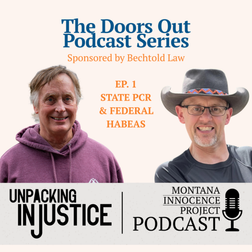
The Doors Out: State Post-Conviction Relief & Federal Habeas
What legal options exist for someone who wants to challenge a conviction after their direct appeal is over? For people who have been wrongfully convicted, the most important potential door out is post-conviction relief, or PCR. In fact, PCR makes up much of the Montana Innocence Project’s legal work. When someone who believes they are innocent applies to MTIP for legal assistance, pursuing post-conviction relief is often the path we are exploring. In the first episode of The Doors Out, a new series from Unpacking Injustice, we’re taking a closer look at two important post-conviction pathways: state post-conviction relief and federal habeas corpus. We’re joined by Colin Stephens, a partner at Stephens Brooke Law and Chair of the Montana Innocence Project’s Board of Directors, and David Ness, an Assistant Federal Defender at the Federal Defenders of Montana and a member of MTIP’s Board. Colin brings his experience with Montana’s state post-conviction process, while David helps us understand the federal habeas system. Together, they break down what these legal mechanisms are, how they work in practice, what they can—and can’t—do, and why these pathways can be so difficult to navigate. Together, they discuss: What state post-conviction relief and federal habeas actually are Why PCR is such an important part of MTIP’s wrongful conviction work How these processes differ from a direct appeal What kinds of claims can be raised after a conviction What these cases look like in practice The investigation and legal work that goes into pursuing post-conviction relief Why procedural rules and other legal barriers can make relief difficult to obtain Why preserving claims in state court can matter for later federal habeas proceedings How long these cases can take What incarcerated people and their families should know if they believe there may be grounds to challenge a conviction or sentence The Doors Out explores the different legal mechanisms that can provide a pathway out of prison, how they work in practice, and the barriers people can face along the way. In the next episode, we’ll explore another important pathway: parole. The Doors Out is sponsored by Bechtold Law.
Bradley Hillious: Inside MTIP's Newest Case
Today's episode introduces MTIP's newest client, Bradley Hillious, and provides an inside look at the investigation that led MTIP to take on his case and prepare a petition for post-conviction relief seeking a new trial. Bradley is serving a 100-year sentence for the death of his wife, Amanda Hillious. Amanda's death was initially believed to be the result of a fall down a staircase, but an autopsy later determined that her death was a homicide. At the time of her death, only two adults were present in the home: Bradley and his father, Scott Hillious. The same day that investigators informed both men that they would be questioned in connection with Amanda's death, Scott told Bradley, "I'm not going to jail," and died by suicide. The defense was barred from presenting its theory that Scott may have been responsible for Amanda's death and that his suicide showed consciousness of guilt. MTIP's central concerns are whether Bradley received a fair trial and effective representation. In this episode, you'll hear from MTIP Legal Director Brady Minow Smith, Intake and Pro Bono Coordinator Charlie McWeeny, and Investigations Manager and Staff Attorney Karl Pitcher. Together, they'll discuss why MTIP accepted the case, the legal issues, and what comes next. You'll also get to meet Bradley and hear his story in his own words.
'Unwilling Student of a Broken Legal System:' Amanda McKnight on Building 406 Revolutionized
In this episode of Unpacking Injustice, we're joined by Amanda McKnight, founder of 406 Revolutionized, a growing Facebook group supporting incarcerated individuals and their families across Montana. Amanda shares how her husband's incarceration led her to become what she calls an “unwilling student of a broken legal system.” What began as a personal search for answers quickly evolved into a statewide advocacy effort focused on helping families navigate Montana’s criminal legal system, access reliable information, and find community during some of the most difficult moments of their lives. Amanda discusses the challenges families face when a loved one becomes incarcerated, the importance of making legal systems easier to understand and navigate, and the role lived experience plays in advocating for change. She also shares her concerns about the parole board, prison conditions, communication barriers, and the need for greater transparency and accountability within Montana’s correctional system. Throughout the conversation, Amanda reflects on the power of community, why families should not be afraid to ask questions and speak up, and how collective advocacy can create meaningful change. To learn more about Amanda’s work, visit the 406 Revolutionized Facebook group and request to join.
Changing Outcomes: Empower 180’s Rosebud Madinger on Reentry for Native Women in Montana
In this episode of Unpacking Injustice, Rosebud Madinger shares the story behind Empower 180 and her work supporting Native women preparing to return home from the Montana Women’s Prison. Inspired by her work as a prison minister—and seeing many of the women return home only to come back to prison shortly after—Rosebud was called to focus on reentry, helping women break cycles of incarceration and build lasting stability in their communities. Montana incarcerates women at one of the highest rates in the world, where Indigenous women comprise roughly 40% of the prison population despite making up less than 7% of the state’s population. Many are incarcerated for crimes connected to addiction, poverty, and survival. Rosebud meets that reality with compassionate mentorship and culturally rooted support for women navigating incarceration and reentry. At the end of the episode, listeners will also hear from Shannon LaMere, Empower 180’s first participant, who reflects on her journey 15 months after leaving prison and speaks to the importance of reentry support and having someone believe in your future. Learn more about Empower 180: https://empower180reentry.org/ If you enjoyed this episode, please subscribe, rate, and share Unpacking Injustice.
A Second Chance at Justice for Aaron Oliphant: MTIP Legal Team Breaks Down New Evidence
In this episode of Unpacking Injustice, Montana Innocence Project Legal Director Brady Minow Smith and Intake & Pro Bono Coordinator Charlie McWeeny discuss a major new development in the Aaron Oliphant case. Aaron was wrongfully convicted in 2016 after doctors claimed his infant son’s injuries were caused by abusive head trauma, often referred to as Shaken Baby Syndrome. Now, MTIP has filed a new post-conviction relief petition presenting newly uncovered medical evidence that challenges the foundation of the prosecution’s case. In this conversation, Brady and Charlie explain: Why Aaron’s original trial attorney failed to provide an adequate defense How missing medical records impacted the case for years The new expert findings that challenge the prosecution’s timeline and medical conclusions How new evidence shows that the injuries are just as likely to be accidental as non-accidental The broader national conversation surrounding Shaken Baby Syndrome and abusive head trauma prosecutions What could happen next in Aaron’s case The episode also explores larger questions about expert testimony, ineffective assistance of counsel, and what justice looks like when critical evidence was never presented at trial. At the center of this case is Aaron Oliphant — a man who has spent years incarcerated while maintaining his innocence, and who is now seeking the opportunity to finally present evidence a jury never heard.
Part 2: Sing Sing’s Brent Buell on Reentry, Transformation, and Believing in People
In part two of this conversation, we continue our discussion with Brent Buell, theater producer, director, and longtime facilitator with Rehabilitation Through the Arts at Sing Sing prison. This episode focuses on reentry and the often invisible barriers that make that transition so difficult. Brent shares what he’s learned from walking alongside people returning home, and we discuss the decision to include the heartbreaking yet deeply informative and realistic parole board scenes in Sing Sing. He also reflects on the film’s broader impact—how honest storytelling can shift public perception and create space for meaningful, lasting change. Rehabilitation Through the Arts: https://rta-arts.org Brent Buell’s website: https://brentbuell.com Watch Sing Sing (available on Max, Amazon Prime, YouTube)
Sing Sing’s Brent Buell on Reentry, Transformation, and Believing in People
In this two-part episode of Unpacking Injustice, we sit down with Brent Buell, a theater producer and director who spent over a decade teaching inside Sing Sing prison through Rehabilitation Through the Arts (RTA). In part one, Brent shares how theater became a powerful tool for transformation, helping incarcerated individuals build empathy and explore their identities. We discuss the impact of RTA’s work on recidivism and how this journey was brought to life in the 2023 Oscar-nominated film Sing Sing, starring Coleman Domingo. This is part one of a two-part conversation. Be sure to come back next week for part two! Rehabilitation Through the Arts: https://rta-arts.org Brent Buell’s website: https://brentbuell.com Watch Sing Sing (available on Max, Amazon Prime, YouTube)
Community Discussion: What’s Prison For? with Bill Keller
In this episode, we share a recording from our book club discussion of What’s Prison For? Punishment and Rehabilitation in the Age of Mass Incarceration by Pulitzer Prize–winning journalist Bill Keller. Keller — former executive editor of The New York Times and founding editor-in-chief of The Marshall Project — joined the first portion of the conversation to discuss redemption, the role of correctional officers in shaping prison culture, and why preparing incarcerated people for reentry is essential to public safety and human dignity. After his remarks, the discussion opens to community members, who reflect on how the book challenged their understanding of accountability, second chances, and the purpose of incarceration. Together, participants explore what justice can look like beyond punishment. Next Book Club Selection We’re looking ahead to our next discussion featuring The Untold Story of Lethal Injection by Montana author Corinna Barrett Lain. We’re grateful that Corinna will join the conversation on September 22 from 12:00–1:00 p.m. Additional details and registration will be available as the date approaches.
Montana’s Mass Incarceration of Indigenous Women: Historical Trauma, Colonization, & Culturally Relevant Healing
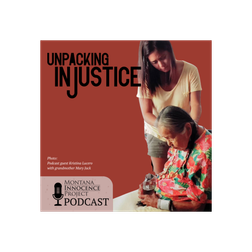
Montana incarcerates women at one of the highest rates in the world — and Indigenous women are disproportionately represented, making up more than 40 percent of the population at Montana’s women’s prison. In this episode of Unpacking Injustice, we are joined by Kristina Lucero, a citizen of the Tseycum Band of the Saanich Nation on Vancouver Island and Director of the American Indian Governance and Policy Institute, to begin unpacking the roots of this crisis. Throughout the conversation, Kristina grounds policy and data in personal history, including the story of her grandmother, Mary Jack, a boarding school survivor whose experiences reflect the intergenerational trauma created by federal Indian boarding school policies. She explains how historical trauma continues to shape the lives of Indigenous women and families today. We also examine how colonization disrupted Indigenous governance, criminalized culture, and replaced community-based healing with punishment, and how that trauma intersects with poverty and lack of access to resources — often turning survival behaviors into pathways to incarceration. Kristina draws our attention to Montana’s women’s prison, where Indigenous women face limited access to culturally grounded healing, trauma-informed care, and meaningful rehabilitation. Kristina highlights the ripple effects incarceration has on children, families, and communities, and why healing during incarceration is essential for both individual well-being and long-term public safety when people return home. This high-level conversation begins to break down complex issues that Unpacking Injustice will continue to explore as the Montana Innocence Project implements its new strategic plan, with a specific focus on addressing the unjust incarceration of women and survivors.This episode lays the groundwork for continued dialogue, understanding, and action toward justice.
Bernard Pease Jr.’s Story at a Turning Point: Examining Faulty Forensics & Finding Hope Ahead
In this episode of Unpacking Injustice, we revisit the case of Bernard Pease Jr., wrongfully convicted of a 1984 murder based on faulty forensic evidence. Two years after a pivotal evidentiary hearing revealed that a hair presented at trial as belonging to the victim was actually a cat hair, the Montana Innocence Project continues its fight to secure justice for Bernie. With new filings due this Friday, this episode comes at a critical moment. MTIP Legal Director Brady Minow Smith breaks down the original trial, the now-debunked forensic evidence that helped secure Bernie’s conviction, and why relying too heavily on certain types of evidence can be dangerous. We also hear from Bernie and his sister, Linda Thomas, as they reflect on the most recent evidentiary hearing and what it meant to finally feel heard by a judge, along with the moments of joy and connection Bernie has experienced since being paroled—powerful reminders of what’s possible when freedom is restored.
1 di 5