The UNLOCKED Podcast

The UNLOCKED Podcast

di Tony Reed
Stagione 1
Peptides — The Body’s Biological Text Messages
Peptides are one of the biggest conversations in fitness, recovery, metabolism, anti-aging, and biohacking right now. But most people are hearing the hype before they understand the biology. In this episode of The Unlocked Podcast, Tony breaks down what peptides actually are, how they work as biological signals, and why they are not all the same. We move from the history of insulin and early peptide medicine into modern GLP-1 medications, recovery peptides, gray market risks, gene expression, and the future of performance biology. This episode is not about telling people what to take. It’s about teaching people how to think. Peptides can influence powerful systems in the body — metabolism, appetite, tissue signaling, hormone release, inflammation, cellular communication. But mechanism does not automatically mean proven outcome, and online popularity does not equal safety. You’ll learn the difference between approved peptide-based medicines, nutritional peptides, topical peptides, and experimental or gray market compounds. You’ll also get a practical decision framework for asking better questions before considering any advanced intervention. The core message: peptides are part of the body’s language, but they should not become a shortcut around assessment, training, sleep, nutrition, biomarkers, and medical guidance. Your biology listens. Live like it. Timestamps 00:00 — Welcome and why peptides are everywhere right now 01:10 — What peptides actually are and why they act like biological messages 02:25 — The history of peptides, insulin, and why peptide medicine is not new 04:05 — How peptides communicate with receptors and influence cellular behavior 05:45 — GLP-1 as a real world example of peptide based medicine 07:10 — The difference between approved peptide medicines and gray market peptides 08:40 — How peptides connect to gene expression and performance genetics 10:15 — The peptide decision protocol 13:20 — Why foundational signals still come first 14:45 — Closing frame: peptides are part of the body’s language, not a shortcut References • FDA — Certain Bulk Drug Substances for Use in Compounding that May Present Significant Safety Risks (current as of April 22, 2026) • Nobel Prize — The first insulin injection in January 1922 • Nobel Prize — Vincent du Vigneaud’s work on oxytocin • NCBI Bookshelf — GLP-1 receptor agonists in type 2 diabetes and obesity care • WADA — The 2026 Prohibited List The Unlocked Podcast is educational content, not medical advice. For personal medical decisions, consult a qualified professional. Want me to also pull a short description (1–2 sentences) for podcast directory listings like Apple/Spotify that have character limits?
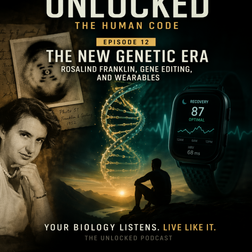
The New Genetic Era: Rosalind Franklin, Gene Editing, and Wearables
What started as a hidden structure inside the cell became one of the biggest turning points in modern science. In this episode of The Unlocked Podcast, we walk through Rosalind Franklin’s role in revealing the structure of DNA, how that opened the door to sequencing, genomics, and gene editing, and why wearables now bring biology into everyday life through sleep, recovery, stress, and performance data. We begin with the early mystery of heredity, when scientists still did not fully know what carried biological information from one generation to the next. From there, we move into Franklin’s X ray diffraction work and Photograph 51, the image that helped bring DNA’s structure into view. Once that structure became clear, biology changed. We then move into the genomic era and break down how science progressed from structure, to sequence, to variation, and eventually to tools that can directly alter parts of the code. We cover CRISPR, base editing, and prime editing in simple language. The second half of the episode brings that science into real life through wearables. We break down why smart rings, watches, and glucose sensors are more than lifestyle gadgets, what they are actually measuring, and how they help capture the real time expression of biology through sleep, recovery, stress, and performance. Timestamps 00:00 Intro 00:45 Why the story of genetics still feels so big 01:25 The early mystery of heredity 02:20 Rosalind Franklin and what Photograph 51 changed 03:50 Why structure changed biology 04:50 From DNA structure to sequencing and genomics 05:55 How gene editing changed the conversation 06:40 CRISPR, base editing, and prime editing explained 07:50 Why sharper tools do not make biology simple 08:30 Why wearables changed the conversation again 09:15 What wearables are actually tracking 09:55 How genetics and wearables work together in real life 10:25 Closing 10:37 End Key terms Rosalind Franklin: A chemist and X ray diffraction scientist whose work helped reveal DNA’s structure. Photograph 51: The X ray diffraction image that became a key clue in identifying the double helix. Genomics: The study of the genome, including sequence, variation, and function. CRISPR: A genome editing system used to target and alter specific DNA sequences. Base editing: A gene editing method that changes one DNA letter into another without a full double strand break. Prime editing: A more precise editing approach that can install small targeted changes in DNA. Wearables: Devices such as watches, rings, and glucose sensors that collect physiological data. Digital biomarkers: Physiological or behavioral signals collected through digital devices to track health and performance. Your biology listens. Live like it. The Unlocked Podcast is educational content, not medical advice. For personal medical decisions, consult a qualified professional.
The Genetic Operating System: Why Nothing in the Body Works Alone
In this episode, we pull the camera all the way back and connect the first ten episodes into one living framework. Instead of treating focus, appetite, stress, recovery, performance, and brain health like separate problems, we look at how the body actually works: as an interacting system. From gene expression and neuroplasticity to signaling chemistry, muscular architecture, methylation, appetite regulation, and long term repair, this episode brings the whole map into view. If the first ten episodes gave you the pieces, this one shows you the organism. Timestamps 0:00 Intro 0:52 Pulling the camera back 1:55 Why the body is not a collection of separate problems 3:05 How science moved from simple genetics to systems thinking 4:20 DNA and gene expression 5:30 BDNF and neuroplasticity 6:45 COMT and signaling chemistry 8:00 ACTN3 and physical architecture 9:05 Momentum, repetition, and behavioral biology 10:15 Resetting the system and nervous system state 11:35 MTHFR, methylation, and biochemical support 13:00 Supplement synergy and biological context 14:10 FTO and appetite regulation 15:25 APOE and long term repair and risk 16:50 The organism as a layered system 18:00 The weekly systems check protocol 19:05 Closing Key terms Gene expression: The process of turning genetic information into active biological output. Neuroplasticity: The brain’s ability to adapt and change through experience, repetition, and challenge. Catecholamines: Chemical messengers such as dopamine, epinephrine, and norepinephrine that affect alertness, motivation, and stress response. Fast twitch muscle fibers: Muscle fibers better suited for explosive force and high power output. Methylation: A biochemical process involving methyl groups that supports gene regulation, neurotransmitter pathways, and metabolic function. Genome wide association study: A large scale research method used to identify genetic variants associated with traits across populations. Nervous system state:The current physiological condition of the system, including whether it is calm, activated, braced, reactive, or shut down. Episode takeaway The body does not solve problems in isolation. Focus, recovery, appetite, performance, stress, and long term resilience all emerge from interacting systems. When you stop looking for one magic answer and start looking for the real bottleneck in the system, biology becomes much easier to understand and work with. Weekly protocol Once a week, score these five categories from 1 to 10: State Chemistry Behavior Adaptation Bottleneck Then ask: What is the one thing creating the most drag across everything else right now? References For the scientific references behind today’s synthesis, see the reference lists from Episodes 1 through 10 of The Unlocked Podcast, including the episodes on DNA and gene expression, BDNF, COMT, ACTN3, MTHFR, supplement synergy and antagonism, FTO, and APOE. Closing Your biology listens. Live like it. Disclaimer The Unlocked Podcast is educational content, not medical advice. For personal medical decisions, consult a qualified professional.
Brain Repair, Lipid Transport, and Alzheimer’s Risk
In this episode, we unpack what APOE actually does, why it matters for moving cholesterol and other lipids, and why that becomes especially important in the brain. We also cover the three common APOE versions, what amyloid is, why APOE4 gets so much attention in Alzheimer’s research, and why genetic risk should never be confused with destiny. We also explore the difference between APOE and the rarer genes tied to inherited early onset Alzheimer’s disease, why APOE4 homozygosity has drawn more attention in recent research, and how this gene now shows up in some treatment decisions involving anti amyloid therapies and ARIA risk. APOE is not just a fear gene. It is part of a larger system involving transport, repair, and long term brain biology. And once you understand that, the conversation shifts. It stops being about panic, and it starts becoming about interpretation, context, and what you do with the terrain you’ve been given. Your biology listens. Live like it. Timestamps 0:00 Intro 0:52 What APOE actually is 1:56 Why lipid transport matters in the brain 3:18 The three common APOE versions 4:36 Why risk does not mean destiny 5:48 Amyloid, brain aging, and why APOE gets attention 7:18 Risk genes versus rare causative genes 8:34 The 2024 APOE4 homozygosity shift 9:42 Why ancestry and context matter 10:28 APOE and treatment risk with ARIA 11:28 What to do with this information in real life 12:18 Closing perspective Key Terms APOE: Apolipoprotein E. A gene involved in packaging and transporting cholesterol and other lipids. Lipid: A fat or fat-like molecule used for structure, signaling, energy storage, and repair. Allele: A version of a gene. Amyloid: Protein fragments, especially amyloid beta, that can collect into plaques in the brain and are associated with Alzheimer’s disease. APOE4 homozygosity: Inheriting two APOE4 copies, one from each biological parent. ARIA: Amyloid-related imaging abnormalities. Changes seen on brain imaging during treatment, often swelling or small areas of bleeding. Risk gene: A gene that changes likelihood rather than guaranteeing an outcome. References National Institute on Aging. Alzheimer’s Disease Genetics Fact Sheet. MedlinePlus Genetics. APOE gene. Mayo Clinic. Alzheimer’s genes: Are you at risk? Fortea J, et al. APOE4 homozygosity represents a distinct genetic form of Alzheimer’s disease. Nature Medicine, 2024. National Institute on Aging. Study defines major genetic form of Alzheimer’s disease. FDA prescribing information for LEQEMBI. FDA prescribing information for KISUNLA. Disclaimer *The Unlocked Podcast is educational content, not medical advice. For personal medical decisions, consult a qualified professional.
FTO: Appetite, Body Weight Risk, and What You Can Still Change
Episode Notes Most people have never heard of FTO, but once you understand what it is, a lot of the body weight conversation starts making more sense. This episode breaks down how researchers first found FTO, why it became such an important part of obesity genetics, what the early numbers actually showed, why the first diabetes signal changed once body mass index was factored in, how this gene region may connect to appetite and food cues, where GLP 1 overlaps with that biology, and what training, movement, sleep, stress, and food quality can still change in real life. Timestamps 0:00 Opening 0:53 What FTO actually is 1:48 How researchers first found it 2:40 What GWAS means 3:24 What BMI means 4:13 Why the early diabetes signal changed 5:18 What FTO may be influencing in the body 6:32 Appetite, hunger, and food cue biology 8:00 Ghrelin and why hunger may feel louder 9:19 Fat cell programming, IRX3, and IRX5 10:42 Where GLP 1 overlaps with the conversation 11:58 Why FTO does not cleanly predict GLP 1 response 12:43 What lifestyle can still change 13:22 Physical activity and the FTO risk signal 14:14 Weight training, sleep, stress, and food structure 15:22 Practical takeaways 16:02 Closing Key Terms FTO Fat mass and obesity associated gene. A gene region strongly associated with body weight risk in common genetics research. GWAS Genome wide association study. A method used to scan the genome for common variants linked to traits or disease across large populations. BMI Body mass index. A rough height to weight measure often used in large population studies. rs9939609 One of the most studied FTO variants in obesity research. In many studies, the A allele is associated with higher average body weight risk. Ghrelin A hormone involved in hunger signaling and appetite regulation. GLP 1 Glucagon like peptide 1. A hormone involved in satiety, appetite regulation, and gastric emptying. GLP 1 receptor agonists act on that pathway. IRX3 and IRX5 Genes implicated in mechanistic studies of how obesity associated variation in the FTO region may influence fat cell programming. References Frayling TM, Timpson NJ, Weedon MN, et al. A common variant in the FTO gene is associated with body mass index and predisposes to childhood and adult obesity. Science. 2007;316(5826):889 to 894. Scuteri A, Sanna S, Chen WM, et al. Genome wide association scan shows genetic variants in the FTO gene are associated with obesity related traits. PLoS Genetics. 2007;3(7):e115. Karra E, O’Daly OG, Choudhury AI, et al. A link between FTO, ghrelin, and impaired brain food cue responsivity. Journal of Clinical Investigation. 2013;123(8):3539 to 3551. Kilpeläinen TO, Qi L, Brage S, et al. Physical activity attenuates the influence of FTO variants on obesity risk: a meta analysis of 218,166 adults and 19,268 children. PLoS Medicine. 2011;8(11):e1001116. Claussnitzer M, Dankel SN, Kim KH, et al. FTO obesity variant circuitry and adipocyte browning in humans. New England Journal of Medicine. 2015;373(10):895 to 907. Zheng Z, et al. Glucagon like peptide 1 receptor: mechanisms and advances. Frontiers in Endocrinology. 2024. German J, et al. Association between plausible genetic factors and weight loss from GLP1 RA and bariatric surgery. Nature Medicine. 2025;31(7):2269 to 2276. Disclaimer *The Unlocked Podcast is educational content, not medical advice. For personal medical decisions, consult a qualified professional.
Synergistic vs Antagonistic Supplements
Episode Notes This episode breaks down synergistic supplements and antagonistic supplements with a baseline first, food first approach. The goal is to stop guessing, stop stacking everything at once, and start using a simple framework that helps you understand what pairs well, what competes, and how to change one variable at a time so your body gives readable feedback. You’ll also hear a short medical history thread about healing, fear, and why mechanism matters, because understanding the body is how results become repeatable instead of feeling like luck. Timestamps 00:00 Why stacks feel random 02:00 Synergistic and antagonistic, simple definitions 03:15 Blood work first, groups of labs, vitamin D test 05:46 Food first and when supplements make sense 08:01 The mechanism logic behind synergy and antagonism 10:16 The history thread, including trials, executions, and why healers were targeted 12:31 Iron and vitamin C, calcium timing 15:47 Fat soluble vitamins with meals 17:32 Zinc and copper, when it becomes a problem 19:17 St. John’s wort safety category 20:32 Wrap up and what’s next What’s Next Episode 9 - focused on FTO. Key Terms Synergistic: two inputs work better together Antagonistic: two inputs compete and reduce effect CBC: complete blood count CMP: comprehensive metabolic panel 25 hydroxy vitamin D: main blood test for vitamin D status Methylmalonic acid: marker often used for B12 deficiency evaluation Homocysteine: marker related to methylation and B vitamin status Serum retinol: vitamin A blood marker Alpha tocopherol: vitamin E blood marker Phylloquinone: vitamin K1 marker Keywords Supplement synergy Supplement antagonism Blood work baseline CBC CMP Iron vitamin C Calcium iron separation Fat soluble vitamins Zinc copper balance St. John’s wort interactions One variable testing FTO References NIH Office of Dietary Supplements fact sheets on iron, vitamin C, vitamin D, zinc, copper, B12, folate MedlinePlus lab test explanations for CBC, CMP, vitamin D test, ferritin, methylmalonic acid, homocysteine Clinical pharmacology reviews on St. John’s wort interactions with medications Your biology listens. Live like it.
MTHFR, methylation, and what this gene actually does. Pt. 1
MTHFR is a real gene in the folate pathway, but it often gets treated like it explains everything. This episode keeps the scale right. You’ll learn what the enzyme does, why homocysteine became a popular lab marker, and how to separate association evidence from intervention evidence so you don’t get misled by a number moving without outcomes changing. You’ll also get a simple decision model you can use without spiraling. You’ll learn: • What MTHFR actually does inside folate metabolism • Why folate was historically studied in medicine • How homocysteine became a biomarker • Why association studies and randomized trials tell different stories • What DNA methylation actually means • Why this is a pathway discussion, not a personality explanation This episode separates evidence types carefully and keeps claims proportional to data. Timestamps 0:00 Primary intro 1:05 Why MTHFR gets inflated in conversation 2:00 Folate history and why it mattered in medicine 3:00 One carbon metabolism explained clearly 4:15 What MTHFR enzyme actually does 5:20 B12 as cofactor and why this is a pathway, not a solo gene 6:10 Homocysteine as a biomarker and what association means 7:20 Randomized trials lowering homocysteine and outcome nuance 8:40 DNA methylation defined properly 9:50 What MTHFR does not control 10:40 Mendelian randomization and causality 11:30 Micro protocol and bridge to Part 2 Key Terms Folate: A B vitamin required for DNA synthesis and red blood cell formation. Named from the Latin “folium,” meaning leaf. One carbon metabolism: A network of reactions that transfer single carbon units for DNA synthesis and methylation reactions. MTHFR: Methylenetetrahydrofolate reductase, an enzyme that converts one form of folate into another needed for homocysteine recycling. Enzyme: A protein that speeds up a chemical reaction. Homocysteine: An intermediate amino acid in methionine metabolism that can accumulate if recycling is impaired. Methionine: An essential amino acid involved in protein synthesis and methyl group donation. Vitamin B12: A vitamin that acts as a cofactor for methionine synthase in homocysteine conversion. Cofactor: A helper molecule required for an enzyme to function. Biomarker: A measurable biological indicator, often assessed through blood testing. Association: When two variables move together statistically; does not prove cause. Randomized controlled trial: A study design that assigns participants by chance to test cause and effect. DNA methylation: The addition of methyl groups to DNA that can influence gene expression levels. Gene expression: The process by which a gene is used to produce a protein. Mendelian randomization: A genetics based method using variants as natural experiments to estimate causality. Keywords MTHFR, folate cycle, homocysteine, methylation, one carbon metabolism, B12, C677T, gene expression, cardiovascular risk, Mendelian randomization References NIH Office of Dietary Supplements. Folate Fact Sheet for Health Professionals. NIH Office of Dietary Supplements. Vitamin B12 Fact Sheet for Health Professionals. HOPE 2 Investigators. NEJM. 2006. NORVIT Trial Investigators. NEJM. 2006. Clarke R et al. Homocysteine and vascular disease. JAMA. 2002. Recent Mendelian randomization analyses on homocysteine and cardiovascular outcomes, 2018–2023.
Resetting the System | A Guided Nervous System Reset (Breathing & Grounding)
A short guided practice to downshift, recover, and ground the nervous system. This episode is a guided nervous system reset designed to help you downshift from stress, stimulation, or mental overload. You don’t need a yoga studio, special equipment, or prior experience. This practice can be done seated or lying down, at home, after work, after training, or before sleep. The breathing and awareness used here are intended to support recovery by gently shifting the nervous system out of a high-alert state and toward a calmer, more regulated one. Over time, practices like this can support better sleep, digestion, emotional regulation, and overall recovery. This session is not about forcing relaxation or clearing the mind. It’s about giving the body enough space to settle naturally. You can return to this reset anytime you feel overstimulated, scattered, or in need of grounding. What You Need A quiet space where you can sit or lie down comfortably. A chair, mat, couch, or bed all work. Optional: a light blanket if the room is cool. After the Practice Try to keep the transition gentle. Hydration is helpful. If you eat afterward, warm, grounding foods are often more settling than highly stimulating options. Your biology listens. Live like it.
Momentum Before Motivation
Episode 5 is a short, high-energy activation episode focused on momentum rather than discipline. Instead of relying on motivation as a prerequisite, this episode explains how movement itself acts as a biological signal that organizes focus, clarity, and drive. The emphasis is on reducing friction, using small actions to shift nervous system state, and creating traction without pressure. This episode is designed to be listened to in real time, especially before work, training, or any task that requires initiation. Energy Adjustment Options High-performance days: Read at a slightly faster pace, with clearer posture cues and more vocal lift in the middle section. Lower-energy or burnout days: Slow the pacing slightly, soften the emphasis, and allow longer pauses between sentences to reduce pressure. Your biology listens. Live like it.
ACTN3, Muscle Architecture, and How Power Is Built
Episode 4 explores ACTN3, a gene tied to fast-twitch muscle fiber structure, and how muscle architecture influences strength, speed, fatigue, and recovery. We move beyond genetic labels and focus on how structure, energy systems, and training signals interact to shape performance over time. The episode traces the scientific history of ACTN3, beginning with the identification of the R577X variant and early athlete association studies, then moves into mechanistic research using Actn3 knockout models to explain why some bodies respond differently to power and endurance demands. Rather than treating genetics as destiny, this episode frames ACTN3 as a structural context that influences training cost, energy use, and recovery timelines. We connect muscle architecture to ATP demand, nervous system load, and how training converts into adaptation rather than lingering fatigue. The practical section introduces a simple one-week “conversion” experiment to help listeners observe how their own system responds to strength-biased versus volume-biased training, without needing a genetic test. This episode sets the foundation for future discussions on training precision, recovery architecture, and the long-term direction of performance systems, regeneration, and bio-integrated technology. Timestamps (0:00 Introduction and framing ACTN3 as structure, not identity 1:10 Muscle architecture overview and why fiber structure matters 2:20 ACTN3 history and the R577X variant 3:35 Athlete association studies and population-level findings 4:55 Mechanistic research and Actn3 knockout models 6:30 Muscle metabolism, ATP demand, and training cost 8:05 Conversion versus fatigue and why recovery timelines differ 9:40 One-week conversion experiment explained 11:30 How this fits into long-term performance systems 13:05 Episode summary and close Key Terms ACTN3: A gene that codes for alpha-actinin-3, a structural protein found in fast-twitch muscle fibers. Alpha-actinin-3: A protein involved in anchoring actin filaments in fast-twitch muscle fibers. Fast-twitch fibers: Muscle fibers specialized for high-force, high-speed output. ATP (Adenosine Triphosphate): The primary energy currency used by cells to perform work. Aerobic metabolism: Energy production that relies more heavily on oxygen-supported pathways. Conversion: How effectively training effort translates into repeatable adaptation rather than fatigue. Muscle architecture: The structural arrangement of muscle fibers and contractile elements. Your biology listens. Live like it. References North KN et al. (1999). A common nonsense mutation results in alpha-actinin-3 deficiency in the general population. Yang N et al. (2003). ACTN3 genotype is associated with human elite athletic performance. MacArthur DG et al. (2007). Loss of ACTN3 gene function alters muscle metabolism and performance in mice. MacArthur DG et al. (2008). Structural and metabolic consequences of ACTN3 deficiency. RSS Footer Disclaimer The Unlocked Podcast is educational content, not medical advice. For personal medical decisions, consult a qualified professional.
1 di 2