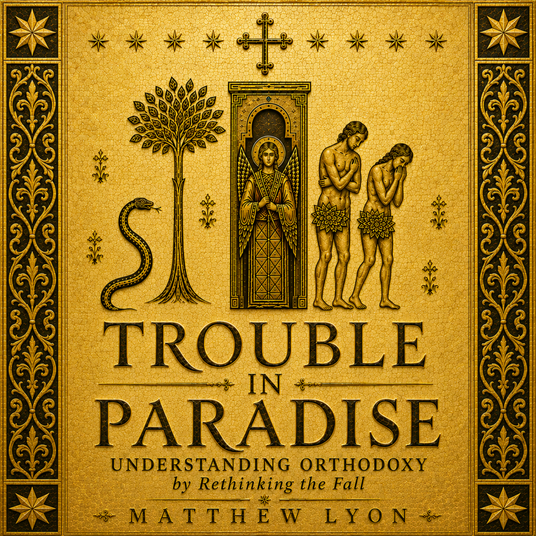
Trouble in Paradise - Understanding Orthodoxy by Rethinking the Fall

Trouble in Paradise - Understanding Orthodoxy by Rethinking the Fall

di Matthew Lyon
Stagione 1
Put to Death? What Is Earthly? What Does That Mean?
Episode 24 — Put to Death? What Is Earthly? What Does That Mean? What does Paul mean when he tells us to “put to death what is earthly”? After becoming Orthodox, I found that one of the hardest things to communicate to my Protestant friends was the Orthodox understanding of the Fall. It isn't simply a matter of learning a different doctrine. You have to begin imagining the human condition from a different starting point. In this episode, I explore a central question: What if death is not merely the consequence of human sin, but one of the great forces driving human sin? We are mortal creatures. Our bodies are designed to preserve our lives in a world where we die. Hunger, sexuality, fear, the desire for security, the accumulation of resources, and our instinct to protect ourselves are not inherently evil. They are part of embodied human life. But what happens when these legitimate bodily systems become our masters? Paul's language about the mortal body, its desires, the flesh, sin reigning, and obedience gives us a way to understand this. The problem isn't that the body has desires. The problem is when the mind takes those desires and decides that they tell us what we ought to do. And Paul says: “For the mindset of the flesh is death, but the mindset of the Spirit is life and peace.” —Romans 8:6, LEB We also look at Hebrews' startling claim that Christ came to free humanity from slavery caused by the fear of death, and what this tells us about Satan's role in human depravity. From there, we explore: What Paul means by “what is earthly” The meaning of Paul's language of “members” and the mortal body The relationship between bodily systems and moral deliberation Why hunger, sexual desire, and the desire for security aren't inherently sinful Blameless and blameworthy passions in St. Maximus the Confessor St. John Chrysostom's understanding of marriage and sexual desire Augustine's different trajectory regarding concupiscence and inherited guilt Why death → life is such a dominant pattern in Paul's theology Baptism as participation in Christ's death and Resurrection Why Paul repeatedly connects Resurrection with Christian holiness How monasticism and marriage can both be understood within the horizon of Resurrection Why Orthodox fasting, almsgiving, and prayer train us to subordinate bodily desires rather than simply eliminate them The Didache and its two ways: the way of life and the way of death Why Satan's great weapon is not the creation of our natural desires, but the exploitation of our fear of death Why Christ being our Life changes the entire moral calculation The central question of the episode is ultimately very simple: If we have died with Christ and been raised with Him, why would we continue living as though death were our master? The Christian life is not about becoming less human, less embodied, or less alive. It is about learning to live according to a new reality: The appetite is not your lord. Fear is not your lord. Security is not your lord. Survival is not your lord. Death is not your lord. Christ is your Life. And because Christ has risen, we can finally learn how to live rather than merely how to survive.
Dark Matter Season 2: Before All Worlds - Leibniz, the Multiverse, and Original Sin
Episode 23 — Dark Matter Season 2: Before All Worlds Leibniz, the Multiverse, and Original Sin What if the multiverse isn't really about other universes—but about finding another version of ourselves? With Season 2 of Dark Matter approaching, Matthew revisits the first season and follows its central ideas into an unexpected theological territory: Original Sin, the Fall, Leibniz's “possible worlds,” the problem of evil, repentance, guilt, grief, and the fear of death. Why this world? Leibniz's attempt to answer that question helped give us the concept of theodicy and his famous argument that God chose the best of all possible worlds. But what happens when that philosophical idea is transformed into the modern multiverse? Instead of asking why this world contains suffering, we can imagine countless worlds where things happened differently. A world where Adam didn't fall. A world where Eve made another choice. A world where you never made the decision you regret. A world where you never experienced the loss that changed your life. And perhaps, somewhere, a version of you got everything right. But is that salvation? Matthew explores the possibility that the modern multiverse functions as a kind of secularized return to Eden—a way of imagining another world in which repentance isn't necessary because another version of ourselves already made the right choices. The episode also draws a surprising parallel with the multiverse response to the argument from design: rather than answering why this particular universe appears ordered or fine-tuned, multiplying universes can make the question of design seem unnecessary. Likewise, multiplying possible worlds can make the problem of why this fallen history exists appear to disappear. But perhaps the deeper problem isn't theodicy at all. Perhaps it is death. Because in Dark Matter, Jason isn't really searching for another universe. He's searching for the life he lost. And that's something much more familiar than quantum physics. It's grief. It's the human desire to undo what cannot be undone—to find the version of ourselves that existed before the fall, before the mistake, before the loss. Hebrews gives Christianity a radically different diagnosis: humanity is held in “slavery” through the fear of death. And Christianity's answer isn't another universe. It isn't another version of yourself. It isn't finding the Adam who never fell. It is resurrection.
Adam, the Fall, and Assurance of Salvation
Episode 22 — Orthodoxy and Assurance of Salvation What happens to assurance of salvation when you become Orthodox? For many Protestants, this is one of the biggest obstacles to considering Orthodoxy. In this episode, I share why it was one of my biggest questions as well—and why I eventually realized that Orthodoxy isn't simply giving a different answer to assurance. It's asking a different question altogether. We'll explore: Why assurance is the logical conclusion of a particular understanding of the Fall. How Calvinism and the Wesleyan tradition, despite their disagreements, share many of the same assumptions about original sin, the human will, and salvation. Why the Orthodox Church begins with union with Christ rather than guaranteed perseverance. The role of Baptism as an objective union with Christ—not merely a symbol of a prior experience. Why Christ's command to "abide in Me" becomes central to the Orthodox understanding of the Christian life. How the early Church Fathers, especially St. Cyril of Jerusalem, describe God's gracious initiative and man's genuine response. Why Ephesians 2 may be emphasizing humanity's bondage to sin, death, and the devil more than constructing a doctrine of total inability. Why assurance ultimately depends on where we place our confidence. Rather than grounding assurance in ourselves, Orthodoxy directs our eyes to Christ—the One who united us to Himself, continually calls us to repentance, feeds us with His own Body and Blood, and remains faithful. Scripture Discussed Genesis 1:31 Matthew 16:24 John 15:1–10 Acts 2:38 Romans 6:3–5 Romans 11:22 1 Corinthians 10:12 Galatians 3:27 Colossians 1:21–23 Ephesians 2:1–5 Historical Figures Mentioned St. Cyril of Jerusalem St. Augustine Martin Luther John Calvin John Wesley George Whitefield Charles H. Spurgeon Paul Washer James H. Brookes St. John Chrysostom Mentioned Resources R.C. Sproul, The Pelagian Captivity of the Church The Westminster Confession of Faith (1646) The 1689 London Baptist Confession St. John Chrysostom's Paschal Homily If this episode was helpful, please consider subscribing and sharing it with someone exploring Orthodoxy. If you have questions or topics you'd like me to cover in future episodes, I'd love to hear from you. Christ is risen!
I Found the Gospel in the Last Place I Expected—Then I Had to Learn to Live in the Church That Preserves It
Episode 21 — In this episode, I share what happened after I became convinced that the Orthodox Church is the true Church. After nearly two years of studying Scripture, the Church Fathers, and the history of Christianity, I expected entering an Orthodox parish to answer all of my questions. Instead, I discovered something unexpected: finding the Church was only the beginning. I discuss why the Gospel—not icons, incense, or aesthetics—ultimately led me to Orthodoxy, the challenges many Protestant converts face, and how my expectations of parish life had to be transformed. Along the way, I reflect on conversations that shaped my journey, why some questions take time to answer, and what it means to love the real Church rather than an idealized one. Whether you're exploring Eastern Orthodoxy, coming from a Protestant background, or simply interested in the theology of the early Church, I hope this episode encourages you to persevere in seeking Christ and His Church. Topics include: Eastern Orthodoxy The Gospel and salvation Protestant to Orthodox conversion The Church Fathers Parish life The Eucharist Expectations and spiritual growth
Delivered from the Domain of Darkness
Episode 20 — For much of my life, I believed in Sola Scriptura. Yet I eventually realized that I had often read many of the New Testament's clearest descriptions of salvation metaphorically. What if the apostles meant exactly what they said when they spoke of being delivered from the domain of darkness, freed from death, and transferred into the Kingdom of Christ? In this episode, we examine the biblical language of salvation, beginning with Colossians 1:13, and ask two foundational questions: Saved from what? Saved for what? Rather than beginning with later theological systems, we'll let the New Testament define the problem Christ came to solve and discover how that shapes our understanding of the Gospel, the cross, and the Christian life. Scriptures Discussed Colossians 1:13–14 Hebrews 2:14–15 Romans 6 Ephesians 2:1–6 John 8:34–36 1 Corinthians 15 2 Timothy 1:10
A Very Simplified Explanation of the Divine Liturgy
Episode 19 — "When I read the Book of Acts, am I seeing the world of the Apostles—or am I seeing my own?" In this episode, we take a very simplified look at the Divine Liturgy and answer a common question: Why does Orthodox worship look so different from most modern Christian services? We begin with a surprising claim: everybody has a liturgy. Whether it's a megachurch service, a basketball game, or the Divine Liturgy itself, repeated practices shape what we love and what we believe. From there, we explore the central claim of Orthodox worship: heaven and earth meet in Christ. Using Hebrews 12:22-24 as our guide, we examine why Orthodox Christians believe worship is participation in heavenly worship, why reverence matters, why incense, icons, and chanting remain part of Christian worship, and why the Divine Liturgy is organized around Holy Communion rather than preaching. Topics include: • What liturgy actually means • Why all of life is liturgical • Hebrews 12 and the heavenly Jerusalem • "Christ is in our midst" • Why Orthodox Christians stand for the Gospel • The role of the Psalms in worship • Fasting and preparation before worship • Why Holy Communion is the climax of the Divine Liturgy • How the Reformation reshaped Christian worship • Why the first Christians being Jewish matters for understanding the Book of Acts Key Scriptures: • Isaiah 6:1-3 • Malachi 1:11 • Matthew 18:20 • Hebrews 12:18-29 • Colossians 1:13 • Revelation 4-5 • Revelation 5:8 • Revelation 8:3-4 If you've ever wondered why Orthodox Christians worship the way they do, this episode offers a biblical and historical introduction to the logic behind the Divine Liturgy.
How Guilt Swallowed Death
Episode 18 — The Pelagian controversy is usually framed as a debate about grace and free will. But beneath the surface was a deeper question: What is the foundational problem of humanity? In this episode, we explore how earlier Greek Fathers like Athanasius of Alexandria and John Chrysostom often described humanity’s condition primarily through the lenses of death, corruption, bondage, and satanic tyranny — while the Augustinian anti-Pelagian framework increasingly centered inherited guilt and condemnation. Topics include: infant baptism in East and West death as bondage in Hebrews 2 Augustine vs. Pelagius Chrysostom’s Paschal Homily ancestral sin vs. original guilt why Reformers accused Anabaptists of Pelagian tendencies moralism vs. conversionism in Western Christianity participatory salvation and union with Christ in Orthodoxy Augustine’s response to accusations of lingering Manichean influence We also examine how the Pelagian controversy may have narrowed the theological center of gravity from cosmic victory over death toward juridical categories of culpability and condemnation — and how that shift still shapes Christian experience today.
Why Calvinism Can’t Let “World” Mean World - Original Sin, Election, and the Narrowing of God’s Love
Episode 17 — Why Calvinism Can’t Let “World” Mean World What does “world” actually mean in John 3:16? In this episode, I explore the theological tension surrounding one of Christianity’s most famous verses: “For God so loved the world…” Why have so many Reformed theologians historically struggled to let “world” mean humanity universally? And how did ideas about: Original Sin, inherited guilt, election, and divine love shape broader Christian anthropology, denominational fracture, and even the moral imagination surrounding slavery in America? This episode examines: the Greek word κόσμος (kosmos) in John, Augustinian and Reformed theology, the emotional logic of limited atonement, Orthodoxy’s understanding of humanity and salvation, Abraham Lincoln’s Second Inaugural Address, and the relationship between divine image, Incarnation, and universal human dignity. Topics include: John 3:16 Romans 5:8 1 John 5:19 Original Sin vs ancestral sin the image of God slavery and the Civil War Protestant denominational fragmentation Orthodoxy and the Incarnation divine solidarity with humanity Referenced figures include: Abraham Lincoln Augustine of Hippo Martin Luther John Calvin John Piper R. C. Sproul Francis Schaeffer “The darker the world becomes, the more astonishing the love becomes.”
Can Love Exist Without Freedom? — Why Orthodox Christianity Doesn’t Fit Modern Free Will Debates
Episode 16 — In this follow-up to “Is the Sovereign God Actually Free?”, I explore why Orthodox Christianity often sounds difficult to categorize using modern ideas like libertarian free will and compatibilism, and why the debate may ultimately trace back to different understandings of Original Sin, grace, participation, and communion. Drawing from St. Maximus the Confessor, Orthodox anthropology, and the essence-energies distinction, this episode explores freedom, divine love, synergy, theosis, and whether salvation is truly participation in the life of God. If God’s love is merely necessary, what happens to freedom, communion, and personhood? And if salvation is union with God, what kind of reality must the universe ultimately be?
Your Husband Suddenly Cares About Constantinople - What Happens When One Person’s Spiritual World Changes First
Episode 15 — What happens when one spouse discovers Eastern Orthodoxy — and the other feels like the entire spiritual world inside the marriage suddenly changed? In this episode, I talk honestly and humorously about the Orthodox “cage-phase,” conversion to Orthodoxy, theological rabbit holes, and what this process can feel like from the spouse’s perspective. I discuss: converting from Reformed theology to Eastern Orthodoxy the emotional impact of spiritual change inside marriage why Orthodox Christianity can feel culturally overwhelming at first church history, liturgy, icons, incense, and theological vocabulary doubts about Calvinism and the Solas of the Reformation why many converts become intensely passionate early on the challenge of maintaining communion and patience during spiritual transition how spouses can feel displaced, confused, or spiritually destabilized why the goal of Christianity is not merely being right, but remaining in loving communion Topics include: Eastern Orthodoxy, Calvinism, Reformed theology, church history, conversion stories, Orthodox Christianity, marriage and faith, theosis, liturgy, Pascha, participation, communion, deconstruction, spiritual growth, and Orthodox converts.
1 di 3