The Policy Stack

The Policy Stack

di Innovaccer
Stagione 1
The Prevention Paradox: Why America Knows What to Do and Won't Do It
Why does almost 80% of America’s healthcare spend go to treating chronic disease while prevention barely receives a fraction of the $5 trillion health budget? On this episode of The Policy Stack, Lisa Bari tries to get to the root of the problem with Dr. Anand Parekh, Chief Health Policy Officer at the University of Michigan School of Public Health and author of Prevention First: Policymaking for a Healthier America. A veteran of two decades at HHS under George Bush and Barack Obama, Parekh explains what's actually being cut when the CDC loses 53% of its budget, why the wins from prevention are politically invisible, what the Supreme Court's ruling on ACA preventive services actually means for your next cancer screening, and why the ratio of social services to healthcare spending may be the single most predictive number in population health.
Inside Medicare's Invisible Backbone: Claims Processing, AI Innovation, and the $500 Billion System Written in COBOL

Brian Janssen reflects on running Medicare operations at WPS Health Solutions, processing 130+ million claims annually through an infrastructure that many healthcare professionals don't know exists. He shares why MACs are "the largest backbone of processing in the country that the healthcare world doesn't really know about," how regional variation matters when Flint, Michigan's environmental crisis affects local coverage decisions differently than in rural Kansas, and the challenge of innovating with AI while maintaining FISMA High security in physical data centers in systems that can't afford a single day of payment disruption.
Seven Models in One Quarter: Making Sense of CMS's Most Aggressive Innovation Push Ever
Liza Health’s Duncan Reece reflects on decades in value-based care, from Medicare Health Support's failure to today's explosion of CMMI models launching simultaneously. He shares why MSSP's $10 billion in savings gets unfairly criticized against Medicare's $1.2 trillion spend, how Iora built its own EHR from scratch when nothing else worked for accountable care, and why the real unlock isn't payment models: it's separating necessary accountability from unnecessary complexity while technology costs plummet and AI adoption in healthcare outpaces every other industry.
Finishing Interoperability: Inside CMS's Voluntary Framework and the Fight Against Portalitis

Kristen Valdes from b.well reflects on building CMS's voluntary Health Technology Ecosystem framework after discovering that, despite a decade of interoperability policy, live demos showed only 1 out of 30+ providers could return data automatically. She shares lessons on community organizing when 500+ companies need coordination, but the government can't lead, why the real barriers are business and liability issues rather than technology, and how to prevent legacy players from relitigating settled policy when the goal is implementation, not debate.
Where Are We Now? The State of Interoperability in Late 2025

Most healthcare decisions happen far from the headlines. The Policy Stack, hosted by Lisa Bari, reveals the people and processes shaping how American healthcare really works. From state leaders to industry innovators, each episode examines the laws, funding, and political realities behind the policies that shape care.
How Current Healthcare Policy Could Reshape the Future of Value-based Care
In this live episode from Innovaccer’s Mini-Xccelerate conference in DC, Blair Childs and Dave Johnson examine the sweeping policy and market shifts transforming U.S. healthcare. They discuss the move from government-designed systems toward market accountability, how “liberating data” is key to real value-based care, and why structural incentives, not funding, determine the pace of reform. With their deep experience in health policy and strategy, they offer a grounded look at where healthcare is heading, and what it will take to finally realign incentives for better outcomes.
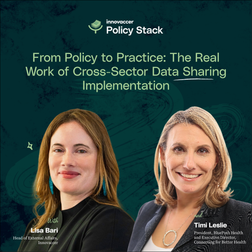
From Policy to Practice: The Real Work of Cross-Sector Data Sharing Implementation
Lisa Bari speaks with Timi Leslie about implementing California's groundbreaking data exchange framework, where healthcare organizations must share data across sectors for the first time. Timi shares lessons from her career in health IT policy, about why technical interoperability is just the beginning, and how to build trust between organizations that don’t usually work together: from hospitals to housing agencies.
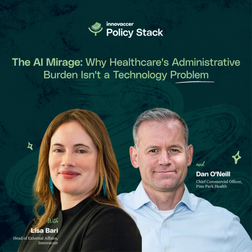
The AI Mirage: Why Healthcare's Administrative Burden Isn't a Technology Problem
Dan O'Neill reflects on 15 years in health technology, services, and policy after discovering that most healthcare administrative problems could have been solved decades ago. He shares lessons on why business model problems masquerade as technology challenges, how organizational inertia perpetuates inefficiency, and why "slapping AI on it" won't fix structural issues rooted in misaligned incentives.
Untangling the Medicaid Maze: Why 56 Different Systems Make Coverage So Hard to Keep
Nikita Singareddy reflects on building technology for America's most complex healthcare system after discovering that 20% of Medicaid enrollees lose coverage due to bureaucratic failures. She shares lessons on why every government case is an "edge case," solving policy problems before building tech solutions, and maintaining an enrollee-first approach across 56 different state systems.
The Capacity Gap: Leading Through Crisis, Constraints, and Impossible Choices
Kody Kinsley speaks with Lisa Bari to reflect on leading North Carolina’s $26 billion health agency through COVID-19, Medicaid expansion, and a behavioral health crisis. He shares lessons on making impossible choices, driving reform under pressure, and turning crises into opportunities.