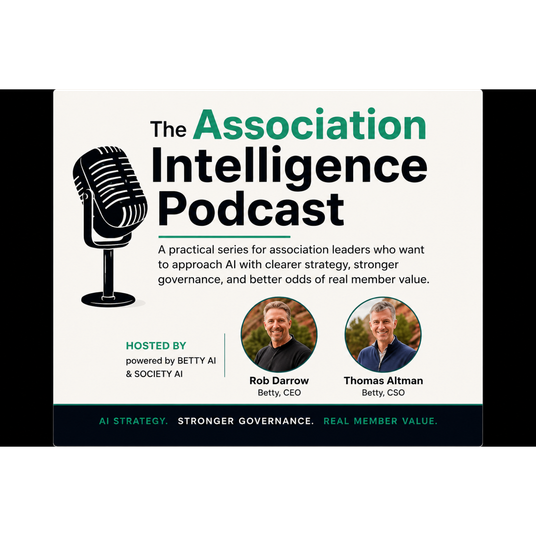
The Association Intelligence Podcast

The Association Intelligence Podcast

di Betty AI
Stagione 1
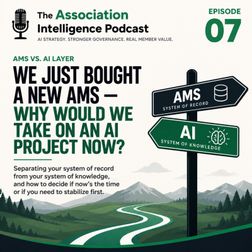
We Just Bought a New AMS — Why Would We Take On an AI Project Now?
IA
Why "we just spent millions on a new AMS" isn't a reason to wait on AI — a framework for separating your system of record (AMS/CMS/LMS/FMS) from your system of knowledge (the AI layer), and how to decide if now's the time or if you need to stabilize first. Companion Assets at https://meetbetty.ai/the-association-intelligence-podcast#episode-07 What this helps your team answer Why an AMS (or any management system) is a system of record, not a system of knowledge — and why AI should never try to replace that record, only sit in front of it as a governed interface. How to tell whether "not now" is the right call (a messy migration, unresolved data cleanup, unstable processes) versus a stall tactic — and why waiting shouldn't mean waiting indefinitely. Why a governed AI layer can actually increase the ROI on the AMS you already bought, by deepening member engagement in ways the AMS alone was never built to do.
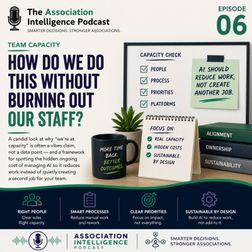
How Do We Do This Without Burning Out Our Staff?
IA
A candid look at why “we’re at capacity” is often a vibes claim, not a data point — and a framework for spotting the hidden ongoing cost of managing AI so it reduces work instead of quietly creating a second job for your team. Get Companion Assets at https://meetbetty.ai/the-association-intelligence-podcast#episode-06 What this helps your team answer Why new work from AI doesn't have to mean extra work — and the three buckets to sort your workflows into: what AI can take on, what it takes to manage that ongoing, and what should stay entirely human (relationship-building, judgment, interpretation). The hidden cost most teams miss: the ongoing work of managing and reviewing an AI system can outweigh the time it saves, so the math has to be done before you implement, not after. What governed AI genuinely can't fix — toxic culture, chronic understaffing, shifting strategic priorities — and why honesty about that upfront builds trust instead of setting your team up to feel burned again.
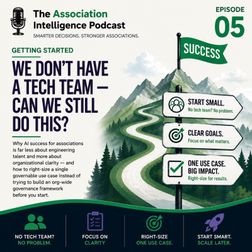
We Don't Have a Tech Team — Can We Still Do This?
IA
Why AI success for associations is far less about engineering talent and more about organizational clarity — and how to right-size a single governable use case instead of trying to build an org-wide governance framework before you start. Get Companion Assets at https://meetbetty.ai/the-association-intelligence-podcast#episode-05 What this helps your team answer Why the real barrier for most associations isn't technical skill but organizational agreement — knowing your use case, your approved sources, and who owns corrections and coaching. How to right-size scope so a pilot is governable and concrete without being so small it loses momentum or so broad it never launches. Why the owner of an AI use case doesn't need to code — they need to clearly explain the use case, the source material, and the rules in plain language, then coach the system as it learns.
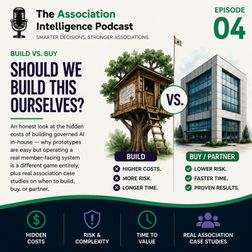
Should We Build This Ourselves?
IA
An honest look at the hidden costs of building governed AI in-house — why prototypes are easy but operating a real member-facing system is a different game entirely, plus real association case studies on when to build, buy, or partner. Get Companion Assets at https://meetbetty.ai/the-association-intelligence-podcast#episode-04 What this helps your team answer Why a working prototype (a few documents, a small demo) and an operated, member-facing knowledge system are two completely different things — and where the "hidden operating surface" (content ingestion, permissions, traceability, SME coaching, analytics, security) actually lives. Real association examples — NFSA, Cornet, and CareerXRoads — showing what happened when they weighed Azure builds, in-house developers, and custom GPTs against buying an already-operated platform. A practical framework for deciding when to build (you have durable, dedicated headcount for every layer of the stack) versus buy (you want the outcome without consuming your internal roadmap) — plus how to run a low-stakes "build to learn" pilot instead of a costly seven-figure attempt.
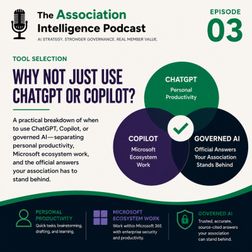
Why Not Just Use ChatGPT or Copilot?
IA
A practical breakdown of when to use ChatGPT, Copilot, or governed AI — separating personal productivity, Microsoft ecosystem work, and the official answers your association has to stand behind. Get Companion Assets at https://meetbetty.ai/the-association-intelligence-podcast#episode-03 What this helps your team answer How to tell the difference between individual productivity tools, ecosystem-specific tools like Copilot, and governed AI — and which job each one is actually built for. Why turning on Copilot can surface risky, forgotten permissions in your SharePoint/OneDrive — and why that's a data-hygiene issue, not a Copilot failure. The six-question decision framework for any AI use case: who's asking, what sources are allowed, who can see the answer, can it trace back to a source, who corrects it when it's wrong, and what signal comes back to the org.
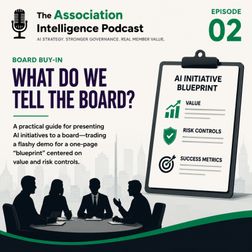
What do we tell the board?
IA
A practical guide for presenting AI initiatives to a board — trading a flashy demo for a one-page "blueprint" centered on value and risk controls. Get Companion Assets at https://meetbetty.ai/the-association-intelligence-podcast#episode-02 What this helps your team answer How to frame AI adoption without triggering board risk aversion. Which outcomes matter to governance-minded leaders, and what boundaries (source, access, traceability, human ownership, rollout scope) need to be defined to earn board confidence and approval. How to set realistic, measurable expectations for a pilot instead of overpromising ROI, and what you should track to prove its working
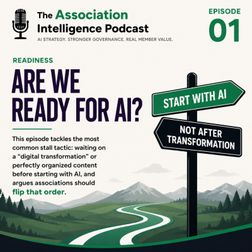
Are we ready for AI?
IA
This episode tackles the most common stall tactic: waiting on a "digital transformation" or perfectly organized content before starting with AI, and argues that associations should flip that order. Get Companion Assets at https://meetbetty.ai/the-association-intelligence-podcast#episode-01 What this helps your team answer Why you should get AI in order first, and let it inform your digital transformation strategy. How to triage content into readiness buckets before launch: fragmented but accurate, incomplete/uneven, and contradictory/obsolete, or permission-confused. Two big governance risks to guard against: stale permissions and outdated versioning. Both require explicit source labeling, access rules, and ongoing human coaching.
How we built it
Thomas Altman and Rob Barnes from Betty explain how the Association Intelligence Podcast came together, why they built it, the tools they used, and why this is the only all-human episode. What this helps your team answer How to use AI to research a topic without ending up with "AI slop" - what a rigorous, governed process for turning AI research into a real deliverable looks like. An example model for pairing human judgment with AI output. How to make AI-assisted work feel human and trustworthy instead of generic or robotic.