The Story of London

The Story of London

di Saul
Stagione 6
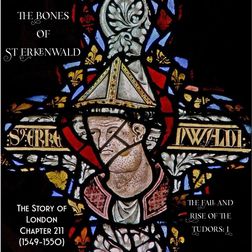
Chapter 211: The Bones of St Erkenwald (1549-1550) (The Fall and Rise of the Tudors: I)
Welcome to the first of two special episodes celebrating the 4th birthday of the Story of London! In the years 1548 and 1549, London existed under the reign of the child King Edward VI, and his Lord Protector, Edward Seymour, the Duke of Somerset… and was heading towards a series of political crisis that would rock it to its core. And the opening one begins now… We see the tale why London’s merchants found themselves at odds with the protectorate regime; how it witnessed the country slip out from under the governments control; how a political disagreement became a crisis, and how suddenly, London the city was presented by a terrible choice… and a moment where one man of the Common Council of the city may have prevented a civil war. All of this, and the awfully sad loss of the remains of London’s ancient Patron Saint… and this is only the open salvo in the disaster to come. Cover art includes a close up of the window to St Erkenwald, in Soulton Hall.
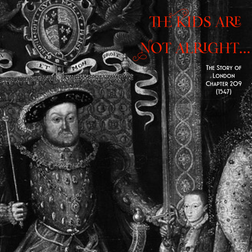
Chapter 209- The Kids are NOT alright… (1547) (The Aftermath of Henry VIII: Part 1)
We are back with a two part examination of the immediate aftermath of the death of King Henry VIII- and look at the impact of his death upon his family (especially his children), the government of England and upon how London reacted to it all. A nine year old boy was now on the throne of England… this changed everything. Lets find out how… Cover features a detail from “An Allegory of the Tudor Succession” c.1590, Unknown painter
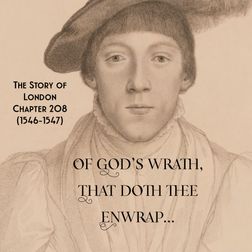
Chapter 208- “Of God’s Wrath, that doth thee enwrap…” (1546-1547)
We return after a short break, and tell the story of London during the final two years of the reign of Henry VIII- a chapter that not only documents the declining health and mental state of the aging king, but also shows how right up to the end, his regime was as deadly and as vicious as ever. This is London witnessing the trial of a noble whose cause became one London supported… even if he was the kind of man to wander the streets firing crossbows at passersby. Welcome to a city which reflected the paradoxical nature of the regime itself. Cover shows detail of a sketch of Henry Howard, Earl of Surrey, credited to Hans Holbein the Younger.
Chapter 207- “Alack! Poor mouse!” (1546)
1546- a year which saw the full tyranny of Henry VIII bloom across London; when the city was not being forced to buy tonnes of surplus wheat from the King; when it was not celebrating the end of the War with France; and when it was not almost burning the wives of cattle barons… it was dealing with a great many things. One of these was the closure of its legal red light district over on Bankside, an event which actually caused the spread of illegal sex trade; but it also witnessed a wild year wherein the 6th wife of Henry VIII came within an inch of being arrested for heresy, and an amazing, and bold woman called Anne Askew found herself suffering a horrendous death upon Smithfield. Welcome to the last full year of the life of Henry VIII- it alls it gory detail. Cover features Portrait of Anne Askew by Hans Eworth (1560)
Chapter 206- “Some for one thing, some for another…” (1543-1546)
The Story finds itself in the last years of the reign of Henry VIII- and we find our metropolis a place where innocent simple teenagers are burned alive, where security clampdowns see curfews and house searches, where ships explode on the Thames, where thousands of men leave the streets to march out to war, where the economy contracts, where no one is safe, and where all of this is caused by an obese, diseased, angry, foul tempered man, playing games with people and dragging all down into insanity. Cover includes portrait of Henry VIII by Cornelis Metsys.
Chapter 205- “Lombard street shall be exercised…” (1520-1550)
An episode where we look under the surface to see what the cities merchants were doing- and run into some surprising truths; this was London at the birth of modern capitalism, and this chapter takes you though the sophisticated financial operations taking place in the city, the newly emergent international trade in credit, why Antwerp was showing the way London had to follow, and introduce a family who would dominate trade in the city over a few generations; the Gresham dynasty. Welcome to the ground floor in the revolution that will change London forever… Cover includes altered picture of the Mercer’s Maid, symbol of the Mercer Livery Company, Dryden Street, London
Chapter 204- “No man dare speak against…” (1539-1544)
Henry VIII was a tyrant. He was a brutal, wilful, petulant king, whose desire to do whatever the hell he felt like and deal with the consequences later, had driven his country into uncharted and dangerous waters. And this is his reign made manifest upon the streets of London- a city filled with massive mock battles on the river, accidental shootings of washerwomen, new churches to prevent bodies being dragged through Whitehall Palace, confusing mass executions of both Protestants and Catholics on the same day, parades of soldiers never destined to fight, and the king going through wives faster than some residents went though a decent jacket. And in all of this- that highest ranked of all London residents, Thomas Cromwell was to fall from power and be put to death. The sheer madness of the king made manifest in a city just trying to cope with his whims… Cover includes altered version of the portrait of Henry VIII, done by Hans Eworth based on the original by Hans Holbein the Younger (1540-1547)
Chapter 203- Gregory Sweet Lips (1536-1540)
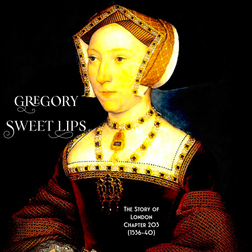
This weeks chapter examines four busy years in the story of our city- culminating in the first death by shooting in its history; along the way we explore a country descending into resentment, resignation and eventually rebellion as Henry VIII descends into tyranny. We examine the seeming madness of his actions, from the speed and ferocity with which he turned on Ann Boleyn, to the dramatic sudden marriage to Lady Jane Seymour, to suddenly being married to a German princess… Along the way we look as the city copes with massive rebellions in the north, violent turmoil in Calais, and crucially, explore why the city itself remained peaceful- discovering that while the king increasingly gave way to his own dark passions, perhaps driven there by a near fatal accident, London’s mercers and others began to look to each other for continuity. Cover includes detail from the portrait of Queen Jane Seymour by Hans Holbein the Younger.
Chapter 202- “With force and arms break down the gate” (1536-1550)
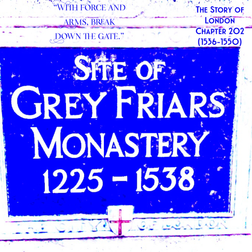
We take a pause from the narrative, to examine, in detail, what the dissolution of the monasteries of London meant for the city- literally, who gained the land and the buildings, what did they do with them, and how much money was made from this? What we see is series of deals that will influence London for the next few decades, as a plethora of new landlords and new homes erupted, and how a small bunch of people were able to make a fortune out of this. Cover includes photograph of the blue plaque denoting the site of Grey Friars Monastery, the City of London
Chapter 201- Down, down, down, down… (1533-1535)
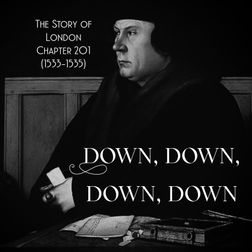
We return with the story as we examine the circumstances that saw a drastic change in fortunes for the cities two most powerful residents- for Thomas Cromwell? His rise in power and status, and his leaving of a physical mark upon the very fabric of the city. For Thomas More? The opposite. The driven man, rushing headlong towards his own death, the circumstances of his life making it impossible to avoid. And around this, a city on the edge of panic, the politics of the new Queen, and much more, as the Story of London reaches the end of the saga of ‘The Boy from Milk Street’. Cover features the Portrait of Thomas Cromwell, attributed to Hans Holbein the Younger, c.1533, Frick copy of original.
1 di 22