Northern Illinois University Presents: The STEAM Studio

Northern Illinois University Presents: The STEAM Studio

di Dr. Kristin Brynteson & April Startzel & Charles Lundsberg
Stagione 2
Big Ideas, Small Teams: The Magic of Film Camp
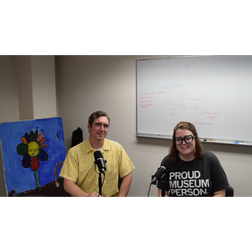
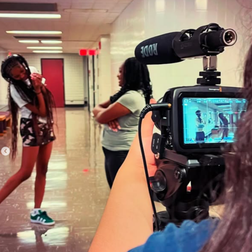
In this episode of the STEAM Studio Podcast, host April Startzel sits down with Michael Corvino, lead instructor of NIU’s summer film production camp, to explore what makes this fast-paced, creative program so impactful. Michael shares his unique dual role at NIU supporting technology across campus while teaching audio and video production. Michael explains how those experiences shaped the film camp he’s helped lead for over a decade.
Mwahaha! Creating Monsters in the Book Lab
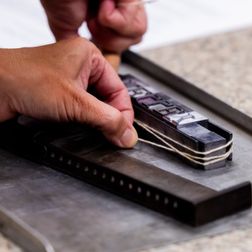
In this episode of the Steam Studio Podcast, we sit down with Dr. Melissa Adams Campbell, professor of English at Northern Illinois University, to explore how literature, creativity, and technology collide in her innovative Monsters and Makers upcoming summer camp. Dr. Melissa Adams Campbell (NIU) shares how her Monsters and Makers camp blends Frankenstein, hands-on bookmaking, and digital design to explore creativity, ethics, and emerging technologies like AI. From printing presses to collaborative monster-building, discover how students read, create, and reimagine what it means to be human in a rapidly changing world.
Spotlight--How DeKalb Students Turned Local Insight into Real-World Innovation
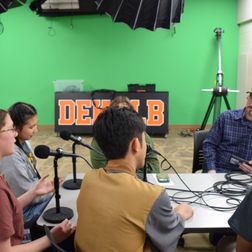
In this episode, we hear from students in DeKalb High School’s Environmental Club as they reflect on their experience in the NIU STEAM Innovation Challenge. Just weeks after competing, they share how they created a solution to reduce microplastics in agriculture by designing a biodegradable seed coating made from chitosan. Working outside of a traditional classroom, the team balanced busy schedules, met after school and at the library, and completed most of their project in a fast-paced final stretch. Their approach was entirely research-driven, relying on scientific literature and real-world examples rather than hands-on experimentation. The conversation highlights what made their experience unique, including their focus on a locally relevant problem in a farming community, their flexible and collaborative workflow, and the challenges of limited time and resources. Students also reflect on what they would improve, such as starting earlier, exploring more creative presentation formats, and connecting with industry mentors. More broadly, this episode showcases how the Innovation Challenge helps students move beyond classroom learning to solve real-world problems, build teamwork skills, and see the impact of science in action.
Spotlight--Romeoville High School Innovators Solving Real World Problems
In this episode, Romeoville students share their award-winning experience at the NIU STEAM Innovation Challenge, where they earned first and third place by tackling antibiotic resistance and microplastic pollution. They discuss how understanding the problem, conducting research, and refining ideas led to innovative solutions, while also highlighting the importance of teamwork, time management, and persistence. Students reflect on the challenges of making ideas both scientifically sound and financially feasible, and how they learned to communicate and market their concepts effectively. The conversation also reveals the critical role of mentorship and the value of connecting student innovation with real world industry insight. As these students move forward into careers in medicine, engineering, and business, they remain driven by one core belief: ideas fuel innovation and create future opportunities.
Spotlight--Sprinting Through Centuries: A Conversation with Dr. Duckett
In this episode of the NIU STEAM Podcast, we sit down with Dr. Duckett, Director of the Black Studies Program at Northern Illinois University, to explore Black history through a global lens and to spotlight the upcoming Sankofa Summer Institute: Learning from the Past, Shaping the Future. Dr. Duckett shares her journey in Black Studies, discusses the importance of pre colonial African history, and explains how culture, music, movement, and symbolism carry knowledge across generations. We dive into what makes this summer camp a unique, hands on, immersive experience and why it is open and meaningful for students of all backgrounds.
Spotlight--Good Morning Campers !
In this STEAM Studio Podcast episode, we spotlight the impact, innovation, and people behind NIU STEAM Camps. Host conversations with NIU STEAM educator Jess Winn and NIU student counselor Erin Lauer offer an inside look at how the camps inspire K–12 students, build confidence, and create lasting connections to STEAM disciplines and the NIU campus. Through personal stories, program insights, and practical information for families, this episode demonstrates why NIU STEAM Camps are a successful, sustainable model for precollegiate engagement and Husky recruitment.
Spotlight--Research Talk with Dr. Bill Martin
In this episode of the STEAM Studio Podcast, we talk with Dr. Bill Martin, assistant professor at NIU, about authentic undergraduate research, learning through uncertainty, and using the campus itself as a living laboratory. From owls in Montgomery Woods to student‑driven research projects across biology and sustainability, Bill shares how curiosity, passion, and community engagement fuel meaningful science experiences for students and citizens alike.
Spotlight--Larry Lurio & Luke Sebby Talk Quantum
Quantum isn’t just a technological miracle of the twentieth century. It is the strange, beautiful rulebook of the universe itself. In this STEAM Studio episode, NIU physics professor Dr. Larry Lurio joins the conversation to demystify quantum mechanics and reveal why the field is having a moment once again. From particles that exist in more than one state at a time to entanglement that links objects across vast distances, Dr. Lurio explains how quantum theory challenges our everyday intuition while quietly shaping the future of computing, medicine, and materials science. With clarity, humor, and plenty of real‑world analogies, the episode journeys through the foundations of quantum mechanics and into the rapidly evolving frontier of quantum computing. Along the way, listeners discover why probability lies at the heart of the quantum world, how entanglement defies classical logic, and why physicists once described their own theories as indistinguishable from magic. The conversation also explores the surprising role of computing and “big data” in quantum research, how noisy early‑stage quantum computers differ from artificial intelligence, and why they are best viewed as complementary technologies rather than competitors. Dr. Lurio shares how quantum tools may someday help design new drugs, model complex materials, and uncover phenomena we do not yet know how to look for. Beyond the theory, the episode highlights NIU’s growing role in quantum research, fueled by deep collaborations with Argonne National Laboratory and Fermilab, access to world‑class supercomputing resources, and a culture that emphasizes partnership over ownership. From student opportunities to statewide leadership in quantum innovation, Illinois is positioning itself at the forefront of this rapidly emerging field. Perfect for the armchair scientist and the everyday learner alike, this episode invites listeners to embrace curiosity, lean into the weirdness, and discover why quantum mechanics is not just something we study—but the world we live in.
Spotlight--White Pines Golf Club
From snow‑covered fairways to summer tee sheets packed with players, the game of golf at White Pines never stops moving. In this STEAM Studio Spotlight episode, we step onto the green to explore how science, technology, and community quietly shape every swing and every putt. White Pines General Manager Andrew Godfrey joins Callaway Golf’s Stacy Borkowski and Bensenville Park District marketing lead Paul Palian for a behind‑the‑scenes conversation on what it really takes to run a year‑round golf facility in the Midwest. Together, they unpack the hidden physics and biomechanics behind putting, the role of data and advanced materials in modern golf equipment, and how technology has transformed both performance and accessibility. The discussion traces the game’s evolution from tradition to innovation, highlighting how women, juniors, and first‑time golfers are helping redefine what golf looks like today. Along the way, the guests reveal how club fitting has become a personalized science, why small adjustments can create outsized results, and how golf offers a powerful, real‑world entry point into STEAM learning. The episode also previews Science of the Swing, an NIU STEAM Café collaboration beginning April 29 at 6:30 p.m, where participants will explore the biomechanics and performance science of golf putting firsthand. It’s a reminder that science doesn’t only live in labs, and learning doesn’t always look like homework. Whether you love golf, science, or simply enjoy discovering how complex systems work together, this episode shows how a centuries‑old game continues to evolve, welcome new players, and remain something people can truly play for life.
Spotlight--John Gallione
A scenic route can sometimes be the most powerful teacher. In this episode of STEAM Studio Spotlight, eighth grade U.S. history teacher and middle school athletic director John Gallione joins the conversation to share how a nonlinear journey marked by early academic struggles, the Great Recession, career detours, and community college transfer ultimately led him to a deeply meaningful life in education. From coaching basketball to teaching history, John reflects on the role of mental health literacy, reflective practice, and learner agency in building sustainable learning environments. As both an athletic director and a musician, he explores how community is formed where shared interests meet on the court, on the stage, and after school, and why those spaces are essential to student belonging and growth. John also shares his philosophy of inviting students to help define expectations for their teacher, reinforcing the idea that learning is a shared responsibility shaped by trust, connection, and mutual respect.
1 di 5