The Mind Machine Chronicles

The Mind Machine Chronicles

di Tech Prodigy
Stagione 1
Double Slit Experiment: A Scientific proof to simulation?

This podcast episode explores the fascinating concept of the simulation theory and discusses potential experiments to test its validity. The simulation theory proposes that our reality is a sophisticated virtual reality, generated by a computer system with finite resources. This theory suggests that the universe's creator prioritizes computational efficiency, rendering reality in detail only when an observer is present. This idea aligns with modern video games that generate content as players explore, minimizing unnecessary processing. The episode examines the implications of this theory for understanding quantum phenomena, such as wave-particle duality. It argues that seemingly paradoxical results in experiments like the delayed-choice quantum eraser could be explained by a simulation that prioritizes consistency while avoiding detection by its inhabitants. The episode discusses several proposed experiments to test the simulation theory. These experiments focus on manipulating the availability of "which-way" information in wave-particle duality setups, aiming to reveal potential inconsistencies or limitations in the simulated reality. For example: One experiment suggests detecting which-way information but not making it available to the observer, potentially leading to an interference pattern even when the path is known. Another experiment proposes delaying the decision to erase which-way data to a macroscopic timescale, examining if the observed pattern changes based on the availability of the information. The episode highlights that these proposed experiments, even if inconclusive, could reveal new insights into the nature of reality and our role as observers.
Are We Living in the Matrix? Decoding the Simulation Argument

This episode explores the fascinating and thought-provoking "Simulation Argument" proposed by philosopher Nick Bostrom. The argument suggests that at least one of the following must be true: Humanity is highly likely to go extinct before reaching a technologically advanced "posthuman" stage. This could occur due to various factors, such as the development of dangerous technologies like self-replicating nanobots. Posthuman civilizations have little to no interest in running simulations of their ancestors. This would imply a significant convergence in the values and societal structures of advanced civilizations. Perhaps they develop ethical concerns about simulating conscious beings, or perhaps their motivations and desires evolve beyond such pursuits. We are almost certainly living in a computer simulation. If advanced civilizations have the capacity and the inclination to run ancestor simulations, and they create many such simulations, then it's statistically more likely that we are simulated beings rather than original ones. The episode will examine the philosophical underpinnings of the argument, including the concept of substrate-independence, which suggests that consciousness isn't bound to biological brains and could theoretically be replicated on other substrates like computers. We'll also consider the potential implications of living in a simulation, including the possibility of multiple levels of reality and the intriguing parallels to religious ideas of gods and an afterlife.
Simulating Reality: Are Computer Simulations Experiments?
Computer simulations are now used in a wide range of scientific disciplines, including astrophysics, materials science, engineering, fluid mechanics, climate science, evolutionary biology, ecology, economics, decision theory, and sociology. Philosophers of science have traditionally focused on the justification of theories, rather than their application. However, the epistemology of computer simulation is primarily concerned with the justification of the application of theories.
The Dunning-Kruger Effect: Self-Insight, Ignorance, and Competence
Think you know what you're doing? Think again. The Dunning-Kruger effect is the mind-bending phenomenon where incompetence breeds overconfidence. This podcast explores the illusion of skill and the dangers of self-deception. Are you sure you're not suffering from it? Are you smarter than you think? Or are you a victim of your own ignorance? This podcast dives deep into the Dunning-Kruger effect, the fascinating psychological phenomenon that explains why the least competent people often think they're the most skilled. Explore the hidden biases that shape our self-perception and learn why we're so frequently blind to our own limitations. Prepare to question everything you thought you knew about yourself...and everyone else. Dunning-Kruger effect, overconfidence, incompetence, self-deception, psychology, bias, self-awareness.
Game Theory: Refinements of Nash Equilibrium
Have you ever been in a situation where you felt like you were playing a game with hidden rules? Welcome to the world of Game Theory, where we dissect real-life scenarios using mathematical models and strategic thinking. From the thrill of auctions to the complexities of negotiations, we delve into the art of making optimal decisions when facing uncertainty. Ready to unlock the power of strategy and play to win?
Balancing Act: How Common Sense Morality Navigates Norms and Evaluations
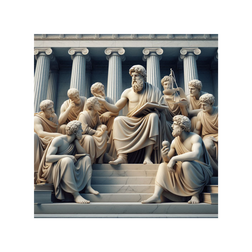
This episode explores the fascinating concept of "common sense morality". It examines how this everyday decision-making process relies on two key elements: norms and evaluations, and the interplay between them. Norms, in this context, are the rules and principles that guide our actions, telling us what we should and shouldn't do. They often depend on the specific circumstances. For example, honesty is generally considered a good norm, but dishonesty might be acceptable in certain situations like wartime interrogation. Evaluations are judgments we form about things or events in our environment. They stem from our initial instinctive reactions of "prizing" or "disprizing" something. Through investigation and reflection, considering both the event's consequences and its relationship to norms, we refine these initial reactions into more balanced evaluations. Common sense morality employs two procedural principles when making decisions: The Formalistic Requirement: This principle considers whether a proposed action aligns with established norms. If an action adheres to a prescribed norm, it's seen as evidence in favor of taking that action. The Teleological Requirement: This principle focuses on the potential consequences of an action, specifically whether it leads to highly valued outcomes. Actions that result in desirable consequences are considered more favorable. Importantly, common sense morality doesn't prioritize one principle over the other. Instead, it recognizes the importance of both norms and consequences in decision-making, often leading to complex considerations and debates. Haworth highlights the dynamic nature of the "ethical tradition," the collection of norms and evaluations that shape our moral judgments. This tradition isn't static; it evolves as inconsistencies arise and new challenges emerge. This evolution aims to achieve "working consistency" where norms and evaluations align, meaning morally right actions also lead to desirable consequences. This episode will explore the challenges of balancing the formalistic and teleological requirements, how the ethical tradition adapts to new circumstances, and how common sense morality ultimately strives to make sound judgments in a complex world.
The Mind-Body Problem: Can Science Explain the Mind?
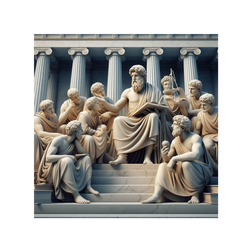
Join us as we unravel one of philosophy's most enduring puzzles: the mind-body problem. We'll explore the fundamental questions about the relationship between mental and physical phenomena, examining concepts like consciousness and intentionality, and considering various philosophical perspectives. Is the mind simply a product of the brain, or is there something more? This episode examines the mind-body problem, exploring different philosophical positions, from substance dualism to eliminative materialism, and the challenges each faces. This episode explores the mind-body problem, a central issue in our understanding of the natural world. We'll discuss attempts to reconcile the mental with the physical, and the implications for our understanding of ourselves and the universe. The provided sources offer a detailed overview of the mind-body problem, outlining different philosophical perspectives and their strengths and weaknesses. This information can help craft an engaging and informative podcast episode. For example, the description could highlight specific thought experiments discussed in the source, such as the possibility of a body behaving like a thinking being without consciousness or the concept of an inverted spectrum
Unveiling the Invisible: Exploring Justice with Plato's Ring of Gyges.
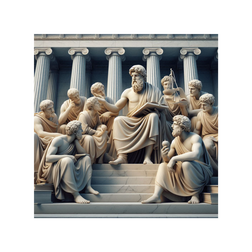
This episode examines the nature and origins of justice through Plato's thought-provoking tale of the Ring of Gyges. Glaucon, engaging in a dialogue with Socrates, argues that justice is merely a social contract arising from people's fear of suffering injustice without recourse. He suggests that if individuals could act with impunity, even the most just would succumb to the temptation of personal gain, highlighting the inherent selfishness of human nature. To illustrate this point, Glaucon introduces the mythical Ring of Gyges, which grants its wearer invisibility. He contends that if both a just and an unjust person possessed such a ring, they would ultimately behave similarly, driven by self-interest and a desire for power. By analyzing this hypothetical scenario, the episode explores whether justice is intrinsically valuable or simply a pragmatic compromise to avoid negative consequences. The discussion also probes the philosophical implications of invisibility, prompting listeners to contemplate their actions if freed from societal scrutiny and accountability.
Morality: Why Should We Care?
This episode explores the fundamental question of why human beings should be moral. It examines various arguments for moral behavior, including: Enlightened self-interest: Acting morally can ultimately benefit individuals as it contributes to a more stable and harmonious society. For instance, if everyone refrains from killing, stealing, and cheating, all members of the group stand to gain. Tradition and law: Respect for established laws and traditions, which often promote moral conduct, provides another incentive. While this argument has merit, it is crucial to critically examine these traditions and laws, and ensure they align with ethical principles. Common human needs: Morality arises from the recognition that cooperation and adherence to moral principles are essential for fulfilling fundamental human needs, such as friendship, love, and peace. It allows individuals to live more meaningfully and without constant fear of harm. The episode emphasizes the significance of ethics in navigating the complexities of human relationships and promoting mutual welfare, growth, and meaning6. It encourages listeners to reflect on their moral values and the importance of striving for ethical conduct in their lives
The Visual Mandela Effect: When Everyone Remembers It Wrong
Have you ever had a memory so vivid, so clear, that you were certain it was true, only to find out it was completely wrong? You're not alone! This phenomenon, known as the Visual Mandela Effect, describes the experience of shared and consistent false memories for specific images in popular culture. Join us as we explore fascinating examples like the Monopoly Man's monocle (or lack thereof!), C3PO’s golden leg, and Pikachu's black-tipped tail. We'll unpack the science behind these memory mishaps and examine different theories about why they occur. Is it faulty attention, schema-based assumptions, or something else entirely? Tune in to challenge your memories and gain a deeper understanding of the fascinating quirks of the human mind! The description draws on several key points discussed in the source: Definition of the VME: It emphasizes shared and consistent false memories for visual icons. Examples: It uses specific examples of VME-affected images mentioned in the study, making the description engaging and relatable. Scientific exploration highlights the scientific approach to studying the VME, examining different theories and potential explanations. Engaging tone: It uses an inviting and intriguing tone to pique listener interest, encouraging them to question their memories and learn more about the topic.
1 di 2