Prehospital Care Research Forum (PCRF) Journal Club

Prehospital Care Research Forum (PCRF) Journal Club

di Prehospital Care Research Forum
Stagione 2026
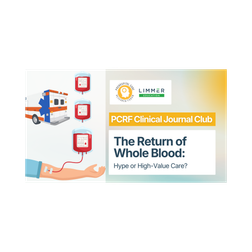
The Return of Whole Blood: Hype or High-Value Care?
In this episode, we explore one of the most talked-about shifts in trauma care: the return of whole blood in prehospital resuscitation. Is it truly a game changer, or simply a more streamlined way to deliver the same care? In this month’s journal club, we break down a large, multicenter randomized trial examining prehospital whole blood transfusion versus traditional component therapy in patients with life-threatening traumatic hemorrhage. With growing adoption of whole blood programs across EMS systems, this study challenges us to think critically about what we carry, how we deliver care, and what actually impacts outcomes when minutes matter most. Join us for our upcoming Prehospital Care Research Forum Journal Club as we unpack the evidence, the logistics, and the real-world implications for trauma care in the field. Article: Prehospital Whole Blood in Traumatic Hemorrhage — a Randomized Controlled Trial
Training Without Patients? Live from ACCREDITCON
LIVE from ACCREDITCON in New Orleans! When clinical sites are scarce, simulation steps in—but what does that mean for paramedic education? This episode dives into national accreditation data to examine the prevalence of simulation substitution for core clinical skills and its relationship to program performance. We unpack the methodology, assumptions, and implications for educators and learners alike. Article: Prevalence and Impact of Simulation Substitution on Paramedic Educational Program Success: A National Examination
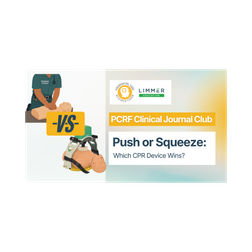
Push or Squeeze: Which CPR Device Wins?
In this episode, we take on a simple but important question in modern resuscitation: when machines take over CPR, does the type of device actually matter? Mechanical CPR use continues to grow across EMS systems, but not all devices are built the same. In this month’s journal club, we unpack a large retrospective study of more than 38,000 out-of-hospital cardiac arrest patients comparing plunger-type and band-type mechanical CPR devices. Does one design actually lead to better outcomes, or are we just splitting hairs between two versions of the same tool? Join us for our upcoming Prehospital Care Research Forum Journal Club as we dig into the data, the design differences, and what this means for equipment decisions, training, and high-performance CPR in the field. Article: A Retrospective Comparison of Plunger-Type and Band-Type Mechanical Chest Compression Devices for Prehospital Resuscitation
Bearing Witness: The Hidden Cost of Paramedic Training
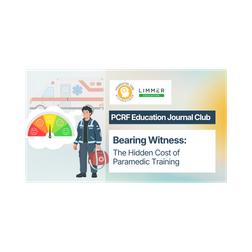
Paramedic students don't just practice clinical skills during their clinical rotations—they are often present for emotionally intense, high-stakes moments in patient care. This journal club explores a qualitative study examining how students experience and make sense of these events, their emotional responses, and the ways they cope. Join us to reflect on what this means for EMS education and student support. Article: Student post-traumatic stress after clinical placement
More Than a Pilot: How eCPR Programs Shape Everyday Resuscitation
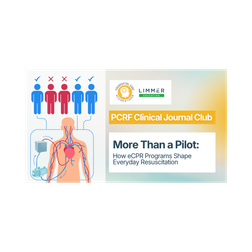
In this month’s clinical journal club, we take a deeper look at one of the most talked-about innovations in resuscitation: extracorporeal CPR (eCPR). But instead of focusing on the patients who receive it, this study asks a different and important question: what happens to everyone else? Using data from over 30,000 out-of-hospital cardiac arrest patients in Los Angeles County, researchers examined whether implementing an eCPR pilot program changed outcomes for patients who never received eCPR at all. We unpack the findings' implications for training, system design, and the potential ripple effects of high-performance resuscitation programs. Does introducing advanced care elevate the entire system, or risk shifting focus away from core fundamentals? Join us for a thoughtful conversation on how innovation, education, and implementation strategy can shape outcomes far beyond the patients we intend to treat. Article: Impact of an eCPR Pilot Program on Outcomes After Out-of-Hospital Cardiac Arrest for Patients Who Do Not Receive eCPR in a Large, Urban EMS System
Can’t Intubate, Can’t Oxygenate: Does Simulation Mastery Make the Cut?
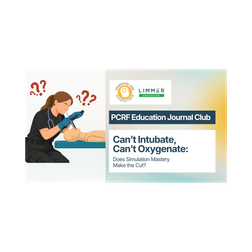
Emergency cricothyrotomy is a rare but life-saving procedure in the “can’t intubate, can’t oxygenate” patient. In this session, we’ll review a study that examines the use of simulation-based mastery learning to train emergency medicine residents in this high-stakes skill. Join us as we discuss how simulation, competency standards, and deliberate practice might shape training for one of the most critical procedures in airway management. Article: Simulation-­ Based Mastery Learning Improves Emergency Medicine Residents' Ability to Perform Emergency Cricothyrotomy https://onlinelibrary.wiley.com/doi/10.1002/aet2.70124
Less Hospital, More Support: Evidence for Paramedic-Led Diversion Models
In March 2026's journal club we step into a nuanced corner of prehospital care that’s quietly reshaping how systems think about patient destinations. We unpack research from Toronto on paramedics transporting intoxicated patients to a stabilization centre rather than straight to the emergency department. Most patients required no medical interventions in the field, and only a small subset needed later transfer to a hospital. What does this mean for EMS diversion practices, resource use, and paramedic decision-making? Join us for a practical, forward-looking discussion on when less hospital might mean better care in the prehospital world. Article: Examining a Stabilization Center for Patients with Alcohol or Opioid Intoxication Transported by Paramedics: A Cohort Study of an Emergency Department Diversion Model
From Sirens to Synapses: Teaching Neurology in the Back of the Ambulance
Neurologic emergencies don’t wait for the hospital—and neither should neurology education. This episode breaks down a longitudinal EMS curriculum using cases, simulation, and gamification to improve prehospital neurologic assessment. We’ll discuss feasibility, knowledge outcomes, and system-level metrics like door-to-needle time and thrombectomy transfers. Does active learning and simulation meaningfully change prehospital neurologic care—or just test scores? And what does “success” really look like for EMS education? Article: Curriculum Innovation: Training the Front Line A Neurologic Emergencies Curriculum Pilot for First Responders https://www.neurology.org/doi/10.1212/NE9.0000000000200286
What Counts as a DNR in EMS Protocols? Wristbands, POLST, Verbal Orders
In this month’s journal club episode, we tackle a topic every EMS educator and clinician wrestles with: how do you honor a patient’s end-of-life wishes when they call 911? We unpack a structured review of U.S. EMS protocols and the wide variation in what counts as a valid Do Not Resuscitate (DNR) order, from physician-signed forms to bracelets, POLST-style documents, and even verbal orders. We’ll discuss how these differences can lead to moral distress and affect goal-concordant care, and why understanding the nuances of DNR documentation matters for field providers, system leaders, and anyone who wants to ensure patient wishes are respected in the out-of-hospital setting.
CPR Mastery: How good is good enough? Is Mastery Learning Overkill? Short, Self-Directed CPR Training Delivers Comparable 6-Month Retention
Does CPR training really need to be “to mastery”? This study suggests a few minutes of self-directed practice may be just as effective months later. Join the journal club to debate what this means for EMS education, standards, and training efficiency.
1 di 9