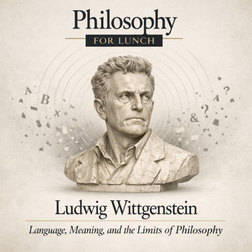
Episode #023 - Wittgenstein: Language, Meaning, and the Limits of What Can Be Said
When you see a red apple and I see a red apple, we agree on the word. But is the inner experience — the actual felt quality of redness as it appears to your consciousness — the same as mine? Philosophers have generated enormous literature on this problem. Wittgenstein looked at it and said: wait. Before we try to answer the question, let us ask whether we have properly understood what we are asking. Ludwig Wittgenstein is probably the most influential philosopher of the twentieth century. He also, unusually, produced two major works that contradict each other in important ways — and repudiated the first while writing the second. In this episode, Shawn and Claire cover both. The early Wittgenstein — the Tractatus Logico-Philosophicus — argued that language pictures the facts of the world, that meaningful propositions correspond to possible states of affairs, and that whatever lies outside this correspondence — ethics, aesthetics, the meaning of life — cannot be said. It can only be shown. The famous last line: whereof one cannot speak, thereof one must be silent. But Wittgenstein insisted the important things in the book were what he did not say — the limits he drew pointed toward what matters most, lying outside those limits. The later Wittgenstein — the Philosophical Investigations — dismantled this picture entirely. Words do not get their meaning by referring to things. They get their meaning from their use — from the role they play in what he calls language games, practices embedded in forms of life. The private language argument shows why mental terms cannot refer to purely private inner states. The concept of family resemblance shows why most philosophical searches for definitions — for the necessary and sufficient conditions of knowledge, justice, consciousness — are looking for something that does not exist. Shawn and Claire together. No prior philosophy required. SHOW NOTES Primary Sources Wittgenstein, L. (2001). Tractatus Logico-Philosophicus (D. F. Pears & B. F. McGuinness, Trans.). Routledge. (Original work published 1921) Wittgenstein, L. (2009). Philosophical Investigations (G. E. M. Anscombe, P. M. S. Hacker, & J. Schulte, Trans., 4th ed.). Wiley-Blackwell. (Original work published 1953) Wittgenstein, L. (1969). On Certainty (G. E. M. Anscombe & G. H. von Wright, Eds.). Harper & Row. Biographical & Contextual Monk, R. (1990). Ludwig Wittgenstein: The Duty of Genius. Free Press. (The definitive biography — one of the great intellectual biographies of the twentieth century.) Works Referenced in This Episode Kripke, S. A. (1982). Wittgenstein on Rules and Private Language. Harvard University Press. Russell, B. (1922). Introduction. In L. Wittgenstein, Tractatus Logico-Philosophicus (pp. ix–xxii). Routledge. Accessible Starting Points Grayling, A. C. (1988). Wittgenstein. Oxford University Press. Kenny, A. (2006). Wittgenstein (rev. ed.). Blackwell. Edmonds, D., & Eidinow, J. (2001). Wittgenstein's Poker. Ecco. (Reads like a thriller — the best possible entry point for a general audience.) New episodes every Monday. Philosophy for Lunch · Big ideas. Human conversations.