Office Hours with Professor Alexander

Office Hours with Professor Alexander

di Alexander Puutio
Stagione 1
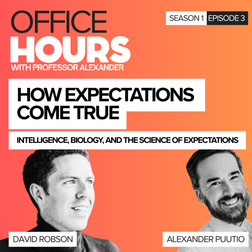
How Expectations come True Intelligence, biology, and the science of expectations
David Robson has spent his career studying the ways the human mind helps us, fools us, heals us, and connects us to one another. As the author of The Intelligence Trap, The Expectation Effect, and The Laws of Connection, Robson has explored a question that sits near the center of Office Hours. Why do capable people make bad decisions, get trapped by their own certainty, underestimate the power of belief, and forget that thinking is never something we do alone? In this episode, we talk about the traps that come with intelligence, the biology of expectation, the science of social connection, and why smarter thinking begins with a little less faith in being smart. Robson explains why expertise can harden into overconfidence, how our beliefs can alter health, performance, and motivation, and why the people around us shape our minds more than we usually admit. We also get into curiosity as a practice of humility, and not the soft kind that asks people to think less of themselves, but the useful kind that keeps the mind open long enough to notice where it might be wrong.

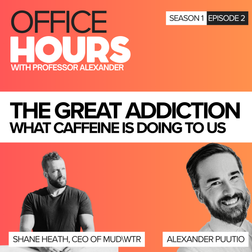
The great addiction: What caffeine is doing to us with MUD\WTR's CEO
Shane Heath didn't exactly set out to start a beverage company. He was trying to figure out why the thing that made him feel productive was also making him feel awful. Before he founded MUD\WTR, Shane was a designer, artist, and startup worker caught inside the same ritual millions of people mistake for ambition. More coffee. More output. More speed. More anxiety. The cup looked harmless enough. The culture around it looked almost heroic, but the chemistry was telling a different story. In this episode of Office Hours, we talk with Shane about caffeine, burnout, mental health, ritual, and the strange ways people self-medicate their way through modern work. We get into the founding story of MUD\WTR, why coffee culture can hide the effects of caffeine in plain sight, and how a product built from cacao, chai, spices, and functional mushrooms became a way to ask a much bigger question. What if the habits that help us perform are also the habits that keep us trapped? This is a conversation about entrepreneurship, but not only entrepreneurship. It is about the body beneath the brand, the nervous system beneath the schedule, and the possibility that changing your life sometimes begins with noticing what you reach for before you are fully awake.
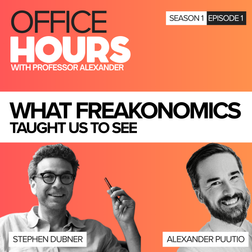
What Freakonomics Taught Us to See: Curiosity with Twenty Years of Receipts
Stephen Dubner has spent the last two decades asking the kinds of questions most people are trained out of asking. As the host of Freakonomics Radio and co-author of the Freakonomics books, Dubner helped turn curiosity into a public method. Why do drug dealers live with their mothers? What do sumo wrestlers and schoolteachers have in common? What happens when you stop accepting the official story and start looking for the incentives underneath? In this episode of Office Hours, we talk about what Freakonomics changed, what it missed, and why the world may now be suffering less from a shortage of answers than from a shortage of better questions. Dubner joins us to explore the craft of asking, the discipline behind curiosity, the relationship between data and storytelling, and the danger of becoming too certain too quickly. We also get into what it takes to make ideas travel, why counterintuitive thinking can become its own trap, and how to stay open-minded without becoming gullible. Along the way, we ask what Freakonomics would look like if it were born today, in a world flooded with data, AI-generated answers, institutional distrust, and a growing appetite for explanations that feel both rigorous and human. Because the hidden side of everything was only the starting point. The real treasure at the end of the rainbow was learning how to look.