
Human Systems — How the World Actually Works

Human Systems — How the World Actually Works

di Oddly Robbie
Stagione 4
When Belonging Requires Obedience, It Stops Being Support

IA
Support is often described as care, loyalty, or being there for one another. But not all support functions the same way. Some forms of support help people become more themselves. Others quietly require obedience in exchange for belonging. In this episode, Oddly Robbie explores the difference between support and control through a Human Systems lens, examining how conditions, authority, belonging, and autonomy interact inside families, friendships, partnerships, communities, and even technology. Topics: • Support vs control • Chosen family and consent-based belonging • The cost of disagreement • Agency and autonomy • Healthy boundaries • Human Systems analysis Key insight: Support becomes safe when it increases agency.
When Paperwork Leaves the Body
IA
In this episode, I reflect on how legal status is not only administrative — it is embodied. Residency approval did not magically solve life. It removed a major uncertainty from my nervous system’s forecast. When the future of home is unclear, the body keeps running background questions: What if this does not work? What if we have to leave? What if the systems I escaped become relevant again? This episode looks at bureaucracy as nervous-system pressure, especially for neurodivergent people, queer people, immigrants, veterans, and anyone who has lived under systems that tried to correct or contain difference. The core Human Systems insight: Paperwork is not neutral when it controls housing, residency, medical access, family stability, or the right to remain in a safe environment. Legal stability changes the body’s threat model. When uncertainty clears, even a little, the body knows. The alarm attached to the paperwork begins to leave. Themes: - residency approval as a stability signal - bureaucracy and nervous-system load - home uncertainty and embodied safety - autism as human variation, not defect - the trauma of corrective systems - Costa del Sol as a regulating environment - sovereignty, safety, and the right to build a life Oddly Robbie explores Human Systems: how policies, cultures, technologies, and environments shape the body, attention, identity, and daily life.
When Learning Breaks: A Human Systems View of Education Failure

IA
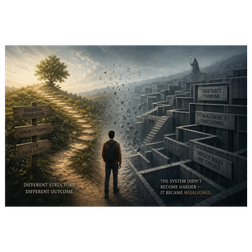
When Learning Breaks: A Human Systems View of Education Failure When someone succeeds in one learning structure but fails in another, the issue isn’t ability—it’s alignment. In this episode, I share my experience attending around ten colleges and universities, earning two associate degrees, and repeatedly encountering the same pattern: success at structured, sequential levels—and breakdown at abstract, non-linear ones. This isn’t about effort or intelligence. It’s about how systems are designed. Key ideas: Learning systems don’t just get harder—they can become misaligned Accommodations don’t fix structural mismatch Abstract models often exclude valid ways of thinking Failure patterns often reflect system design, not human limitation If learning breaks, the better question isn’t “what’s wrong with the person?” It’s: what changed in the system? Category: Human Systems Tags: human systems, learning design, cognitive systems, education, decision guidance
Worst-Case Bias — Why Small Risks Take Over Your Thinking

IA
This insight came directly from navigating real-world systems in Spain. This episode explores a common cognitive distortion: How low-probability outcomes begin to dominate perception—and behavior. After a simple paperwork error triggered a denial notice, the experience revealed a deeper pattern: The mind does not prioritize what is likely. It prioritizes what is wrong. This episode breaks down: Why the brain overweights small risks How incomplete situations stay active in awareness Why a 1% possibility can override a 99% reality How to restore proportional thinking in real time This is not about ignoring risk. It’s about placing it correctly. Because clarity is not removing concern— it’s putting it in proportion. For a deeper system breakdown and practical application: https://oddlyrobbie.eu/low-probability-distortion-worst-case-thinking/
Accessibility Gap — Why Advanced Systems Still Fail People
IA
Created and hosted by Robbie Ellestad (Oddly Robbie), exploring the intersection of human experience, AI, and immersive systems. Episode Summary (Quick Read) Spain has one of the most advanced digital systems I’ve used—but it revealed something important: Advanced doesn’t mean accessible. This episode explores the gap between systems that work and systems that actually guide people. Through real experience navigating residency processes, I break down how modern systems often assume knowledge instead of supporting entry—and why that creates invisible barriers. Key Moment “A system can be advanced… and still not be accessible.” That realization shifts everything. It moves the problem away from the individual—and back to the structure. Partial Transcript (Highlighted) “I was uploading forms, responding to automated requests as they came in—one after another. Everything was working exactly as designed. Efficient. But it required constant attention. Miss something… and you’re suddenly out of sync. It wasn’t confusing. It was demanding.”
Care System Failure — Why Robots May Improve Human Dignity

IA
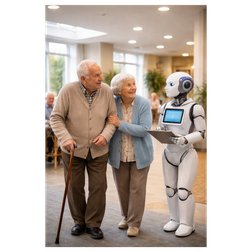
When I worked maintenance in assisted living, I learned something I was never meant to see. The system was efficient, organized, and profitable — but it was not designed for fragility. Every small repair became a line item. Every line item became pressure. And somewhere between documentation and billing, dignity started depending on who happened to care enough that day. If you’re thinking about the future of care, autonomy, and human-centered technology, this is a space I’ll continue exploring.
Integration System — Why Living Somewhere Is Different Than Visiting

IA
What does it actually take to feel like you belong in a new country? After ten months living on Spain’s Costa del Sol, this episode reflects on the difference between visiting and truly integrating. From daily rhythms to cultural expectations, I share what it means to adapt—not by forcing yourself in, but by learning how to move within a place respectfully. Because in the end, money might open doors— but humility is what keeps them open.
Regulation System — Why Stimming Calms the Nervous System

IA
Why do people stim—and why is it often misunderstood? This episode explores stimming as a natural and necessary way the nervous system regulates itself. From an autistic perspective, stimming isn’t disruption or rebellion—it’s a way to find balance, reduce overwhelm, and stay grounded in a world that can feel too loud. If you’ve ever wondered why people stim—or felt the need to regulate yourself in small, repetitive ways—this offers a clearer, more human way to understand it.
Social Visibility System — Why Some Relationships Depend on an Audience
IA
🎙️ Episode: Love, Performance, and the Systems We Don’t See Valentine’s Day looks like love. But often, it reveals something deeper— a system of visibility, roles, and social positioning. In this episode, I break down how rituals like weddings and holidays don’t just express connection… they reorganize it. 🧠 What You’ll Hear Why Valentine’s Day is more about visibility than love How weddings silently restructure relationships The difference between emotional distance vs structural distance Why some people get “cut off” without conflict The hidden rules most people follow—but never say out loud 🔍 Core Insight Not all distance is conflict. Some distance is structural. And when you misread structure as emotion, you create confusion that doesn’t need to exist. ⚖️ Two Types of Love Performative Love Needs visibility Responds to timing Depends on an audience Durable Love Functions without attention Continues without reinforcement Does not require display 🧭 Reflection Ask yourself: Does this relationship require an audience? Does it change with attention? Does it hold without reinforcement? What happens if I step back? 📍 Context This episode is part of the Human Systems series— exploring the hidden structures behind everyday experiences. 🔗 Read the full post https://oddlyrobbie.eu/valentines-day-social-system/ — Oddly Robbie
Longevity System — Why Reducing Impact Extends Physical Capacity
IA
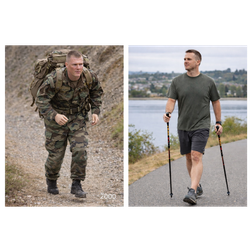
Is walking with poles a step back—or a smarter way forward? This episode explores why I started walking with poles and how it’s changed the way I think about movement, longevity, and joint health. Instead of pushing the body harder, this is about preserving it—reducing impact, improving stability, and extending how long we can stay active. Because real strength isn’t just about what you can do today. It’s about what your body can still do years from now.
1 di 11