Last Christian Ministries

Last Christian Ministries

di Pastor Charles Wiese
Stagione 2
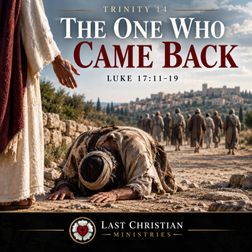
Title: The One Who Came Back — Trinity 14 Sermon (Luke 17:11–19)

Ten lepers cry out to Jesus for mercy. Ten hear His Word. Ten believe His promise and go on their way to the priests. Ten are cleansed. But only one comes back. The one who returns is the least likely of them all—a Samaritan, a foreigner, and a leper. The other nine receive the earthly blessing they wanted and continue on their way. The Samaritan returns to Christ, falls at His feet, and gives thanks. Their cleansing was not defective. Their faith had not been false simply because they later fell away. But earthly blessings became enough for the nine. They wanted to be clean, restored to society, and accepted under the outward order of the Law. Only the Samaritan continued to cling to Christ. So it remains in the Church. Many receive Baptism, hear God's Word, and come to the Lord's Supper, yet become satisfied with earthly blessings, outward church membership, ancestry, respectability, or their own works. Christ's true Church remains a little flock, often found where the world and even the visible Church least expect it. The truth has never been popular. The descendants of those who killed the prophets built monuments to them. Men praise Athanasius, Luther, and Walther after they are safely dead while rejecting the Word for which they contended. If Christ Himself appeared among many who bear His name, they would cast Him out for saying the same things He says in Scripture. Yet among ten cleansed lepers, faith endures in the Samaritan outcast. “Rise and go your way; your faith has saved you.” A Trinity 14 sermon on Luke 17:11–19 about faith, thanksgiving, the little flock, and clinging to Christ rather than our works, ancestry, church membership, or earthly blessings.
Who Is My Neighbor? — Trinity 13 Sermon (Luke 10:21–37)
The expert in the Law asks Jesus, “What must I do to inherit eternal life?” But an inheritance is not earned. Someone else earns it, and it becomes yours through his death. When the lawyer tries to justify himself by asking, “Who is my neighbor?” Jesus gives him far more Law than he expected. The Good Samaritan shows that loving our neighbor means more than avoiding murder or outward wrongdoing. Wherever God places someone who is suffering before us—friend or enemy, foreigner or fellow citizen—we have been given a neighbor to love. God demands genuine compassion that regards our neighbor’s suffering as our own. By that standard, none of us can justify ourselves. But Jesus does not merely tell us about the Good Samaritan. Jesus is our Good Samaritan. He finds us helpless and half-dead, has compassion on us, binds up our wounds, restores us to life, and pays the entire cost. He does everything for our salvation; we do nothing. And those who have received such mercy cannot remain indifferent to the suffering of others. United to Christ, we become neighbors to those God places before us—not to earn eternal life, but because eternal life has already been given to us in Christ. Trinity 13 — Luke 10:21–37
Paul E. Kretzmann on the Revelation of St. John
In this episode of Last Christian Ministries, we begin our reading through Paul E. Kretzmann’s commentary on the Revelation of Saint John from The Popular Commentary of the Bible. Kretzmann represents an older Lutheran approach to Revelation that takes seriously the historicist framework found in Luther and maintained by generations of Protestant interpreters. At a time when even many modern amillennial commentaries have moved away from historic interpretations in favor of broad and often vague readings of Revelation, Kretzmann offers something refreshingly clear, sober, and level-headed. He maintains the basic historic framework while refining it and avoiding the sensationalism and speculative date-setting that has sometimes characterized historicist interpretation. His commentary provides a useful example of how Lutherans can read Revelation as a prophecy concerning Christ, His Church, the enemies of the Gospel, and the course of history without losing sight of the central message of the book: Jesus Christ reigns, preserves His Church, judges His enemies, and will finally come again in glory. In this first episode, we read the introduction to the series followed by Kretzmann’s Introduction to the Revelation of St. John. The complete written commentary will also be available on the Last Christian Ministries website, and the audio recordings will be posted on the same pages alongside the text so that listeners can read along as they listen. Scripture is not a puzzle for speculation, but the revelation of Jesus Christ. Let us hear what an older Lutheran commentator has to say about it.
The Blood That Cries Out — Trinity 11 Sermon (Genesis 4:1–15)

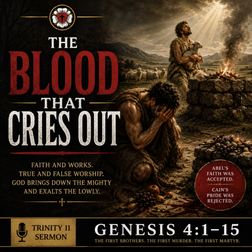
Cain was the firstborn—the son in whom Adam and Eve placed their hopes. Abel was the insignificant one, a mere “breath” or “vapor.” Yet God rejected Cain’s offering and received Abel’s, because Abel offered his sacrifice by faith, clinging not to his own works but to God’s promise. Cain and Abel reveal a division that runs throughout the history of the Church: the false church trusts in its works, its institutions, and its own importance, while the true Church lives by faith in the promise of God. When called to repentance, Cain hardened himself, persecuted his brother, and finally shed his blood. But in murdering Abel, Cain could not defeat him. Abel became the first martyr, and his blood cried out from the ground. In this Trinity 11 sermon on Genesis 4:1–15, we consider Cain and Abel, true and false worship, faith and works, the persecution of the faithful, and the danger of trusting in religious institutions rather than Christ. God is not democratically elected, and truth is not determined by the majority. He brings down the mighty, exalts the lowly, and calls us to cling by faith to Christ and His promise of forgiveness.
When God Comes to Visit — Trinity 10 Sermon (Luke 19:41–48)
Jesus wept over Jerusalem because it did not recognize the time when God came to visit. He warned that enemies would surround the city, its children would perish, and its stones would be thrown down. Less than forty years later, Jerusalem and the Temple were destroyed by the Romans in A.D. 70—events described in horrifying detail by the Jewish historian Josephus. The destruction of Jerusalem stands as a warning against mistaking God’s patience for His approval. Churches may prosper, religious institutions may endure for centuries, and false teachers may feel secure, but none of these things can save us from the judgment of God. We must not cling to institutions, hirelings, our own goodness, or the promises of false prophets. We cling to Christ alone, to His Word, and to His promises. Yet Judgment Day is not a terror for those who belong to Christ. The Jesus who wept over Jerusalem is the same Jesus who went to the cross and died for sinners. This world is not our home. We are strangers and pilgrims waiting for the day when Christ will finally deliver us from sin, death, and every sorrow.
The Unjust Steward — Trinity 9 Sermon (Luke 16:1–9)

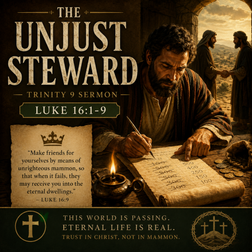
Podcast Title The Unjust Steward — Trinity 9 Sermon (Luke 16:1–9) Why would Jesus commend a dishonest steward? In one of His most surprising parables, Christ is not praising deception but exposing how seriously the unbelieving world pursues temporary security while Christians often treat the promises of eternal life as though they were of little importance. In this Trinity 9 sermon, we explore Jesus' call to live with genuine faith in His Word. The unjust steward recognized that judgment was coming and acted decisively. Christ asks why the children of this world often show greater urgency for passing earthly gain than the children of God show for the eternal kingdom. This sermon confronts the false security of culturally acceptable Christianity, the temptation to excuse cherished sins, and the danger of trusting in wealth, institutions, or human schemes rather than in Christ alone. It also proclaims the sure hope of the Gospel: Jesus has won for us an everlasting inheritance, an eternal Sabbath rest, and communion with God that far surpass every treasure of this passing world. If Christ's promises are true—and they are—then nothing in this life is worth more than hearing His Word, clinging to His Gospel, and trusting Him alone for salvation. "Make friends for yourselves by means of unrighteous mammon, so that when it fails, they may receive you into the eternal dwellings." — Luke 16:9
Beware the Wolves-Trinity 8 Sermon (Matthew 7:15-23)

Jesus warns that the greatest danger to His Church does not come from those who openly reject Him, but from false prophets who come in His name while leading people away from His Word. In this Trinity 8 sermon, we examine Christ's sobering warning to test every teacher by the fruit of his doctrine rather than by popularity, credentials, sincerity, or outward success. Why does Jesus command Christians to judge prophets by their teaching? How have false teachers throughout history disguised human wisdom as biblical truth? And how can Christians remain steadfast when error often appears more respectable than the truth? This sermon calls believers to flee from false doctrine, to search the Scriptures diligently, and to cling to Christ alone as the Good Shepherd whose Word never fails. In a world filled with competing religious voices, our confidence rests not in pastors, denominations, traditions, or experts, but in Jesus Christ and His holy, infallible Word. "Beware of false prophets, who come to you in sheep's clothing but inwardly are ravenous wolves." — Matthew 7:15
A Righteousness Greater Than the Pharisees | Trinity 6 Sermon (Matthew 5:20–26)
Jesus' words are more searching than we often realize: "Unless your righteousness exceeds that of the scribes and Pharisees, you will never enter the kingdom of heaven." What kind of righteousness does God require? In this sermon for Trinity 6, we expose the false righteousness that seeks praise from men while neglecting mercy, reconciliation, and love for one's neighbor. Christ's command against murder reaches beyond outward actions to hatred, contempt, and indifference toward those God has made. No amount of religious activity can replace repentance or excuse an unreconciled heart. The Law leaves every sinner condemned, but the Gospel reveals the only righteousness that surpasses that of the Pharisees—the perfect righteousness of Jesus Christ, freely given to sinners through faith. Those who receive His forgiveness are also renewed to seek reconciliation, love their brothers and sisters, and serve their neighbors in mercy. Scripture: Matthew 5:20–26 Trinity 6 | Law and Gospel | Christ's Righteousness | Repentance | Reconciliation | Mercy | Christian Living
Rogate John 16:23–30 sermon "Ask, and You Will Receive"
IA
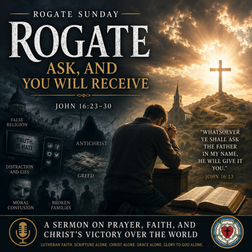
On Rogate Sunday, Christ commands His Church to pray boldly in His Name because the Father Himself loves those who believe in the Son. In this modernized and abridged sermon inspired by Martin Luther’s Rogate preaching, we examine the Lord’s Prayer petition by petition while confronting the false gods and antichrists of the modern age. This sermon addresses the collapse of truth in church and society, prosperity religion, political idolatry, technological utopianism, moral confusion, and the spiritual warfare surrounding Christian families and children. At the same time, it proclaims the comfort of Christ for weary consciences burdened by sin, suffering, financial hardship, temptation, and fear. What does it mean to pray “Hallowed Be Thy Name” in an age that mocks God’s Word? What does “Thy Kingdom Come” mean when the world seeks salvation through politics and power? Why does Christ teach us to pray daily for bread, forgiveness, protection from temptation, and deliverance from evil? This sermon calls Christians away from despair and back to repentance, faith, Word, Sacrament, and prayer — not as empty ritual, but as holy warfare against the devil, the world, and the flesh. “Ask, and ye shall receive, that your joy may be full.” — John 16:24
Easter 4 Cantate John 16:5-15
IA
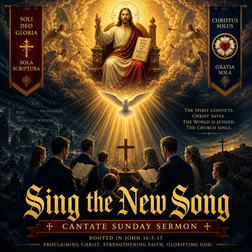
On Cantate Sunday, Martin Luther’s timeless proclamation is freshly abridged and powerfully updated for today’s faithful remnant. In this episode, discover how Christ’s ascension, the coming of the Holy Spirit, and the Spirit’s work of convicting the world still speak directly to modern Christians surrounded by confusion, falsehood, suffering, and spiritual weariness. Rooted in John 16:5–15, this sermon explores the Spirit’s ongoing mission: exposing sin, revealing true righteousness in Christ alone, and announcing the judgment of the defeated ruler of this world. Luther’s evangelical clarity is preserved while contemporary application addresses the struggles of family life, cultural decay, false religion, and the believer’s call to joyful perseverance. This is a proclamation for those seeking: Historic Lutheran theology faithfully applied today Strength amid personal and family trials Confidence in Christ over against worldly fear Encouragement for small, faithful home churches A renewed call to “sing unto the Lord a new song” Join us as the ancient Gospel is proclaimed with boldness for our present age. Scripture: John 16:5–15 Theme: The Holy Spirit glorifies Christ by convicting the world and sustaining His Church.
1 di 16