The Kronos Fusion Energy Podcast

The Kronos Fusion Energy Podcast

di Priyanca Ford
Stagione 1
The Magnets That Make Fusion Possible — Superconductors, Quench & the ITER Story Dr. Joseph Minervini
Dr. Joseph Minervini of the MIT Plasma Science and Fusion Center joins Priyanca Ford for a masterclass in the technology at the heart of magnetic confinement fusion. They cover why high-temperature superconductors like REBCO changed the game, the twin challenges of quench protection and structural stress, why tokamaks are inherently pulsed, and hard-won lessons from decades on ITER and the world’s largest superconducting magnet systems.
Tritium, Timelines & the Workforce Gap — The Realities of Commercial Fusion Dr. Nitendra Singh
Dr. Nitendra Singh, a nuclear engineer focused on advanced fuel cycles and fusion policy, joins Priyanca Ford for a clear-eyed look at what stands between today’s experiments and commercial fusion. They dig into the real complexity of tritium breeding and neutron economics, why levelized-cost comparisons are so slippery this early, the honest engineering timelines that regulators and power grids actually allow, and why building a skilled global workforce may be the field’s most underrated challenge.
Fifty Years & the Next Generation — Confinement, Collaboration & Fusion’s Workforce Dr. Guido Van Oost
Dr. Guido Van Oost of Ghent University joins Priyanca Ford for a half-century view of magnetic confinement fusion. They discuss the power of international collaboration, why training the next generation of fusion engineers may be the field’s most important gap, the role of irradiation facilities like MYRRHA in qualifying materials, and where realistic commercialization timelines actually land.
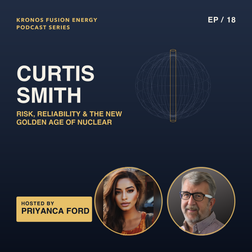
Designing for Safety — Risk, Reliability & the New Golden Age of Nuclear - Dr. Curtis Smith
Dr. Curtis Smith of MIT, a leading authority on probabilistic risk assessment, joins Priyanca Ford to explore why many now call this a golden age of nuclear energy. They discuss what fusion can learn from decades of fission safety engineering, why regulators are treating fusion systems more like particle accelerators, and how advanced modeling, AI, and heat-storage technology could reshape clean-energy systems.
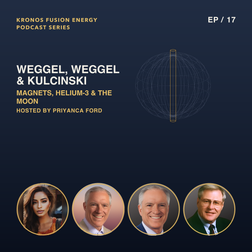
Magnets, Helium-3 & the Moon Dr. Bob Weggel, Dr. Carl Weggel & Dr. Gerald Kulcinski
Three pioneers of fusion science and engineering join Priyanca Ford: magnet designers Dr. Bob Weggel and Dr. Carl Weggel, whose work at MIT’s Francis Bitter Magnet Laboratory pushed the limits of high-field magnets, and Dr. Gerald Kulcinski, a founding voice of advanced low-neutron fusion fuels and the helium-3 fuel cycle. Together they trace the history of high-field magnet development, the promise of lunar helium-3, and why direct energy conversion could reshape how fusion makes power.
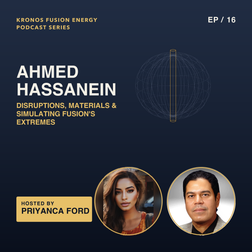
Plasma Meets the Wall — Disruptions, Materials & Simulating Fusion’s Extremes Dr. Ahmed Hassanein
Dr. Ahmed Hassanein of Purdue University joins Priyanca Ford to discuss the “showstopper” problem of transient plasma events — disruptions, runaway electrons, and the intense heat that reaches a reactor’s walls. He describes the world-leading simulation package his group built to model that damage, and how the same plasma physics reaches into everything from EUV chip lithography to cancer-cell treatment.
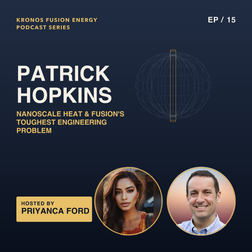
The Physics of Heat — Nanoscale Thermal Transport & Fusion’s Toughest Engineering Problem Dr. Patrick Hopkins
Dr. Patrick Hopkins of the University of Virginia joins Priyanca Ford to explain how energy really moves through materials — one electron, phonon, and photon at a time. From the heat crisis that once threatened Moore’s law to cooling technology in the vacuum of space, he connects the science of nanoscale heat transfer to one of fusion’s hardest engineering challenges: managing enormous heat loads inside a reactor.
From Tokamaks to Stellarators — 50 Years of Fusion & the Physics of Confinement - Dr. Donald Spong
Dr. Donald Spong of Oak Ridge National Laboratory joins Priyanca Ford for a sweeping look at magnetic confinement fusion — from the early tokamak era and the birth of ITER to the modern renaissance in optimized stellarators. He shares how the Simons-funded Hidden Symmetries project transformed stellarator design, why burning-plasma physics remains the field’s final frontier, and how AI and reduced models are accelerating reactor design.
Materials at the Edge — Radiation, Reactor Walls & Why Fusion Changes the Game - Dr. Gary Was
Dr. Gary Was, one of the world’s foremost authorities on radiation effects and nuclear materials, joins Priyanca Ford to discuss how structural materials survive extreme radiation, heat, and particle flux inside reactors. Drawing on four decades at the University of Michigan and its Ion Beam Laboratory, he explains how ion-irradiation techniques stand in for reactor neutrons, why small modular reactors are reshaping fission economics, and why lowering neutron production makes the materials challenge far more tractable for fusion.
Three-Dimensional Plasmas & Direct Energy Conversion - Dr. Wilfred Cooper
Description Dr. Wilfred Cooper, a pioneer of MHD stability and three-dimensional plasma modeling, joins Priyanca Ford to trace a career spanning tokamaks, stellarators, and the Terpsichor stability code he helped create at Oak Ridge and EPFL. They explore how long-lived, three-dimensional plasma structures could drive energetic particles out of the plasma for direct energy conversion — and how fusion moved from decades of government-led research into today’s wave of private innovation. Hashtags: #FusionEnergy #KronosFusionEnergy #NuclearFusion #CleanEnergy #FusionPower #PlasmaPhysics #Stellarator #Tokamak #DirectEnergyConversion #MHD #FusionResearch
1 di 3