The World's Mayor Experience by Joshua T Berglan

The World's Mayor Experience by Joshua T Berglan

di Joshua T Berglan 'The World's Mayor'
Stagione 8
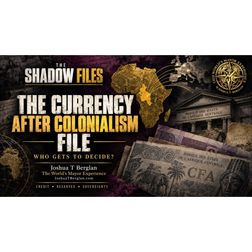
The CFA Franc in Cameroon: The Currency After Colonialism File
What does the CFA franc give Cameroon—and what does it cost? I spend this currency every day, and a question about the cash in my pocket became an investigation into monetary power, political independence, and the choices shaping everyday life. In The Currency After Colonialism File, I examine the Central African CFA franc, BEAC, CEMAC, France’s role, foreign reserves, and the euro peg. The investigation revisits the 1994 devaluation, distinguishes Central Africa’s arrangements from West Africa’s, and follows the debate into access to credit, offshore extractive-industry funds, and economist Joseph Tchundjang Pouemi’s critique. What would greater monetary sovereignty make possible—and what institutions would Cameroon need for it to succeed? I’m Joshua T Berglan, reporting from Cameroon. This is The Shadow Files, part of The World’s Mayor Experience: asking difficult questions, examining competing claims, and following the evidence. Explore the series: https://www.joshuatberglan.com/the-shadow-files-by-joshua-t-berglan More from Joshua T Berglan: https://www.JoshuaTBerglan.com
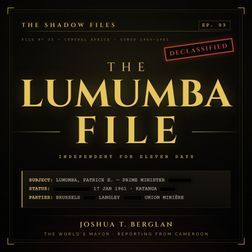
The Lumumba File: Did the CIA Really Kill Patrice Lumumba?

There was a CIA plot to kill Patrice Lumumba. There was an assassination of Patrice Lumumba. Those are two different facts — and confusing them makes the story weaker, because the documented history is extraordinary enough on its own. In Episode 3 of The Shadow Files, Joshua T. Berglan — The World's Mayor, reporting from Cameroon — opens the Lumumba File and applies one standard: What do we know? What does the evidence suggest? What do we still not know? And who are we asking for answers? Inside this episode: Congo independent for eleven days before Katanga — its mineral heart — broke away Shinkolobwe, the Manhattan Project, and why the atomic age has an African address Belgium's own parliamentary inquiry, and the phrase "definitive elimination" The July 1960 American assessment that could not substantiate Lumumba was a Communist The documented CIA assassination operation — biological material, transported, never used Mobutu, the coup, the capture, and the transfer to Katanga Alive on arrival, dead within five hours — and the bodies dissolved in acid MI6, Daphne Park, and three words: "We did. I organised it." March 2026: Étienne Davignon ordered to trial. May 2026: Davignon dies. No verdict. Foreign interference does not erase African agency. African agency does not erase foreign interference. The truth has room for both. Propaganda usually doesn't. Next episode: The Nkrumah File. Follow the work: The World's Mayor Experience: https://joshuatberglan.com The World's Mayor: https://theworldsmayor.com IMDb: https://www.imdb.com/name/nm9137796/ Follow the document. Follow the resource. Follow the ownership. Follow the money. Follow the power. And wherever the evidence goes, we go. The Lumumba File is open.
The Shadow Files #2 - One Airport Seizure Was Bigger Than Cameroon’s Entire Gold Exports
In November 2023, authorities intercepted approximately 30.5 kilograms of gold at Yaoundé-Nsimalen International Airport. Cameroon’s officially recorded gold exports for the entire year? 22.3 kilograms. One documented airport seizure was larger than the country’s entire officially recorded annual export total. That does not prove how much gold successfully leaves the country illegally. But it raises an extraordinary question: How much gets caught—and how much doesn’t? This investigation follows Cameroon’s gold through mining regions, informal markets, SONAMINES, Customs, airports, borders and global trading hubs. No predetermined villains. No outrage for clicks. Just four questions: What do we know? What does the evidence suggest? What do we still not know? Who are we asking for answers? The full Shadow Files investigation hub: https://www.joshuatberglan.com/the-shadow-files-by-joshua-t-berglan #Cameroon #GoldSmuggling #TheShadowFiles #InvestigativeJournalism #Africa #GoldMining
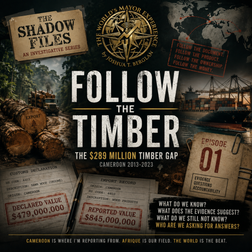
The Shadow Files #01: The $289 Million Timber Discrepancy
$289 million per year. That is the average unexplained gap between timber export values declared by Cameroon and import values reported by global trade partners between 2013 and 2023. In this premiere episode of The Shadow Files, Joshua T. Berglan unpacks official trade data from the Financial Transparency Coalition (Financial Secrets of the Forests). We examine how a peak single-year discrepancy of $327M in 2023, coupled with tax hikes jumping from 17.5% to 75%, has heavily incentivized product misclassification and supply chain opacity across trade routes to China, Vietnam, the EU, and the UK. Timestamps: 00:00 – $289M/Year Missing: The Scale of the Discrepancy 03:10 – Peak Gaps: Inside the 2023 $327M Trade Divergence 06:05 – Tariffs & Tactics: 75% Tax Rates and Misclassification 09:20 – Beneficial Ownership & Public Registry Gaps 12:00 – Methodology: Investigative Framework 14:10 – Next Episode: The 15-Tonne Gold Discrepancy Sources & Secure Contact: Data Sources: Financial Transparency Coalition (May 2026), ANIF Cameroon. Whistleblowers: Submit confidential files safely. Avoid work devices/networks. Contact: joshua@joshuatberglan.com Official Resources & Links: 🎙️ The Broadcast Hub: Stream live broadcasts and podcast archives at The Broadcast Hub by Joshua T. Berglan ✉️ Newsletter: Subscribe for deep-dive analysis at The World's Mayor Newsletter 🏛️ Sovereign Architecture: Build purpose-driven systems at Sovereign Architecture 📚 Bookshelf: Explore published works and readings at The World's Mayor Experience Bookshelf
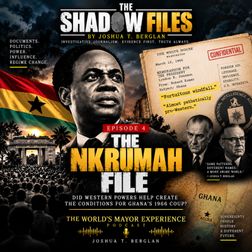
The Nkrumah File: Did Western Powers Help Create the Conditions for Ghana’s 1966 Coup?
You’ve heard the clips. Now hear the complete investigation. In Episode 4 of The Shadow Files, Joshua T. Berglan follows the documentary trail surrounding Kwame Nkrumah, Ghana’s 1966 coup, and the role Western governments played in the political, economic, and informational pressure surrounding his removal. The investigation begins in February 1964—two years before the coup—with a U.S. State Department proposal discussing an “Action Program for Ghana,” “psychological warfare,” and pressure that could contribute to Nkrumah’s downfall. From there, the documents reveal American awareness of coup plotting, economic pressure intended to further weaken Nkrumah, the extraordinary statement that “the plotters are keeping us briefed,” British covert propaganda, intelligence reporting immediately before the coup, and Washington’s description of Nkrumah’s overthrow sixteen days later as a “fortuitous windfall.” But The Shadow Files does not stop where the evidence becomes inconvenient. Nkrumah was a transformational Pan-African leader who also became increasingly authoritarian. Ghana faced genuine economic problems. Domestic political opposition existed. Military and police grievances were real. And Ghanaian officers ultimately carried out the coup. So did the CIA overthrow Kwame Nkrumah? The released documentary record does not allow Joshua to state that as established fact. What it does establish is extensive Western hostility, pressure, covert influence, knowledge of coup plotting, and strategic satisfaction after Nkrumah was gone. The result is not a simple story about one villain. It is an investigation into what happens when domestic weakness meets foreign pressure, economic vulnerability becomes leverage, and information becomes a weapon. And it raises one final question: Was Nkrumah simply paranoid about neo-colonialism—or did he identify forms of external power that government archives would later partly reveal? The Shadow Files — Episode 4: The Nkrumah File Hosted by Joshua T. Berglan The World’s Mayor Experience Explore The Shadow Files: https://www.joshuatberglan.com/the-shadow-files-by-joshua-t-berglan The investigation continues next with Episode 5: The Currency After Colonialism File, examining the CFA franc from Cameroon.
Stagione 7
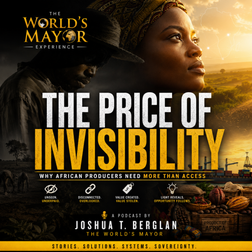
The Price of Invisibility: Why African Producers Remain Underpaid
A farmer can help supply a billion-dollar industry and still return home unable to feed his own family. That is not only a pricing problem. It is the price of invisibility. Across Africa, farmers, cooperatives, founders, artisans, and entire communities create extraordinary value. Yet many remain invisible to the buyers, financiers, policymakers, investors, and consumers who determine how that value is recognized and rewarded. In this episode of The World’s Mayor Experience, Joshua T. Berglan explores what invisibility costs a farmer, a cooperative, a village, a nation, and an entire continent. The episode examines how undocumented work weakens negotiating power, limits financing, separates producers from customers, and allows others to control the story, the relationship, and the price. It also explores the role of faith, preparation, stewardship, media, and ownership in transforming invisible producers into known, trusted, documented, and bankable participants in the global economy. Visibility is not about fame. For the farmer, visibility can mean negotiation. For the cooperative, it can mean financing. For the village, it can mean opportunity. For the producer, it can mean ownership. A hidden season may be part of the process, but it was never meant to become a permanent identity. African producers need more than access. They need evidence, identity, trusted systems, direct relationships, ownership, and the power to participate in defining their own value.
Finding Your Voice: Cameroon’s Sovereign Creators Speak
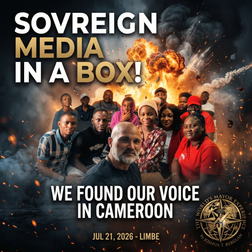
What happens when people stop waiting to feel ready and finally begin using their voices? Recorded live in Limbe, Cameroon, during the final day of a six-day Media Company in a Box workshop, this special episode of The World’s Mayor Experience places the microphone in the hands of the participants. Joshua T. Berglan invites the emerging creators to speak about what they discovered within themselves, the missions they feel called to pursue, and what they want the world to understand about Cameroon. The conversation explores mental health advocacy, childhood trauma, hospitality, entrepreneurship, health education, tourism, faith, culture, personal transformation, and the importance of owning your story. Several participants entered the workshop uncertain about their ability to create content or build independent platforms. By the final day, they had begun developing websites, clarifying their messages, recognizing their multiple gifts, and finding the courage to speak publicly. This is more than a workshop recap. It is a real-time demonstration of what can happen when ordinary people are given the architecture, encouragement, and tools to build stages of their own. The world needs to know Cameroon—and these creators are preparing to tell its stories.
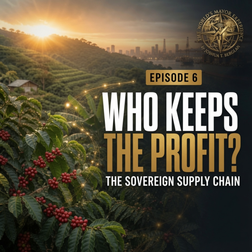
The Sovereign Supply Chain: Own the Story, the Sale, and the Future | Episode 6
A community can finally own its story and still be robbed of its value. A farmer can finally be seen and remain underpaid. An artisan can create something extraordinary while somebody else controls the market, sets the price, and owns the customer. In this episode of The World’s Mayor Experience, Joshua T. Berglan broadcasts from Limbe, Cameroon, and examines the dangerous global trap of production without power. Joshua introduces The Sovereign Supply Chain—a complete system connecting story, product, market, media, documentation, trust, and revenue. He explores how communities can preserve the origin of their products, build direct relationships with buyers, document both success and failure, and transform visibility into genuine economic participation. This episode speaks directly to farmers, cooperatives, women’s groups, young innovators, artisans, buyers, and investors seeking a more transparent and equitable global economy. A community should not simply tell the world who it is. It should be able to build a future from what it produces. Own the story. Own the sale. Own the relationship. Own the future. Learn more at https://joshuatberglan.com.
The Highway and the Voice: Why African Trade Needs Media to Move
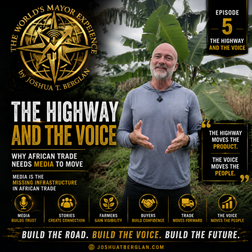
Roads can move products. Ports can move shipments. Trucks can move harvests. But only trust can move people. In Episode Five of The World’s Mayor Experience, Joshua T. Berglan speaks from Limbe, Cameroon about one of the most overlooked pieces of African trade infrastructure: media. Trade platforms need roads, financing, logistics, documentation, technology, and market access. But if farmers do not understand the platform, buyers cannot see the proof, investors do not trust the system, and communities never hear the story, adoption will remain slow. Media creates trust. Media provides education. Media documents the process. Media gives farmers visibility. Media gives buyers confidence. Media gives investors proof. Media turns transactions into relationships. This episode also explores a powerful new idea: farmers can build virtual worlds around their work in the same way musicians build digital ecosystems around their talent. A farm can become more than a place of production. It can become a platform. A farmer can use websites, podcasts, videos, virtual farm tours, product catalogs, QR codes, WhatsApp communities, digital marketplaces, harvest updates, and transparent storytelling to build trust and strengthen the value of what they produce. The farmer does not need to become a celebrity. The farmer needs to become visible. Joshua also speaks directly to young African creators, showing how skills in video, design, websites, social media, podcasting, e-commerce, and storytelling can become part of the future of agriculture. You do not have to leave agriculture to work in the future. You can bring the future into agriculture. The highway moves the product. The voice moves the people. Africa needs both. The World’s Mayor Experience is Joshua T. Berglan’s lived and digital platform, documenting the people, ideas, communities, and systems helping build a stronger future for Cameroon, Afrique, and the world. Learn more at joshuatberglan.com
The 19-Year-Old Sovereign Creator: Maxtyper's Phone-Made Pop Empire - A teenage pop artist from Cameroon proves you don't need a label — just a phone and the refusal to quit.
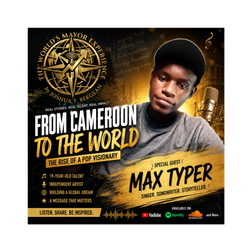
Every once in a while a hidden gem stops you in your tracks. Maxtyper (OJONG Loic) is a 19-year-old singer-songwriter from Cameroon making pop music in a country where everyone told him only Afrobeats matters — and he's doing it with nothing but a smartphone, BandLab, SoundCloud, and TikTok. In this episode, Joshua T. Berglan broadcasts live from Limbe, Cameroon and sits down with one of the most undeniable young voices on the continent. They talk about the song "Save Me" (written in one sitting after a breakup), what it costs to create art nobody around you understands, and why building your own platform beats the social media echo chamber every single time. Maxtyper is the definition of a sovereign creator. No record label. No backing. Just a phone, a gift, and the refusal to stop dreaming. In this episode: • The moment Maxtyper knew he had a gift • Why he chose pop in an Afrobeats nation • How he taught himself to produce on BandLab from YouTube tutorials • The real challenge facing independent artists in Cameroon • Why your own platform finds your true audience • The story behind "Save Me" Listen to Maxtyper: SoundCloud — https://on.soundcloud.com/C8WiZrNKvfLexq9mC4 BandLab — @maxtyper TikTok — @singmax123 Build your own sovereign media platform and get the book Media Company in a Box at joshuatberglan.com. The World's Mayor Experience — where talent doesn't need the world's permission to exist.
1 di 17