Growing Elder

Growing Elder

di Oceana Sawyer
Stagione 1
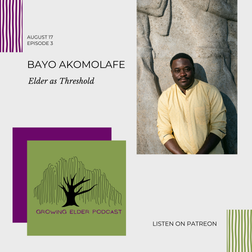
Elder as Threshold
In this episode we depart from elder as a physical being and look at the energy of elder can do in a world that is collapsing. BIO Bayo Akomolafe is the descendant of Yoruba fields of archetypal becomings and mythopoeic landscapes. He is an author, celebrated speaker, teacher, and self-styled trans-public intellectual (a concept imagined together with and inspired by the shamanic priesthood of the Yoruba healer-trickster)- whose vocation goes beyond justice and speaking truth to power to opening up other spaces of power-with, and queering fond formulations and configurations of hope. The convener of the concepts of ‘postactivism’, ‘transraciality’ and ‘ontofugitivity’, Dr. Bayo Akomolafe is a widely celebrated international speaker, teacher, public intellectual, essayist and author of two books, These Wilds Beyond our Fences: Letters to My Daughter on Humanity’s Search for Home (North Atlantic Books), and Selah: A Báyò Akómoláfé Reader Bayo considers his most sacred work to be learning how to be with his daughter and son, Alethea Aanya and Kyah Jayden – and their mother, his wife and “life-nectar”, Ijeoma. “To learn the importance of insignificance” is the way he frames a desire to reacquaint himself with a world that is irretrievably entangled, preposterously alive and completely partial. As Visionary Founder and Elder of The Emergence Network and Chief Host of the widely popular online-offline course/festival series, We Will Dance with Mountains, Bayo curates an earth-wide project for the re-calibration of our ability to respond to civilizational crisis – a project framed within a material feminist/posthumanist/postactivist ethos and inspired by Yoruba indigenous cosmologies. He considers this a shared art – exploring the edges of the intelligible, dancing with posthumanist ideas, dabbling in the mysteries of quantum mechanics and the liberating sermon of an ecofeminism text, and talking with others about how to host a festival of radical silence on a street in London – and part of his inner struggle to regain a sense of rootedness to his community. Bayo Akomolafe is a recipient of the 2021 New Thought Walden Award, meant to honor those who use empowering spiritual ideas and philosophies to change lives and make our planet a better place. Bayo has given up his longing for the “end-time” and is learning to live in the “meantime”...in the middle, where we must live with confusion and make do with partial answers. His greatest vocation is however learning to be a satellite orbiting his greatest gift, his goddess Ijeoma, and knowing the blessings of her gravity - as well as co-researching into magic and the utter unspeakability of the world in its ongoingness along with his children. He speaks and teaches about his experiences around the world, and then returns to his adopted home in Chennai, India – “where the occasional whiff of cow dung dancing in the air is another invitation to explore the vitality of a world that is never still and always surprising.” Come to the Elder by Bayo Akomolafe
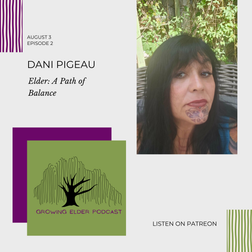
Elder: A Path of Balance
Welcome to episode 2 with my friend and indigenous culture keeper, Dani. I didn't really begin thinking out loud about eldership until Dani approached me 3 years ago to be on her podcast, which was part of a research project. There are very few cultures to which we have access in the global north that still have a robust role for elders. Dani belongs to one of them and her perspective is steeped in culture which is a gift to all of us. Danielle (Dani) Pigeau is a Stólō woman whose traditional name is Seesamya (Bumblebee). She was later gifted the feast name Humhotsi, meaning Beehive, by her adopted Kitlope Kemano family through Momma Bear Wilson, with the support of Johnny Wilson. Her names reflect a lifelong commitment to community, relationship, and service. Dani's journey began in the arts as a professional makeup artist with the Vancouver Playhouse Theatre Company. During her years in theatre, she found more than a career—she found an artistic family who nurtured her spirit through storytelling, paint, music, and creativity. Those early experiences shaped her understanding that art has the power to heal, teach, and connect people. She later returned to the ancient rainforest of the Kitlope, close to where she had grown up in Terrace b.c. There she was embraced by the Wilson family, who became her cultural teachers and family. Through their guidance, Dani immersed herself in Indigenous ways of knowing, learning traditional songs, dances, plant knowledge, ceremony, and cultural responsibilities. These teachings became the foundation of her life's work. As her knowledge deepened, Dani was honoured to share these teachings with others. She taught through Haisla Rediscovery camps and worked alongside Indigenous youth and adults, helping people reconnect with their own cultural identities, histories, and traditions. Her work has always been guided by the belief that cultural knowledge is a pathway to wellness, belonging, and responsibility. Inspired to continue serving young people, Dani entered the Professional Development Program in Elementary Education at Simon Fraser University. After graduating in 2005, she began teaching with Coast Mountains School District 82 on a series of contracts before receiving a permanent teaching position in 2010. Throughout her career as an educator, she brought Indigenous perspectives, relationship-based learning, creativity, and cultural understanding into the classroom, believing that every child deserves to be seen, valued, and supported. In 2020, after years of experiencing discrimination in her workplace, Dani filed a human rights complaint with the British Columbia Human Rights Tribunal. Her case has now been ongoing for more than six years. While the process has been long and challenging, she has remained committed to advocating not only for herself but also for broader understanding of Indigenous cultural rights, accessibility, and fairness within public institutions. She continues to self-represent in pursuit of both accountability and meaningful change. Today, Dani is on leave from teaching while supporting her son Estin and her mother through cancer treatment in the beautiful Cowichan Valley, the traditional territory of the Cowichan Peoples. During this time, she continues to contribute to projects that promote wellness, cultural understanding, reconciliation, and shared responsibility. Whether through art, education, ceremony, or advocacy, Dani's life's work has always centred on helping people reconnect—with themselves, with one another, and with the responsibilities we all carry toward community and the land. She considers it a privilege to be part of initiatives that foster healing, understanding, and a more compassionate future.
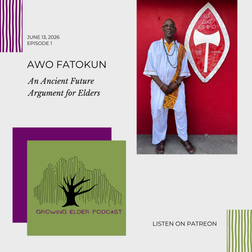
An Ancient Future Argument for Elders - Part I
We kick off the podcast with a deep dive into eldership with Awo Fatokun (also known as Bill Calhoun). This is a two-part episode. In the first part he unpacks the historical basis of the current state of these Times from an Afro-Indigenous perspective. In part two, he discuss the role of elder for in the current context. Note: it is such an honor that Awo Fatokun has continued to call me Iya since our intensive time together during an intimate gathering of people in African descended bodies hosted by the GTDF. It means "mother' in Yoruba as in the Earth or elder. It is a name I humbly try to live into. There is some Yoruba terms used in this episode that you may not be familiar. I suggest that you open a digital translator like this one to make your way through the episode as desired. It is, however, fairly easy to discern meaning in the context that he paints so well. Awo Fatokun Bio: Bill Calhoun’s journey through life reads like an epic woven with threads of courage, curiosity, and connection. From walking alongside the Black Panthers to studying in a Franciscan seminary, from the courtroom as a human rights lawyer to the grassroots as an educator, Bill embodies the art of bridging worlds. With over three decades spent coordinating transformative study abroad programs, Bill has guided students—many from the Global North’s most elite institutions—into profound encounters with Indigenous, peasant, and favela communities in Brazil. Long before “decolonization” became an academic buzzword, Bill was cultivating learning spaces that challenged the assumptions of modernity and coloniality, placing relational accountability and community wisdom at the heart of education. Carrying the ceremonial name Awo Fatokun as an Elder of the Yoruba Ifa tradition, Bill integrates deep spiritual insight with his lived experience. To him, the Orisa are not distant deities but relational forces of wisdom and responsibility, calling humanity to cultivate self-love and entanglement with all life. In his work with the Gesturing Towards Decolonial Futures (GTDF) collective, Bill navigates the spaces between—between modernity’s collapse and the emergence of new paradigms, between ego-driven individualism and a renewed ethic of collective care, between humans and the more-than-human world. Bill is not only a knowledge keeper but also a weaver of futures. Whether mentoring students, co-authoring groundbreaking decolonial curricula, or cultivating dialogues between Indigenous and academic communities, his work invites others to step into the complexity of entanglement. His current focus is on practices of "introspective study within" and “depth education,” centering the consciousness of the land and the Orisa to explore pathways for coexistence in a world that has forgotten its interdependence. Bill’s unique background, which spans law, spiritual traditions, and global education, has prepared him to tackle the urgent questions of our time: How do we dismantle the illusion of separability? How do we unlearn the violence of modernity? And how do we cultivate relational ethics in the face of permanent crises? With Bill as a guide, the GTDF collective engages these challenges with humility, creativity, and a fierce commitment to healing the web of life. Show Notes: Awo Fatokun will be leading an experience of Ifa in Brazil next year. You can find out the details here. https://cla.umn.edu/aaas/undergraduate/learning-abroad
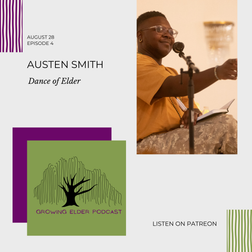
Dance of Elder - Austen Smith
In this episode, Austen picks up a bit from where Bayo leaves off and goes in a slightly different direction from a Millenial perspective. BIO Austen Smith (they/them) is a storyteller, land-listener, and researcher based in the Deep South. In 2023, they founded Our Lunar Intelligence, which provides support for cultural preservation and organizational development in reproductive health, language access, environmental and housing justice, and ImaginationDoulas, a creative and spiritual community that explores daydreaming, ritual, and ancestral reverence as alternatives to imagination. Photo courtesy of Comfrey Films.
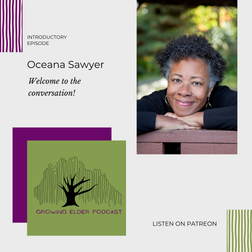
Welcome to the Coversation
Bonus
Hello and welcome to the conversation. In this introductory episode, I give a bit of the backstory about how I arrived in this inquiry and what it means to me. Show Notes: "Come of Age" by Stephen Jenkinson "Eldership Blown Open" inspired by Bayo Akomolafe "Some Thoughts on Eldering Inspired by Leny Strobel"
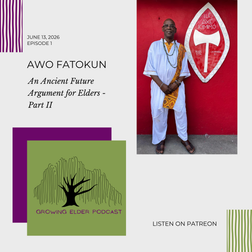
An Ancient Future Argument for Elders - Part II
In part two of the conversation with Awo Fatokun, he breaks down the role and the qualities that are required of elders in these times. There is also an invitation at the end for an immersive Candomblé experience in the town where he resides in Brazil. The link is in the show notes. Show Notes: University of Minnesota Brazilian Study Abroad https://cla.umn.edu/aaas/undergraduate/learning-abroad Further reading: Gesturing Toward Decolonial Futures Collective (GTDF) https://decolonialfutures.net/author/metarelationaltech/ https://decolonialfutures.net/portfolio/towards-eldering/