Gender Budget Talks

Gender Budget Talks

di Gender Budget Watchdog Network
Stagione 1
Intersectionality and Justice in Combating Gender-Based Crimes
Moderated by Alexandru Gribincea (Keystone Moldova), this episode features Valeria Babără, legal adviser with the international NGO Women’s Initiatives for Gender Justice, and Andriana Zaslaveț, Representative of the Platform for Gender Equality and Project Coordinator at the Rehabilitation Center for Torture Victims “Memoria”. Together, they explore how gender-based crimes are defined and addressed through an intersectional lens, discuss common misconceptions about legal frameworks, and examine the psychological, social, and economic impact on victims. Drawing on their frontline experience, the speakers highlight the role of education, institutions, and civil society in prevention, protection, and rehabilitation, offering concrete strategies to strengthen justice and support for survivors.
GRB impact by the Gender Budget Watchdog Network’s Members
In this episode, moderator Slavica Strikovic (Women Action) speaks with Milan Stefanovic (Protecta) and Bojana Naimarević (ImpAct) about their organizations’ journeys within the Gender Budget Watchdog Network. They share how they became involved in GBWN, highlight concrete initiatives supported through the network, and reflect on how gender-responsive budgeting and regional collaboration have strengthened their impact. The conversation explores lessons learned, policy influence, and the tangible changes achieved in communities, offering practical insights for civil society organizations working to advance gender equality through public finance.
GRB transforming cities
In our latest episode, Marija Risteska, GBWN regional director chats with Blai Martí Plademunt from Barcelona, the Director of the City’s Gender Equality Department, who reveals the city’s journey in integrating gender budgeting and its impacts, like shifting sports funding towards more inclusive initiatives. Also, joining us is Ivana Angelova from Slovenia, a Senior Advisor at the Center of Excellence in Finance, who explores how greening human capital can drive environmental and social change in the Western Balkans, focusing on holistic skill development. Tune in to discover how strategic budgeting and a shift in perspective can make a real difference.
Engendering municipal policy making and budgeting
In this episode of our podcasts, Natasha Dokovska engages with Drita Mehmedi, from the Network of Women in Science, and Marija Kamcheva, a coordinator for equal opportunities from the Municipality of Kavadarci, to explore the impact and challenges of gender-responsive budgeting (GRB). Drita and Marija share their positive experiences and insights from their work on integrating gender perspectives into local governance and municipal programs. They discuss the importance of collaboration between civil society and municipal administrations, the role of municipal councils in supporting GRB, and the need for increased budget support and training. Listen in for practical recommendations on encouraging local governments to adopt gender-responsive policies and strategies to enhance gender equality in budgeting.
Communicating gender responsive budgeting
In this episode of the Gender Budget Watchdog Network podcast, Kristian Lika from GDAC explores the complexities of communicating gender-responsive budgeting (GRB) with expert guests Ludmila Malcoci, Executive Director of Keystone Moldova, and Natasha Dokovska, Founder of Journalists for Human Rights. The discussion delves into the challenges media face in reporting on GRB and the importance of building media capacity to effectively convey these issues. Ludmila and Natasha share insights on the need for specialized training for journalists, the integration of GRB into academic curricula, and strategies for enhancing public understanding. Tune in to discover how improved media engagement and education can foster a more equitable society through informed budgeting practices. The overall objective of our network is to improve public commitments for gender responsive climate action and increase available financing to implement gender-responsive climate action in the Western Balkan region and Republic of Moldova. The podcast was produced with the financial support of the Austrian Development Agency and the Swedish International Development Cooperation Agency. Its contents are the sole responsibility of the implementing partners and do not necessarily reflect the views of the Austrian Development Agency or the Swedish International Development Cooperation Agency.
Waste management through gender lenses
This podcast talks about a very interesting topic ‘Waste Management Through Gender Lenses’ offering opinion from two men guests, Boran Ivanovski from NALAS and Emil Angelov from Salar, hosted Biljana Matevska from Center for Research and Policy Making. In this episode of the Gender Budget Watchdog Network podcast, Biljana Matevska from CRPM hosts Boran Ivanovski and Emil Angelov for a discussion on "Waste Management Through Female Lenses." They explore how gender perspectives impact waste management, from household waste generation to disposal. Boran, an expert in local waste management, and Emil, a specialist in sustainable development, share insights on how both men and women interact differently with waste systems. They discuss the importance of integrating gender considerations into waste management practices and highlight successful approaches to making waste systems more inclusive and effective. Tune in to learn how understanding these gender differences can lead to better waste management solutions and more equitable outcomes.
Gender Responsive Budgeting - Care
Moderator: Mersiha Jaskic, CPCD, Bosnia and Herzegovina Guest speakers: Liz Hind and Samah Krichah, Women’s Buget Group, UK This episode is discovering how to the research on unpaid care work and what is needed for unleashing women’s economic potential that will demand changes in how care work is valued and distributed within households and workplaces and shared between men and women. What we need for the future to change the unpaid care work in our countries is a burning question for many of us. Understanding the needs of half of the population, the women, is crucial for our economies to function in alignment with needs of both women and men and the social roles we share.
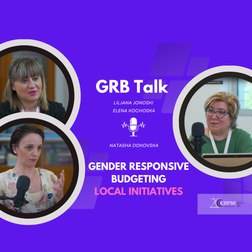
Gender Responsive Budgeting - Local Initiatives
Moderator: Natasa Dokovska, Journalists for Human rights, Macedonia Guest speakers: Liljana Janoski, Rural Coalition and Elena Kochoska, Consultant -Expert for disability and CRPD, Macedonia
Geder Responsive Budgeting in Academia
Moderator: Ivana Petrisková, CRPM, Macedonia Guest speakers: Ana Marija Sikirić Simčić, Faculty of Economics and Business, University of Rijeka, Croatia and Gloria Alarcón-García, University of Murcia, Spain In this episode we discuss how can we apply gender budgeting in academic and scientific institutions and how can GRB help to improve the gender gap between some of the study fields. Further we touch upon the topics of the academic research findings on how GRB can contribute to our understanding and application of GRB in real-world contexts and also why academia needs to collaborate with policymakers and practitioners to ensure that the insights and recommendations from GRB research are implemented in government budgets and policies.
Gender Responsive Budgeting - Current Trends
Moderator: Marija Risteska, CRPM, Macedonia Angela O'Hagan, Professor of Equality and Public Policy at Glasgow Caledonian University, Scotland, UK The discussion on the trends in the GRB includes the growing number of CSOs who focus on budgetary processes and integration of gender analysis in those. This trend requires the capacity building of the civil society and at the same time building the bridge between CSOs and governments. Data about people’s needs are crucial for the CSOs to be able to advocate for their cause in front of the stakeholders and policymakers. You will learn in this episode why it is not enough to have international methods of tracking of how we are progressing with gender equality, why we need to build the capacity of the institutions that are safeguarding the scrutiny and integrity.
1 di 2