For Isley My Love
di CiVL News
CiVL News: Apr 26, 2026, 4:04 PM PDT -- Salmon Seasons, Dead Whales, and a Textbook That's Wrong
Here's your latest episode from the For Isley My Love CiVL News Roundup produced by CiVL.com. This episode details new salmon fishing regulations designed to protect killer whales and reports on a surge in gray whale deaths in San Francisco Bay. It also covers a groundbreaking study challenging a century-old bacterial classification method. • The Pacific Fishery Management Council adopted 2026 West Coast salmon fishing recommendations.• Oregon's recreational salmon season opened March 15 and runs through August 31.• A mark-selective coho fishery runs June 6 to August 23, with a 47,600 fish quota.• A Chinook abundance threshold of 623,000 fish aims to protect Southern Resident killer whales.• Eight gray whales have died in the San Francisco Bay Area this season.• A dead gray whale near Alcatraz Island could not be recovered for necropsy.• Vessel strikes are the leading suspected cause of gray whale deaths.• California expanded its Blue Whales Blue Skies program to reduce vessel strikes.• The SAVE WILLY Act proposes a Whale Desk at the US Coast Guard to prevent collisions.• A new study found bacteria that defy the traditional Gram stain classification.• Bacillaceae strains, expected to stain purple, stained pink despite lacking an outer membrane.• Misidentifying pink-staining Bacillaceae could lead to inappropriate antibiotic therapy. Join CiVL and be part of building the future you want to live in. Be an early adopter. We're just getting started. Human respect, a core tenet of CiVL's vision, recognizes that the path to a flourishing civilization does not lie in more efficient forms of coercion, but in the widespread adoption of human respect as a primary value. By moving away from the "Conflict Machine" and toward a culture of voluntary cooperation, we align ourselves with the natural requirements for human well-being. We built CiVL News out of our passion for free and open access to information. Follow the topics you care about, and don't be subjected to algos! You're invited to build a hub with us for ideas that upgrade civilizations.
CiVL News: Apr 24, 2026, 4:04 PM PDT -- Gray Whales Starving, Neurobots Think, and Prairie Secrets
Here's your latest episode from the For Isley My Love CiVL News Roundup produced by CiVL.com. This episode explores record gray whale strandings, the creation of self-assembling neurobots, and new insights into biodiversity's role in ecosystem stability. • 12 gray whales beached in Washington by April 17, 2026, the highest early-season total ever.• Necropsies confirmed malnutrition as a primary factor in the gray whale deaths.• The eastern North Pacific gray whale population fell from 27,000 in 2019 to 13,000 in 2023.• Scientists at Tufts and Wyss Institute created "neurobots" from frog cells that self-assemble nervous systems.• These neurobots exhibited more complex movement and different responses to stimuli than non-neural biobots.• The neurobots survived 9-10 days on stored yolk nutrients without external feeding.• A 40-year study on tallgrass prairies revealed biodiversity's varied impact on ecosystem stability.• Greater species richness enhanced resistance to extreme drought in prairie ecosystems.• Dominance by a few abundant species improved resistance to extreme wet events.• Fertilization significantly altered biodiversity-stability relationships in the prairie study. Join CiVL and be part of building the future you want to live in. Be an early adopter. We're just getting started. Human respect, a core tenet of CiVL's vision, recognizes that the path to a flourishing civilization does not lie in more efficient forms of coercion, but in the widespread adoption of human respect as a primary value. By moving away from the "Conflict Machine" and toward a culture of voluntary cooperation, we align ourselves with the natural requirements for human well-being. We built CiVL News out of our passion for free and open access to information. Follow the topics you care about, and don't be subjected to algos! You're invited to build a hub with us for ideas that upgrade civilizations.
CiVL News: Apr 22, 2026, 4:05 PM PDT -- Whale Watchers Log 50,000 Sightings, Sperm Whales Speak in Vowels
Here's your latest episode from the For Isley My Love CiVL News Roundup produced by CiVL.com. This episode delves into new scientific findings across marine life, linguistics, and plant science, including a detailed report on Salish Sea whale observations and a study on sperm whale communication. • The Pacific Whale Watch Association reported 50,323 documented observations and 1,429 protective actions in the Salish Sea in 2025.• Bigg's killer whales were seen on 342 days, humpbacks on 314, and endangered Southern Residents on only 93 days.• Crews removed 472 pieces of marine debris, including 224 balloons, and reported 44 injured animals.• A study analyzed 3,948 sperm whale codas, identifying a-codas and i-codas with distinct phonetic properties.• The research found coarticulation in sperm whale calls, a feature also present in human speech.• Five properties in sperm whale vocalizations parallel human phonology, suggesting independent evolution.• Researchers published global maps of specific leaf area, leaf nitrogen, and leaf phosphorus at 1-kilometer resolution.• Machine learning models were trained using remote sensing and biodiversity records from GBIF, TRY, and sPlotOpen. Join CiVL and be part of building the future you want to live in. Be an early adopter. We're just getting started. Human respect, a core tenet of CiVL's vision, recognizes that the path to a flourishing civilization does not lie in more efficient forms of coercion, but in the widespread adoption of human respect as a primary value. By moving away from the "Conflict Machine" and toward a culture of voluntary cooperation, we align ourselves with the natural requirements for human well-being. We built CiVL News out of our passion for free and open access to information. Follow the topics you care about, and don't be subjected to algos! You're invited to build a hub with us for ideas that upgrade civilizations.
CiVL News: Apr 19, 2026, 4:04 PM PDT -- Deep Trenches, Right Whale Babies, and Warblers Out of Sync
Here's your latest episode from the For Isley My Love CiVL News Roundup produced by CiVL.com. This episode explores newly discovered deep-sea ecosystems, a record-breaking North Atlantic right whale calving season, and the impact of climate change on warbler migration. • Chinese scientists mapped the deepest methane-fueled animal communities in the Kuril-Kamchatka and western Aleutian Trenches.• Ecosystems were found at depths up to 9,533 meters, fueled by chemosynthesis from hydrogen-sulfide-rich fluids.• Dominant organisms include frenulate siboglinid polychaetes and bivalves like Abyssogena phaseoliformis.• NOAA Fisheries confirmed 23 North Atlantic right whale calves, the highest count since 2009.• The species' total population is 380, with 70 reproductively active females.• Four-year-old Division died from entanglement in fishing gear, highlighting ongoing threats.• Amelia Island Whale Ambassadors held a community baby shower to celebrate the new calves.• North American moths and butterflies advanced egg-laying by 14 days due to rising temperatures.• Cerulean warblers shifted spring arrival by only 4 days, causing a mismatch with peak caterpillar abundance.• This mismatch impacts cerulean warbler chicks, who need caterpillars for food.• Cerulean warblers are endangered in Indiana, where they breed for three months annually.• Climate change is causing range shifts and impacting breeding success for many warbler species. Join CiVL and be part of building the future you want to live in. Be an early adopter. We're just getting started. Human respect, a core tenet of CiVL's vision, recognizes that the path to a flourishing civilization does not lie in more efficient forms of coercion, but in the widespread adoption of human respect as a primary value. By moving away from the "Conflict Machine" and toward a culture of voluntary cooperation, we align ourselves with the natural requirements for human well-being. We built CiVL News out of our passion for free and open access to information. Follow the topics you care about, and don't be subjected to algos! You're invited to build a hub with us for ideas that upgrade civilizations.
CiVL News: Apr 17, 2026, 4:04 PM PDT -- Air Cushions, Ancient Ash, and a Bacterial Puppet Master
Here's your latest episode from the For Isley My Love CiVL News Roundup produced by CiVL.com. This episode covers a dramatic whale rescue attempt in Germany, new research on ancient volcanic eruptions' impact on whale evolution, and a study on how bacteria control spider mite reproduction. • Rescue crews attempted to save Timmy, a humpback whale stranded in the Baltic Sea since March 3rd.• The rescue involved air cushions to lift the 12-15 meter whale onto a tarp for towing to deeper water.• Environment Minister Till Backhaus approved the high-risk plan after conventional methods failed.• A study links 6-9 million-year-old volcanic eruptions in the Andes to whale evolution and mass extinctions.• Ash from the Altiplano-Puna Volcanic Complex fueled diatom blooms, transforming the Southern Ocean ecosystem.• These blooms supported larger whales and caused mass mortality events, evidenced by fossil bonebeds.• The diatom blooms also reduced atmospheric CO2 by 10-15 ppm, contributing to global cooling.• Researchers in China studied Wolbachia bacteria's control over spider mite reproduction via microRNAs.• Inhibiting microRNAs novel-33 and novel-40 reduced both host fecundity and Wolbachia density.• Inhibiting novel-65 reduced fecundity without altering Wolbachia density, showing distinct control pathways.• This research provides molecular targets for using Wolbachia in agricultural pest management. Join CiVL and be part of building the future you want to live in. Be an early adopter. We're just getting started. Human respect, a core tenet of CiVL's vision, recognizes that the path to a flourishing civilization does not lie in more efficient forms of coercion, but in the widespread adoption of human respect as a primary value. By moving away from the "Conflict Machine" and toward a culture of voluntary cooperation, we align ourselves with the natural requirements for human well-being. We built CiVL News out of our passion for free and open access to information. Follow the topics you care about, and don't be subjected to algos! You're invited to build a hub with us for ideas that upgrade civilizations.
CiVL News: Apr 17, 2026, 6:04 AM PDT -- Sperm Whales Speak in Vowels, Whales Die on the East Coast
Here's your latest episode from the For Isley My Love CiVL News Roundup produced by CiVL.com. This episode explores groundbreaking research into sperm whale communication and ongoing challenges for marine mammal conservation. It also covers a new AI platform for antibody design. • Sperm whales off Dominica produce vowel-like patterns in codas, acoustically paralleling human vowels. • Project CETI and UC Berkeley linguists identified a-codas and i-codas in 3,948 codas from 15 whales. • The study in Proceedings of the Royal Society B suggests sperm whale codas are a close parallel to human phonology. • NOAA Fisheries documented 263 humpback whale mortalities in an ongoing Unusual Mortality Event since 2016. • 45% of 129 necropsied whales showed human interaction, primarily vessel strikes and fishing gear entanglement. • A 2024 study in Conservation Biology links increased humpback mortalities to ocean warming and altered prey distribution. • NOAA Fisheries states no scientific evidence links offshore wind surveys to whale deaths. • NMFS corrected incidental take estimates for Gulf of Mexico geophysical surveys, reducing blackfish harassment takes. • The corrected rule projects a mean of 26 annual Level B harassment takes for Rice's whales. • Amazon Web Services launched Amazon Bio Discovery, an AI platform for antibody drug discovery. • The platform provides no-code access to over 40 biological AI models and connects to wet-lab validation. • Memorial Sloan Kettering Cancer Center researchers used the platform to design nearly 300,000 antibody candidates. Join CiVL and be part of building the future you want to live in. Be an early adopter. We're just getting started. Human respect, a core tenet of CiVL's vision, recognizes that the path to a flourishing civilization does not lie in more efficient forms of coercion, but in the widespread adoption of human respect as a primary value. By moving away from the "Conflict Machine" and toward a culture of voluntary cooperation, we align ourselves with the natural requirements for human well-being. We built CiVL News out of our passion for free and open access to information. Follow the topics you care about, and don't be subjected to algos! You're invited to build a hub with us for ideas that upgrade civilizations.
CiVL News: Apr 16, 2026, 4:04 PM PDT -- Gray Whales Dying, Ancient DNA Rewrites Evolution, Galápagos Secrets
Here's your latest episode from the For Isley My Love CiVL News Roundup produced by CiVL.com. This episode covers a gray whale stranding in Oregon, a new Harvard study on human evolution, and the genome sequencing of a critically endangered Galápagos dwarf tree. • A 40-foot male gray whale washed ashore dead on Seaside Beach, Oregon, on April 14, 2026.• This is the third known dead gray whale on the Oregon coast recently, with over a dozen in Oregon and Washington.• Food shortages linked to melting Arctic sea ice and population decline are cited as causes for whale deaths.• Harvard Medical School published a study in Nature on April 15, 2026, examining 15,836 ancient DNA samples.• The study identified 479 genetic variants showing directional natural selection over the past 10,000 years.• Natural selection increased after farming began, driving adaptations in immunity, skin pigmentation, and metabolism.• Researchers at the Norwegian University of Science and Technology sequenced the genome of Scalesia atractyloides.• Scalesia atractyloides is a critically endangered dwarf tree endemic to the Galápagos Islands.• The genome assembly is 3.2 gigabase-pairs and contains 43,093 candidate gene models.• Genomic analysis identified positive selection in genes linked to vascular development, growth, and salinity adaptation.• The ancestor of all 15 Scalesia species was traced to a single colonizer, an allotetraploid.• The study provides evidence for plant island syndrome in Darwin's giant daisies. Join CiVL and be part of building the future you want to live in. Be an early adopter. We're just getting started. Human respect, a core tenet of CiVL's vision, recognizes that the path to a flourishing civilization does not lie in more efficient forms of coercion, but in the widespread adoption of human respect as a primary value. By moving away from the "Conflict Machine" and toward a culture of voluntary cooperation, we align ourselves with the natural requirements for human well-being. We built CiVL News out of our passion for free and open access to information. Follow the topics you care about, and don't be subjected to algos! You're invited to build a hub with us for ideas that upgrade civilizations.
CiVL News: Apr 15, 2026, 6:05 AM PDT -- Old Thom Returns, AI Builds Protein Switches, and DNA Rides the Air
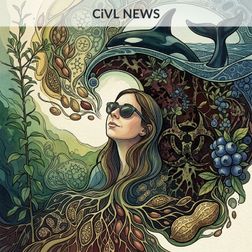
Here's your latest episode from the For Isley My Love CiVL News Roundup produced by CiVL.com. This episode explores advanced scientific discoveries, from AI-driven protein engineering and environmental DNA detection to autonomous AI experimentation. It also features a rare killer whale sighting off Massachusetts. • Old Thom, a 30-foot killer whale, was filmed off Massachusetts on April 13, 2026.• Old Thom has been sighted annually in the New England area since the mid-2000s.• Researchers at Queensland University of Technology used AI to build 47 protein sensors.• AI-designed proteins detected cortisol with 0.9 micromolar affinity and 17-OHP with 17 nanomolar affinity.• Professor Kirill Alexandrov stated AI greatly expands protein engineering capabilities.• University of Florida researchers identified species DNA from airborne samples.• Samples from Florida and Dublin identified spiders, alligators, mosquitoes, rats, and 25 mammal/bird species.• One Dublin sample contained 63 viruses; cowpox virus was found in Florida seawater.• OpenAI and Ginkgo Bioworks announced an AI system autonomously ran 36,000 biological experiments. Join CiVL and be part of building the future you want to live in. Be an early adopter. We're just getting started. Human respect, a core tenet of CiVL's vision, recognizes that the path to a flourishing civilization does not lie in more efficient forms of coercion, but in the widespread adoption of human respect as a primary value. By moving away from the "Conflict Machine" and toward a culture of voluntary cooperation, we align ourselves with the natural requirements for human well-being. We built CiVL News out of our passion for free and open access to information. Follow the topics you care about, and don't be subjected to algos! You're invited to build a hub with us for ideas that upgrade civilizations.
CiVL News: Apr 12, 2026, 6:04 AM PDT -- Seeds Against Extinction, Orcas in Puget Sound, and a Peanut Cancer Study
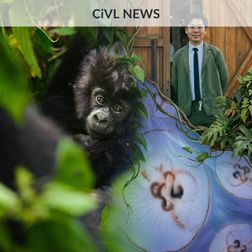
Here's your latest episode from the For Isley My Love CiVL News Roundup produced by CiVL.com. This episode explores conservation efforts in Wales, orca sightings in Puget Sound, and a new approach to treating bile duct cancer. We delve into seed banking, marine mammal movements, and promising cancer research. • Wales' National Seed Bank stores 5 million seeds from 160 native plant species. • Curator Kevin McGinn notes 60 plant species are unique to Wales, with one-sixth facing extinction. • Seeds from the bank helped restore Shore Dock after a landslide in Southerndown. • The bank collects wild relatives of crops, important for future food security. • Orca Network reported three Bigg's transient orcas (possibly T-060 family) in Puget Sound on April 11, 2026. • These orcas, originating from Alaska, were observed moving southward, following prey into Case Inlet. • Boaters must maintain 400 yards from orcas and not block their path. • Researchers from Thailand published a study on a peanut extract and gemcitabine for bile duct cancer. • The extract (PCE) combined with gemcitabine induced apoptosis in KKU-100 cancer cells. • Mouse xenograft experiments showed PCE-gemcitabine inhibited tumor growth more effectively than either alone. • The interaction was antagonistic in KKU-213A cells, indicating cell-line dependent results. Join CiVL and be part of building the future you want to live in. Be an early adopter. We're just getting started. Human respect, a core tenet of CiVL's vision, recognizes that the path to a flourishing civilization does not lie in more efficient forms of coercion, but in the widespread adoption of human respect as a primary value. By moving away from the "Conflict Machine" and toward a culture of voluntary cooperation, we align ourselves with the natural requirements for human well-being. We built CiVL News out of our passion for free and open access to information. Follow the topics you care about, and don't be subjected to algos! You're invited to build a hub with us for ideas that upgrade civilizations.
CiVL News: Apr 11, 2026, 6:05 AM PDT -- Orcas Head South, Whales Die, and Turing Gets His Proof

Here's your latest episode from the For Isley My Love CiVL News Roundup produced by CiVL.com. This episode explores unusual whale movements, significant conservation milestones, and new scientific discoveries. It covers Alaskan killer whales in the Pacific Northwest, a record gray whale mortality in Washington, and a 17-year high in North Atlantic right whale births. • Three Alaskan Bigg's killer whales (T190A) traveled 1,500-2,000 miles to the Salish Sea. • Washington state recorded its seventh gray whale death of the year, the highest early-season total. • The gray whale population has declined since 2019, linked to reduced prey in the Arctic. • The Swinomish Indian Tribal Community held a ceremony for the deceased gray whale. • Twenty-three North Atlantic right whale calves were born, the most in 17 years. • Calves face entanglement risks from lobster and crab fishing gear. • Paleontologists named a new lungfish species, Sinoceratodus fortunus, from Early Jurassic deposits in China. • NOAA Fisheries identified a new deep-sea barracudina fish species, Stemonosudis dianea. Join CiVL and be part of building the future you want to live in. Be an early adopter. We're just getting started. Human respect, a core tenet of CiVL's vision, recognizes that the path to a flourishing civilization does not lie in more efficient forms of coercion, but in the widespread adoption of human respect as a primary value. By moving away from the "Conflict Machine" and toward a culture of voluntary cooperation, we align ourselves with the natural requirements for human well-being. We built CiVL News out of our passion for free and open access to information. Follow the topics you care about, and don't be subjected to algos! You're invited to build a hub with us for ideas that upgrade civilizations.