Faith Speaks, Love Gives Podcast

Faith Speaks, Love Gives Podcast

di Marlo Barge
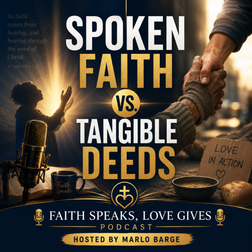
Spoken Faith Versus Tangible Deeds: When Faith Becomes Action
In this episode of the Faith Speaks, Love Gives Podcast, host Marlo Barge explores the difference between simply talking about faith and living it out through practical action. Prayer, Scripture, and words of encouragement are powerful, but biblical faith should also become visible through compassion, generosity, service, and obedience. Many people are silently facing job loss, financial hardship, grief, illness, loneliness, family struggles, and uncertainty. They need our prayers, but sometimes God may also be calling us to become part of the answer. Sometimes faith says, “I’m praying for you.” Other times, faith says: “I brought you something to eat.” “I found a job opportunity for you.” “I gave you a ride.” “I helped you complete the application.” “I came to sit with you.” “I used what God placed in my hands to help.” We are not saved by good works. Salvation is a gift of grace through faith in Jesus Christ. However, genuine faith produces fruit. Our actions do not earn salvation, but they demonstrate that our faith is alive and changing how we live. In This Episode: • The difference between spoken faith and active faith • Why prayer should lead to obedience when we are able to help • How faith, grace, and good works fit together • Why real love may require sacrifice and inconvenience • How small acts of kindness can become answers to prayer • Why our private actions should match our public declarations of faith Key Scriptures: James 2:15–17 1 John 3:18 Ephesians 2:8–10 Matthew 5:16 This Week’s Challenge: Ask one person: “How can I support you right now?” Then listen and take one practical step to help. Send the message. Share the resource. Make the introduction. Prepare the meal. Offer transportation. Visit the person. Pray with them—and continue supporting them after the prayer is over. Faith speaks. Love gives. When faith and love work together, people do not simply hear about the goodness of God—they experience it. Faith Speaks, Love Gives Podcast Hosted by Marlo Barge Helping everyday believers live out real faith, real love, and real obedience in today’s world.
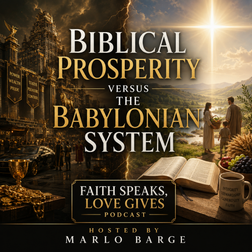
Biblical Prosperity Versus the Babylonian System
What does it truly mean to prosper according to the Bible? In this episode of the Faith Speaks, Love Gives Podcast, Marlo Barge examines the difference between biblical prosperity and the worldly system of wealth, status, power, and self-glorification represented by Babylon. God is not against His people building businesses, earning income, owning property, creating opportunities, or leaving an inheritance. The danger begins when money becomes our master, success becomes our identity, and people become tools for personal advancement. Biblical prosperity is much greater than material wealth. It includes peace, wisdom, strong character, healthy relationships, spiritual maturity, responsible stewardship, and the ability to serve others with what God has placed in our hands. The Babylonian system says: Build your own name. Trust in wealth and influence. Measure your worth by possessions and status. Compromise your values to get ahead. Use people to accomplish your ambitions. Accumulate without accountability. Glorify yourself instead of God. Biblical prosperity says: Seek God’s Kingdom first. Work with integrity and diligence. Treat people fairly. Manage resources responsibly. Remain generous and content. Remember that God is the source. Use increase to bless your family, community, and the work of the Kingdom. Money itself is not evil. Scripture warns us about the love of money and the pride that can develop when we begin believing our success came entirely through our own strength. God may bless the work of our hands, but He also cares about the condition of our hearts, the methods we use, and the way we treat people along the journey. In this episode, we discuss: The biblical meaning of prosperity. Why prosperity should not be reduced to money. How Babylon represents a corrupt spiritual and economic system. The difference between ownership and stewardship. Why God examines how wealth is created and used. The danger of building success through exploitation. How contentment protects us from greed. Why integrity must grow alongside influence. How believers can build without bowing to Babylon. This episode challenges us to ask: Am I building to glorify God or to prove my importance? Would I compromise my values for a larger opportunity? Have I connected my identity to money, titles, possessions, or recognition? Am I treating people with dignity as I pursue my goals? Am I managing what God has already given me responsibly? God does not simply want to give us more. He wants to make us trustworthy. He wants our character to carry our calling, our integrity to support our influence, and our generosity to grow alongside our resources. Build. Work. Create. Plan. Invest. Grow. But do it with clean hands, a surrendered heart, and the understanding that everything ultimately belongs to God. Scriptures Referenced Genesis 11:1–9 Deuteronomy 8:18 Proverbs 10:22 Matthew 6:24, 33 1 Timothy 6:6–10 James 5:1–6 Revelation 18. Listen, reflect, and share this episode with someone seeking to build a prosperous life without sacrificing faith, integrity, or purpose. Faith Speaks, Love Gives Podcast Hosted by Marlo Barge Helping everyday believers live out real faith, real love, and real obedience in today’s world.
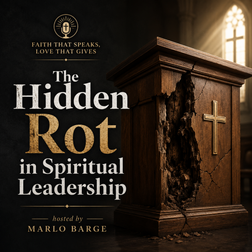
The Hidden Rot in Spiritual Leadership
A spiritual leader can look strong, sound faithful and maintain a polished public image while privately becoming hollow. Like a freshly painted support beam hiding rotted wood, visible success cannot compensate for hidden character decay. Eventually, pressure reveals what appearance has concealed. This episode examines an important question: Does honestly acknowledging an internal struggle weaken spiritual authority, or does performing perfection create the greater danger? Jesus taught that “out of the abundance of the heart the mouth speaks” (Matthew 12:34). Our words often reveal what has been developing inside us. Anger, pride, exhaustion, resentment, dishonesty and hopelessness do not disappear simply because a leader knows how to speak spiritually in public. However, honesty does not mean broadcasting every private wound to the people we are called to serve. Mature leadership requires bounded honesty. Some struggles belong first in the private workshop of accountability—with God, a trusted mentor, counselor, pastor, spouse or mature friend who can pray, confront, guide and help rebuild the damaged structure. There is a difference between genuine vulnerability and emotional dumping. Leaders should not make their followers responsible for carrying the weight of their healing. Private accountability should often come before public disclosure. This protects the congregation, family, team or community while also preventing leaders from hiding behind the words, “I’m good.” The episode also distinguishes honest lament from hopeless speech. Honest lament says, “I am hurting, but I am still turning toward God.” Hopeless speech declares that healing is impossible and spreads despair. Faith does not deny pain; it brings pain into the light without surrendering hope. Real repentance is demonstrated through responsibility. A sincere apology does not say, “I’m sorry you felt hurt,” or demand that the wounded person understand the pressure the leader was under. It says: “What I did was wrong.” “I hurt you.” “I take responsibility.” “I am sorry.” Explanation must never replace ownership. First John 3:18 reminds us to love “in deed and in truth.” Sometimes love looks like practical help. Sometimes it looks like correction. Sometimes it requires a necessary boundary. Healthy boundaries are not the opposite of love; they can protect people from manipulation, dependency, burnout and misplaced responsibility. The true measure of spiritual leadership is not a title, platform, following or public performance. It is private integrity, truthful speech, responsible repentance, disciplined accountability and a life that consistently points people back to Jesus Christ. Questions for Reflection Where might polished language be covering hidden decay? Who has permission to challenge you privately? Are your apologies taking responsibility or protecting your image? Does your honesty produce healing and hope—or place your burden on others? What needs to be repaired privately before you return to the platform? Faith must speak truth. Love must act responsibly. And leadership must be strong enough to confront what is hidden before pressure exposes it. Read the companion LinkedIn article: The Hidden Rot in Spiritual Leadership: The Foundation We Must Fix https://www.linkedin.com/pulse/hidden-rot-spiritual-leadership-foundation-fix-africa-qhjuc Faith That Speaks, Love That Gives Podcast Hosted by Marlo Barge
Community Accountability vs. Healthy Spiritual Solitude
Faith Speaks Love Gives Podcast Hosted by Marlo Barge Every believer needs time alone with God. Quiet prayer, reflection, Scripture, and rest can renew the mind and strengthen the spirit. Jesus Himself stepped away from the crowds to pray. But healthy spiritual solitude is not the same as unhealthy isolation. Healthy solitude says, “I need time with God so I can hear clearly, heal, and return stronger.” Isolation says, “I do not need anyone. Nobody understands me. I can handle everything by myself.” One brings clarity and renewal. The other can lead to secrecy, discouragement, pride, bitterness, and spiritual vulnerability. In this episode, Marlo Barge explores why believers need both personal time with God and trustworthy spiritual community. God speaks through prayer and Scripture, but He also uses pastors, mentors, friends, family members, and fellow believers to encourage us, correct us, and help us see what we may be missing. Healthy accountability is not control, manipulation, public embarrassment, forced vulnerability, or spiritual intimidation. It is built on trust, prayer, truth, humility, confidentiality, and genuine concern. A trustworthy accountability partner may ask: How are you really doing? Are your current choices moving you closer to Christ? Are you staying faithful to what God called you to do? Are you avoiding something that needs to be addressed? Do you need prayer, encouragement, correction, or support? Community becomes unhealthy when people use spiritual authority to dominate others. Solitude becomes unhealthy when it is used to avoid responsibility, correction, difficult conversations, or meaningful relationships. The answer is not choosing community over solitude—or solitude over community. The answer is learning how to practice both in a healthy, Christ-centered way. Spend time alone with God, but do not disappear from everyone who genuinely loves you. Protect your peace, but do not build walls so high that nobody can reach you. Use discernment, but do not let past hurt convince you that every Christian relationship will fail. Key Scriptures Luke 5:16 Hebrews 10:24–25 Ecclesiastes 4:9–10 Galatians 6:1–2 Proverbs 27:17 Reflection Question Are you practicing healthy spiritual solitude, or have you slowly become isolated? Healthy solitude strengthens your relationship with God. Healthy accountability strengthens your walk with God. We need both.
Accountability Is for Healing, Not Punishment
🎙️ New Episode: Accountability Is for Healing, Not Punishment In this episode of the Faith Speaks Love Gives Podcast, hosted by Marlo Barge, we talk about a truth many believers need to hear: godly accountability is not designed to shame you, punish you, control you, or make you feel small. It is designed to help you heal, grow, mature, and stay faithful to Christ. Many people avoid accountability because they have seen it misused. They have experienced correction without compassion, leadership without love, or discipline without grace. But real biblical accountability does not destroy people. It restores them. It helps us come out of isolation, walk in truth, face what needs to be healed, and become stronger in our faith. Accountability is not about someone standing over you. It is about someone walking with you. It is not about exposing you for embarrassment. It is about helping you become whole. When accountability is rooted in love, prayer, humility, and Scripture, it becomes a tool for healing, not punishment. This episode is for anyone who has ever been hurt by correction, misunderstood accountability, or felt afraid to let people close enough to help them grow. Godly accountability does not cancel your calling. It helps protect it. 📖 To build a strong foundation in this message, you can also purchase the first book in the series here: https://www.amazon.com/dp/B0H22NNWP6 Stay encouraged. Keep growing. Keep healing. And remember: you were not created to walk alone. #FaithSpeaksLoveGives #MarloBarge #ChristianPodcast #FaithThatSpeaksLoveThatGives #Accountability #HealingNotPunishment #ChristianGrowth #BiblicalCommunity #SpiritualGrowth #FaithAndLove
Character Forged in the Hidden Workshop
Faith Speaks, Love Gives Podcast Hosted by Marlo Barge Some of the most important work God performs in our lives happens where nobody else can see it. In this episode, “Character Forged in the Hidden Workshop,” we explore the quiet seasons of preparation—the private struggles, repeated lessons, delayed answers, and everyday acts of obedience that shape who we are becoming. The hidden workshop may feel lonely, uncomfortable, or unproductive, but it is not wasted time. It is often the place where faith becomes stronger, motives become purer, and character develops the strength necessary to carry the responsibility connected to our calling. Before there is public recognition, there is usually private preparation. Before God expands our influence, He often works on our integrity, patience, humility, discipline, and ability to remain faithful without applause. In This Episode You will be encouraged to understand that: Hidden seasons are seasons of preparation, not punishment. Character is developed through consistent choices when nobody is watching. Pressure can reveal the areas God is still strengthening. Delays do not mean God has forgotten you. Private faithfulness prepares you for public responsibility. Your identity must be rooted in God rather than recognition, titles, or approval. The process is preparing you to carry what you have been praying for. God is not only concerned about where you are going. He is also concerned about who you will become when you arrive. Do not rush through the hidden workshop. Allow God to strengthen your foundation, correct what needs correction, heal what needs healing, and prepare your heart for the next season. Reflection Questions What is God developing in you during this season? Are you remaining faithful even when your work is not being noticed? What habits, attitudes, or distractions must you release so your character can grow? The hidden work matters. The private decisions matter. The process matters. You are not being overlooked. You are being prepared. Continue the Journey Discover more faith-centered encouragement in the book: Faith That Speaks, Love That Gives Available on Amazon: https://www.amazon.com/dp/B0H4897G4S Listen, reflect, and share this episode with someone who may be walking through a hidden season. Remember: what God develops privately will eventually become visible through the life you live publicly. #FaithSpeaksLoveGives #ChristianPodcast #FaithJourney #CharacterDevelopment #SpiritualGrowth #TrustTheProcess #GodsTiming #Purpose #PrivatePreparation #Faithfulness
Stop Building Your Identity on Sand
Stop Building Your Identity on Sand What happens when the things you have allowed to define you suddenly begin to shift? Titles can change. Money can come and go. Relationships can rise and fall. People’s opinions can change overnight. Success can fade, and painful seasons can challenge everything you thought you knew about yourself. In this meaningful episode of the Faith Speaks, Love Gives Podcast, Marlo Barge shares an important reminder: if your identity is built on temporary things, life will always feel unstable when storms come. Jesus taught that the wise person builds their house on the rock. The storms still came, the winds still blew, and the rain still fell — but the house stood because it had the right foundation. That same truth applies to our lives. If your identity is built on appearance, approval, status, career, relationships, finances, or even past pain, then your sense of self can crumble when those things are shaken. But when your identity is rooted in God, His truth, and His purpose, you can remain steady even in difficult times. This episode is a heartfelt encouragement to stop building on sand and start building on the solid foundation of God’s Word. In This Episode, You’ll Be Encouraged To: Examine what has been shaping your identity Let go of false labels and unstable foundations Stop depending on outside validation for your worth Understand how storms reveal what your life is built upon Rebuild your confidence on God’s truth, love, and purpose Strengthen your walk with faith that remains firm under pressure You are not just your past. You are not just your struggles. You are not what people said about you. You are who God says you are. Featured Scripture Matthew 7:24–27 Continue the Journey Faith That Speaks, Love That Gives Amazon Book Link: https://www.amazon.com/dp/B0H4897G4S Podcast Faith Speaks, Love Gives Podcast Hosted by Marlo Barge May this episode encourage you to build your life on what lasts, trust God more deeply, and remember that a strong foundation in Christ will carry you through every storm.
Can Your Words Steer Your Faith?
This episode, “Can Your Words Steer Your Faith?”, is a reminder that the words we speak can influence the direction of our thoughts, decisions, relationships, and spiritual walk. Just as a small rudder can steer a large ship, our words can help guide our lives toward faith—or pull us toward fear, doubt, and discouragement. This message is dedicated to everyone who is learning to speak life in the middle of difficult circumstances. You may not always be able to control what happens around you, but you can become more intentional about what you allow to come out of your mouth. Ask yourself: Are my words strengthening my faith or feeding my fear? Am I speaking healing, hope, truth, and love—or repeating the pain and negativity surrounding me? Let your words agree with God’s promises. Speak with wisdom. Speak with compassion. Speak with faith. Your voice has the power to encourage someone, restore hope, and help steer your own heart in a better direction. Thank you for listening to the Faith Speaks, Love Gives Podcast. May this episode inspire you to use your words to build, heal, encourage, and give life. “Death and life are in the power of the tongue.” — Proverbs 18:21
Faith Speech: Is It a Life Raft—or an Anchor Pulling You Down?
Faith Speaks, Love Gives Podcast Hosted by Marlo Barge Your words can become a life raft that keeps you spiritually afloat—or an anchor that pulls you deeper into fear, discouragement, and defeat. In this episode, Marlo Barge explores the power of faith-filled speech during life’s most difficult moments. Faith does not require us to ignore pain, deny reality, or pretend that serious problems do not exist. True faith allows us to acknowledge the facts without allowing those facts to become the final word over our lives. The question is not only, “What are you going through?” The deeper question is, “What are you saying while you are going through it?” The words we repeatedly speak can strengthen our endurance—or reinforce fear and hopelessness. We may not control the storm around us, but we can control the language we use while standing in it. In this episode: • The difference between honesty and hopeless speech • Why faith-filled words are not the same as denial • How negative declarations can deepen discouragement • Why temporary seasons should not receive permanent labels • How speech can affect our attitude, decisions, and endurance • Guarding what we say about ourselves and others • How to acknowledge pain while remaining connected to hope • Why faith must be practiced before the pressure arrives • How our words can support us spiritually during hardship Scripture Focus Proverbs 18:21 teaches that death and life are in the power of the tongue. James 3 reminds us that something as small as the tongue can influence the direction of an entire life. Mark 11:23 shows the relationship between belief, faith, and what we speak. These Scriptures do not teach us to ignore reality. They teach us to bring our words into agreement with faith, truth, wisdom, and love. You can describe the storm without declaring that it will destroy you. You can admit that you are hurting without saying that you will never heal. You can acknowledge that you are struggling without declaring that your life is over. Faith-filled speech may sound like: “This is difficult, but God is still with me.” “I do not understand everything, but I have not lost hope.” “I may be hurting today, but I will continue taking the next faithful step.” “The facts are real, but they do not have the authority to become my final identity.” Your words should not become another weight attached to your life. They should keep your heart connected to hope, truth, God’s promises, and the strength to keep moving. Reflection Questions What negative statement have you repeatedly made about yourself or your future? Are your words helping you move forward or keeping you emotionally trapped? Can you speak honestly about your circumstances without surrendering hope? What truth from God’s Word needs to replace the language of fear? What faith-filled sentence can you begin speaking today? Closing Prayer Father, help me become intentional about the words I speak. Teach me to be honest without becoming hopeless, realistic without becoming faithless, and truthful without allowing fear to control my language. When life becomes heavy, let my words keep me connected to Your promises, wisdom, and presence. Give me the discipline to speak life, encouragement, truth, and love over myself and others. In Jesus’ name, amen. Final Takeaway Your speech may not change your circumstances immediately, but it can change how you stand within them. Do not let your words become an anchor that pulls you beneath the pressure. Let faith-filled speech become a life raft—keeping you connected to hope until you reach the other side.
Steer Your Life with Faith-Filled Honesty
Faith does not require you to pretend that everything is fine. Real faith gives you the courage to face the truth about your life while continuing to believe that God can guide, correct, heal, and restore you. In this episode, Marlo Barge explores the importance of faith-filled honesty—being truthful about your pain, mistakes, habits, relationships, and present circumstances without allowing those realities to determine your final destination. Your life is constantly being steered by something. Your thoughts, words, emotions, relationships, and daily decisions are all moving you in a particular direction. When you invite God into the truth of where you are, He can begin showing you where you need to go. Faith-filled honesty is not hopeless confession, negative thinking, or living in denial. It is the willingness to say, “This is where I am right now, but with God’s help, this is not where I have to remain.” In This Episode The difference between genuine faith and pretending Why acknowledging a problem is not the same as surrendering to it How your thoughts, words, and choices steer the direction of your life The importance of being honest with God and yourself Recognizing when pride, fear, pain, or disappointment is influencing your decisions Accepting correction without falling into shame or condemnation Speaking truth with faith, wisdom, and love Making small course corrections before they become major consequences Trusting God to direct your path when you cannot see the entire journey Scripture Focus “Trust in the Lord with all your heart and lean not on your own understanding; in all your ways submit to Him, and He will make your paths straight.” — Proverbs 3:5–6 Additional Scriptures for reflection: Psalm 139:23–24 Proverbs 4:25–27 John 8:32 Ephesians 4:15 James 1:5 Key Takeaway Faith does not ask you to deny the truth. Faith gives you the courage to face the truth with God. You can acknowledge that something hurts and still believe in healing. You can admit that you made a mistake and still believe in restoration. You can recognize that you are traveling in the wrong direction and still allow God to help you turn around. Honesty reveals where you are. Faith reminds you that God can lead you somewhere better. Reflection Questions What has been steering my thoughts, words, and decisions lately? Is there an area of my life where I have been avoiding the truth, making excuses, or pretending everything is okay? What is one honest, faith-filled course correction God may be asking me to make? Closing Prayer Lord, search my heart and show me the truth about the direction of my life. Give me the courage to be honest without becoming discouraged. Help me recognize the thoughts, habits, relationships, and decisions that are moving me away from Your will. Correct my path, renew my mind, and teach me to speak truth with faith and love. Steer my life according to Your wisdom and purpose. In Jesus’ name, amen. About the Podcast The Faith Speaks Love Gives Podcast, hosted by Marlo Barge, helps everyday believers live out real faith, real love, and real obedience in today’s world. Speak faith. Give love. Walk humbly. Obey fully. Let Christ be seen.
1 di 2