Sales Comp Decoded

Sales Comp Decoded

di ABIMBOLA OLAYIWOLA
What Is Sales Compensation Really?
In this episode of Sales Comp Decoded, Abimbola Olayiwola, founder of Compswell, explores what sales compensation is really doing inside a business. Many companies treat sales compensation as a formula, a commission rate, or a payout calculation. But a pay plan does much more than calculate earnings. It shapes behaviour, communicates strategy, and either builds or breaks trust. Through the story of “John,” an account executive who appears successful on paper but starts making decisions that do not fully support the company’s long-term strategy, this episode shows why sales teams often follow the pay plan more closely than the strategy deck. The episode unpacks a simple but important idea: commission pays for sales, but sales compensation shapes behaviour. When companies design only for cost and payout, they may unintentionally reward discounting, short-term thinking, weak collaboration, or behaviours that conflict with the business strategy. This episode is for founders, sales leaders, RevOps, HR, finance, and compensation professionals who want to understand sales incentives as a management system, not just a payment mechanism. By the end, you will be left with one practical question: when your sales team makes a decision, do they follow the strategy or the pay plan? And if those two are not saying the same thing, which one wins?
Episode 1: Sales Compensation Was Not Born in a Spreadsheet

Sales Comp Decoded is a practical podcast by Compswell for leaders, founders, sales operations, HR, finance, and compensation professionals who want to understand sales incentives without complexity. Each episode unpacks the logic, behaviour, history, and future of sales compensation, from quotas and commissions to fairness, governance, pay transparency, and AI. Hosted by Abimbola Olayiwola, founder of Compswell, the show helps listeners see sales compensation not just as a payout formula, but as a management system that shapes trust, performance, and business outcomes.
Determine How to pay your first salesperson before you hire one

IA
Thinking about hiring your first salesperson? Many founders and small business owners reach the same point. You are doing the selling, delivering, invoicing, following up, and managing customers yourself — and the idea of hiring someone on commission-only starts to feel like the smart, low-risk move. But commission-only is not always as low-risk as it looks. In this episode of Sales Compensation Decoded, I explain what you need to think through before hiring your first salesperson. We cover why commission-only can create problems, what needs to be in place before you hire, and how to structure a first sales hire in a way that gives both the business and the salesperson a fair chance to succeed. In this episode, you will learn: Why commission-only can be risky for a first sales hire The three things you need before hiring a salesperson The real cost of getting your first sales hire wrong Why base + commission is usually stronger than commission-only Why a written plan, ramp period, and review point matter The question many founders avoid: are you ready to manage? If you are a founder, small business owner, or entrepreneur thinking about hiring your first salesperson, this episode is a practical place to start. Because how you pay people shapes how they sell.
Ronaldo Took Guaranteed Cash. Messi Took Upside. The Compensation Lesson Nobody Talks About

ristiano Ronaldo and Lionel Messi made two very different compensation choices. One leaned toward guaranteed cash and certainty. The other reportedly included upside participation connected to commercial growth and value creation. But this is not really a football debate. It is a compensation design lesson. In this episode, I break down what these two deals teach us about guaranteed pay, variable upside, risk transfer, equity-style participation, and incentive alignment. Because how people are paid shapes how they behave.
From Good Idea to Signed Plan
In this episode of Sales Comp Decoded, Abimbola follows the journey from leadership intention to signed plan and explores where good ideas are most often lost. A company may begin with a clear ambition to grow enterprise sales, encourage longer contracts, improve profitability, or strengthen collaboration. But as that ambition moves through measures, formulas, financial modelling, stakeholder reviews, legal wording, and manager communication, the final plan can become something very different. The episode explains why effective plan design requires more than good mechanics. It needs one clear purpose, measurable behaviours, realistic financial testing, genuine alignment across Sales, Finance, Human Resources, Legal, and operations, and managers who can explain both the rules and the logic. You will also hear the story of eight stakeholders who believed they had designed the same plan, until each person described its purpose differently. Before launching any compensation plan, complete this sentence: “This plan is designed to produce…” If stakeholders and managers cannot finish that sentence in the same way, the plan may not be ready. Because even a strong idea can disappear before the plan reaches the people expected to follow it.
The Curve That Made Sellers Stop at Target

What happens when a seller reaches target, still has strong opportunities in the pipeline, but the compensation plan gives them very little reason to keep going? In this episode of Sales Comp Decoded, Abimbola explores how payout curves shape behaviour at every stage of performance. Thresholds can create cliffs, accelerators can either pull sellers forward or sit too far out of reach, and caps can quietly tell top performers that additional effort is no longer worth it. The episode looks at why target should mark successful performance without becoming a stopping point, how flat sections and sharp payout jumps can influence deal timing, and why leadership should test what the next ten percent of performance is actually worth to both the seller and the business. A well-designed curve should motivate someone who is behind, reward the final push to target, and make continued overperformance worthwhile. Because when the next deal no longer feels valuable, the plan may be encouraging sellers to stop at exactly the moment the company wants them to continue.
How Much Risk Should One Seller Carry?

How much of a salesperson’s income should depend on performance? Two roles can advertise the same target earnings while creating very different levels of financial security. The difference sits inside the pay mix: how much is fixed salary, how much is variable pay, and who carries the risk when sales do not go as planned. In this episode of Sales Comp Decoded, Abimbola explores why pay mix is not only a motivation decision. It is also a decision about control, fairness, and how commercial uncertainty is shared between the company and the seller. The episode examines why short-cycle and complex enterprise roles should not automatically carry the same risk, how team selling changes individual accountability, and when profitability measures can unfairly make sellers responsible for decisions taken elsewhere. It also looks at the way quotas, thresholds, payout timing, new-hire ramps, and territory quality shape the real experience of variable pay. The central principle is simple: a seller should carry the risk they can genuinely influence, while the company should carry more of the uncertainty created by the business itself. Before approving a pay mix, ask: “We are asking this seller to place this much of their income at risk because they can directly influence these outcomes.” If that sentence is difficult to complete, the design may need another look.
The Behaviour You Pay For Is the Behaviour You Get
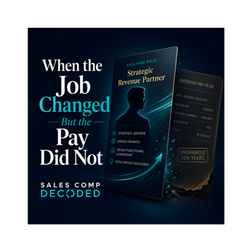
In this episode of Sales Comp Decoded, Abimbola explores how salespeople make everyday choices based on the economic signals inside their pay plan. A seller may choose the easier product, the faster deal, or the safer customer, even when leadership wants a different outcome. The episode looks at why compensation design should begin with behaviour rather than the commission rate, how measures and weightings influence attention, and why conflicting incentives can quietly produce the wrong decisions.
When the Job Changed But the Pay Did Not

Sometimes the job changes quietly. The title stays the same. The team stays the same. The pay plan still processes payouts. But underneath the surface, the work has become broader, heavier, and more complex. A seller who was once focused mainly on new customers may now be expected to protect long-term customer value. A customer success role may now carry expansion expectations. A sales manager may now be asked to coach behaviour, improve forecasting, and support a more disciplined sales process. But when the pay plan does not move with the role, the company sends a confusing message. In this episode of Sales Comp Decoded, Abimbola explores why role clarity must come before compensation design. When the business asks people to do one job but pays them as if they are still doing another, the issue becomes more than a pay problem. It becomes a clarity and fairness problem, and eventually, it can become a talent problem too. This episode is for sales leaders, compensation professionals, Finance, Human Resources, revenue operations, and anyone involved in designing or approving sales incentive plans. If a role in your organisation has quietly changed, this episode will help you ask whether the pay plan has changed with it.
The Promise Hidden Inside Every Commission Plan
Commission often feels simple: when someone helps the business win revenue, the company shares part of that success with them. But behind every commission plan is a promise. It tells the seller what kind of performance will be rewarded, when the reward is earned, and what the company believes that performance is worth. The challenge is that different people can read the same plan and understand that promise differently. In this episode of Sales Comp Decoded, Abimbola explores why compensation is never just payment. It is a business promise, and like any promise, it needs to be clear before trust is tested. The episode looks at how commission plans can become confusing when revenue definitions, payout timing, customer cancellations, deal changes, territory moves, shared work, or seller exits are not clearly addressed. It also explains why a plan may be mathematically correct but still create disputes if the company, seller, manager, Finance, and Human Resources do not understand the promise in the same way. If you still think commission is just a percentage, this episode will help you see the deeper agreement behind the number.
1 di 2