Context with Sebenzile Nkambule

Context with Sebenzile Nkambule

di Sebenzile Nkambule
Stagione 1
You Can't Build What You Can't See | Exposure, Entrepreneurship & the African Dream
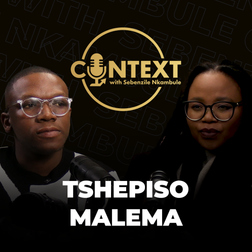
In this episode of Context, Sebenzile Nkambule sits down with entrepreneur Tshepiso Malema for a conversation about possibility. Growing up in Ivory Park, Tshepiso's journey has taken him from gaming and educational technology to chicken farming, startup failure, international exposure, and ultimately the creation of Flockify—an AI-powered platform designed to help African farmers make better decisions. But this is not simply a founder story. It is a conversation about exposure, mentorship, resilience, purpose, and why so many young Africans struggle to imagine futures they have never seen. We explore what it means to build from the margins, navigate setbacks, embrace reinvention, and create technology rooted in local realities rather than borrowed ideas. At its heart, this episode asks a simple question: What becomes possible when young people are given permission to imagine differently? A thoughtful conversation about innovation, leadership, entrepreneurship, and the future of African possibility.
Why Is Indignity So Easy? | Dignity, Belonging and the African Experience
Dignity is one of the most important human needs, yet it is often discussed the least. In this episode of Context, Sebenzile Nkambule explores the hidden costs of poverty, unemployment, migration, and exclusion through the lens of dignity. What happens when people feel unseen? When opportunity feels permanently out of reach? When belonging becomes conditional? Drawing on the experiences of young Africans navigating economic uncertainty and social exclusion, this conversation examines why indignity has become so normalised, and what it means for individuals, communities, and societies. The episode explores the emotional consequences of unemployment, the politics of migration, the relationship between recognition and self-worth, and why creating opportunities is about more than economics — it is also about restoring dignity. At its core, this is a conversation about what it means to be fully human. A thoughtful reflection on belonging, identity, opportunity, and the future of African societies.
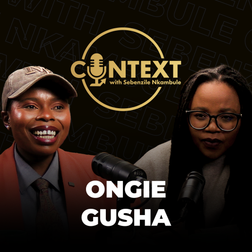
Making South Africa Pay Attention | Ongie Gusha on Satire and Accountability
In this episode of Context, Sebenzile Nkambule sits down with content creator and satirist Ongeziwe 'Ongie' Gusha, whose character-driven skits about the Madlanga Commission have helped thousands of South Africans engage with one of the country's most important accountability processes. At a time when many people are switching off from traditional news, Ongie has found a different way to hold attention — using humour, satire, and meticulous storytelling to make complex political developments accessible, engaging, and impossible to ignore. The conversation explores creativity, identity, digital culture, and the changing ways young people consume information. We discuss her upbringing in Bizana in the Eastern Cape, the craft behind her viral content, the tension between audience growth and meaningful storytelling, and why creators are increasingly becoming trusted interpreters of public life. At its heart, this is a conversation about attention, excellence, and the power of storytelling to help a society understand itself.
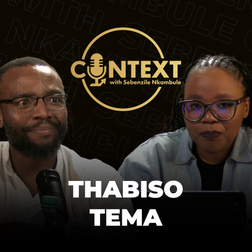
Jack of All Mics | Thabiso ''TT'' Tema on Radio, Reinvention & South Africa’s Story
What does it take to stay relevant for nearly 30 years — in one of the toughest industries in the country? From the early days of SAFM in the 1990s to Metro FM, SABC Sport, Classic FM and Power FM, Thabiso “TT” Tema has built something rare in South African broadcasting: Trust. Credibility. Longevity. In this episode of Context with Sebenzile Nkambule, veteran broadcaster TT reflects on a career that has spanned sport, news, politics, radio, television, and the changing story of South Africa itself. But this conversation is about more than broadcasting. It is about: reinvention, staying power, mastering craft, and learning how to evolve without losing yourself. We explore: - Breaking into radio in the mid-90s — and facing the pressure of a demanding, conservative SAFM audience - The discipline behind great sports broadcasting — from Setswana TV commentary to national television - The SABC as an institution — mentorship, newsroom culture, politics, opportunity, and why public broadcasting still matters - Moving from sport to hard news without losing credibility - The changing state of South African media — trust, public discourse, and what audiences expect today - Football, flair and fandom — Sundowns’ dominance, Chiefs’ struggles, the generational talent problem in South African football, and whether over-coaching is killing creativity - Why young broadcasters today face a more informed, demanding — and unforgiving — public than ever before At its heart, this episode asks a deeper question: What does it take to build a voice — and a career — that lasts? Whether you care about media, football, public broadcasting, leadership, reinvention, or the art of staying relevant, this conversation is full of wisdom, honesty, and hard-earned perspective. - Subscribe to Context for thoughtful conversations on leadership, power, identity, media, and the ideas shaping South Africa and beyond.
Who Gets Protected — And Who Gets Left Behind? | Wendy Isaack on Human Rights & International Law
What does international law actually mean for ordinary people? And when justice feels selective — who gets protected? In this episode of Context, Sebenzile Nkambule sits down with international human rights lawyer Wendy Isaack for a deeply personal and intellectually rich conversation on the politics of justice. Drawing on over 20 years of work across Africa, the United Nations, and Palestine, Wendy reflects on her journey into human rights law and unpacks the systems that shape accountability, freedom, and dignity globally. The conversation explores: Free speech and harmful speech in South Africa Violence against women and the politics of accountability Apartheid as an international crime and unfinished justice in democratic South Africa The role of civil society in holding governments accountable Why international law matters, even to ordinary citizens navigating difficult lives Africa’s historic solidarity movements and lessons for today At its core, this episode asks: What happens when justice and power collide? A compelling and accessible conversation on law, politics, history, identity, and the human cost of inequality.
Resilient or Just Surviving? Making Sense of South Africa’s Economy
In this episode of Context with Sebenzile Nkambule, financial journalist and communications professional Tehillah Niselow joins the conversation to unpack the state of South Africa’s economy — and what it means for ordinary people trying to build stable lives in uncertain times. From rising costs and economic anxiety to youth unemployment, debt, and shifting expectations about success, this conversation explores not just what is happening in the economy — but how people can navigate it with clarity and intention. We unpack: - How global political decisions (like US tariffs) cascade into South African fuel prices, transport costs, and household budgets. - How official narratives of progress often feel out of sync with people’s daily struggles. - How long-term data can show modest improvements (e.g., slight declines in child poverty) while hardship remains widespread. - How perceptions, fears, and lived experiences around issues like immigration and crime may conflict with data but still powerfully drive public sentiment and politics. This is a conversation about economics, hope, resilience, and how to make decisions when the future feels unclear. 🎧 Subscribe to Context for thoughtful conversations on power, economics, culture, leadership and modern life across Africa and beyond. #SouthAfricanEconomy #EconomyExplained #FinancialWellness #YouthUnemployment #CostOfLiving #ContextPodcast
Leading Without Certainty | Purpose, Presence & The Real Work of Coaching with Phetsile Dlamini
What does leadership look like when there are no clear answers? In this episode of Context with Sebenzile Nkambule, executive coach and consultant Phetsile Dlamini joins the conversation to explore leadership in uncertain times — not as a theory, but as a lived practice. Volatility is constant and clarity is sometimes delayed. This conversation reframes uncertainty as an invitation to lead more consciously, to return to purpose, and to build the internal capacity required to guide others through complexity. We explore: why uncertainty is not something to eliminate — but something to work with - the discipline of leading self before leading others how purpose becomes an anchor in unpredictable environments what it means to hold space for people in moments of ambiguity the difference between advice-giving and true coaching what it actually takes to coach well in high-stakes, real-world contexts This is a grounded, reflective conversation for leaders, coaches, and professionals navigating complexity and seeking to lead with clarity, presence, and integrity. If you are thinking about leadership not just as position, but as practice, this episode will resonate. Subscribe to Context for thoughtful conversations on leadership, power, identity, and the realities shaping work and life across Africa and beyond.
African (Dis)Unity? South Africans, Nigerians & The Truth We Avoid
We often speak about African unity as if it is automatic. But beneath that idea are real tensions — between countries, communities, and people. In this episode of Context, Sebenzile Nkambule explores the ongoing friction between South Africans and Nigerians, using it as a lens to examine deeper questions about identity, migration, economic pressure, and belonging on the continent. This conversation unpacks: the history of tensions and key incidents between South Africans and Nigerians the role of economic competition and systemic failure how narratives and perceptions shape conflict why avoiding difficult conversations weakens unity what it will take to build meaningful collaboration across Africa At its core, this episode asks: Are the cracks in African unity rooted in our inability to be honest about how we treat each other? A thoughtful, balanced conversation about power, identity, and the work required to build a shared future.
He Survived the Mamelodi 10: A Story Apartheid Tried to Erase.
In June 1986, ten young boys from Mamelodi left home—and never came back. They were later known as the Mamelodi 10: victims of a brutal apartheid-era operation built on deception, informants, and the systematic targeting of youth. In this episode of Context with Sebenzile Nkambule, we sit down with Mxolisi Malinga, the last surviving member of that group. This is not just a retelling of history. It is a conversation about memory, betrayal, survival—and the cost of freedom. Mxolisi reflects on what it meant to grow up in Mamelodi during one of South Africa’s most volatile periods (1983–1986), the political awakening of young people under apartheid, and the devastating moment when trust was weaponised against them. We also explore the role of apartheid informant networks—later exposed in processes like the Truth and Reconciliation Commission—and what justice, if any, looks like decades later. Nearly 40 years on, the story of the Mamelodi 10 remains a painful reminder of how systems of power can reach into the lives of children—and alter them forever.
The Simplicity of the Sacred | Faith in Uncertain Times (feat. Father Lawrence)
What does faith look like when everything feels uncertain? In this episode of Context, Sebenzile Nkambule sits down with Father Lawrence for a reflective conversation on faith, doubt, religion, and the evolving role of spirituality in modern life. This episode explores: Whether religion is losing influence Why young people are questioning institutions The rise of personal spirituality Faith, doubt, and modern belief The meaning of “the simplicity of the sacred” Listen if you’re interested in: Faith, religion, spirituality, philosophy, meaning, culture.
1 di 2