Cities Reimagined

Cities Reimagined

di Johannes Riegler
Reimagining Cities Beyond Sustainability - with Indy Johar and Caroline Paulick-Thiel
In August 2025, Johannes sat down with Caroline Paulick-Thiel and Indy Johar deep in the Austrian Alps. During the European Forum Alpbach they discussed nothing less than the future of European (urban) civilisation. Looking for a way to make sense of the daily news, current geopolitical shifts, climate catastrophe, and general what feels like insanity around the world? Then, this is an episode you cannot afford to miss. If you like the episode, make sure to subscribe to Cities Reimagined or drop Johannes a line on LinkedIn or at johannes@anthropocene.city . In this episode: Why Europe, in between authoritarian superpowers, can lead the way to new societies. Why this is a post-war-like moment for Europe, demanding structural rebuilding. Why we need to rewire the metabolism of everything. How to reimagine urban economies for a secure Europe. Why we need more honesty in the scope of the current crises. How to embrace insanity and what knowledge our bodies hold. Caroline is a Berlin-based strategic designer and public policy expert, specialising in transformative innovation within the public sector. She is the Director and Co-founder of Politics for Tomorrow, an organisation dedicated to democratising systems change and fostering responsible public innovation. With a background in Design and Public Policy, she focuses on developing participatory processes and innovative frameworks to address complex public challenges. Indy is a London-based architect, social innovator, and serial entrepreneur. He is best known as the co-founder of 00 (Project00.cc) and Dark Matter Labs, organisations focused on systemic change, urban innovation, and sustainable urbanisation. Indy is also a Senior Innovation Associate with the Young Foundation and a Visiting Professor at the University of Sheffield.
Reimagining Bruges: Water, green spaces and community
If you have ever been to Bruges, or seen it in films or photos, chances are you have noticed at least one of the following: canals, swans, water, tourist boats. What often goes unnoticed is that Bruges, and the wider region of Flanders in Belgium, regularly suffers from droughts. In this episode, we meet Astrid Stroobandt from the City of Bruges and Simon Thys from the non-profit organisation Waterland, who are currently running the Blue4Green project, an Innovative Action funded by the European Urban Initiative. Astrid and Simon explain how the project aims to change the city’s relationship with water in multiple ways, and how children’s dreams can inspire change just as much as data and technological innovation. We also hear how the city is experimenting with medieval infrastructure as water buffers, and how green and blue algae are cutting summer fun short. If you would like to find out more about the project, have a look at the links below, connect with Astrid, Simon and Johannes on LinkedIn and follow Blue4Green on Portico. · European Urban Initiatives: https://www.urban-initiative.eu · Portico - Gateway to urban learning: https://portico.urban-initiative.eu · Article: From smart sensors to medieval cultural heritage: A new chapter in Bruges' water identity with Blue4Green · Article: A hot summer’s wake-up call to the City of Bruges: A blue-green algae crisis and what comes next
The People Behind Urban Change - with Kristijan Radojcic
I have to start with an apology. To the guest of this episode, Kristijan Radojcic. After we had this conversation in a wild hotel room with tacky wallpaper in Wroclaw, Poland, the raw version of the recording was sitting unedited on my notebook for much too long. Finally, I am more than happy to share this episode with you, where Kris takes on a deep dive into his childhood in Slovenia and how a trip to Southeast Asia changed everything. If you are around urban EU programmes, you might have bumped into Kris on various occasions as he is working with URBACT, a programme that helps cities to develop an integrated set of actions for sustainable change. He and his family live in Paris. Connect with Kristijan and Johannes on LinkedIn and take a look at URBACT. In this episode: How did growing up in 1980s Ljubljana shape everyday urban life? How do music and architecture intersect in shaping cities and communities? How can encounters beyond Europe reshape ideas of sustainable urbanism? How do European cities learn from each other in practice, not theory? How do paradox economies shape our societies? Why does neighbourhood-level community matter for urban resilience?
Reimagining Urban Biking - with Josip Rotar
Do you remember the first time you learned how to ride a bike? Chances are that you do, and if you kept on kicking those pedals, you might have some fond memories about the (daily) adventures with your bicycle. But… although biking ticks almost all boxes when it comes to urban sustainability, health, livability, affordability and accessibility, our cities still do not unfold the full potential of how urban biking can make our neighbourhoods better places. My guest today, Josip Rotar from the Maribor Cycling Network, is one of those who pushed for change in the city. Find out how advocacy for urban biking led Josip to take a political role and why urban biking is competing with the SUV of your neighbourhood (or your own?). Find out more about Josip and the Maribor Cycling Network here. Josip and the Maribor Cycling Network was part of the first round of Driving Urban Transition’s Urban Doers Community. We recorded this conversation just before the ACT NOW Mayor’s Conference in Vienna.
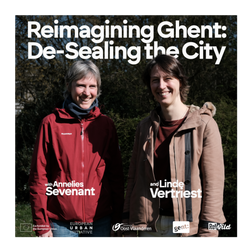
Reimagining Ghent: De-sealing the City
Urban rewilding is more than planting trees. It’s about reshaping cities by de-sealing land and inviting nature back in. In this episode, we head to Ghent to explore REWILD, a bold project funded by the European Urban Initiative that breaks up concrete, engages residents, and creates space for ecosystems. With Linde Vertriest and Annelies Sevenant, we talk about the barriers and challenges and touch upon the 1 Mio dollar question: what does it take to rewild a city? 🔗 www.rewildthecity.eu 🔗 Read more: Where the pavement ends. Can Ghent become a truly rewilded city? 🔗 Rewild is an European Urban Initiative Innovative Action: https://www.urban-initiative.eu
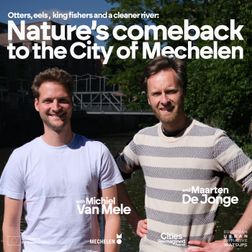
Nature's comeback to Mechelen - with Michiel Van Mele and Maarten De Jonge
Today we go back to the City of Mechelen, to find out how nature is making a comeback in Mechelen’s old town, why that is not only good for house sparrow, eels, and otters but for everyone living and working in the city and how residents are part of the journey for cleaner water, more biodiversity and green in the city. Healthy rivers and rich ecosystems cool our cities, filter our air, and offer places for both people and wildlife to thrive. Yet, for decades, urban waterways have been neglected, covered, or polluted, breaking the vital link between cities and nature. We have Michiel van Mele who is the City Ecologiest of Mechelen and Marteen de Jonge who is the head of the lab department of the Flanders Environmental Agency on the show. Tune in to find out more... This episode is part of the Johannes' work with the City of Mechelen's WATSUPS project, a New European Bauhaus demonstrator. WATSUPS is an Innovation Action funded by the European Urban Initiatives. More information here: European Urban Initiative WATSUPS - Water as the Source of Urban Public Spaces project In case you missed it: To dig in deeper into the amazing work of Mechelen's, you might want to give these past episodes a listen. Reimagining Mechelen Pt. 1 - Water as the Source of Urban Public Space with Nicole La Iacona Reimagining Mechelen Pt. 2 - Nature as a Stakeholder in the Revival of the River Dijle with Mark Van der Veken
Reimagining the City at Night - with Simone d'Antonio
Have you ever felt how different cities feel, look, and smell at night? How everything is seems to be so different than during the day… having organised punk rock concerts and worked in a club myself during my teenage and student years, I had many touchpoints with the nighttime economy from early on. You might think now of all the clubs and bars… yes, they are part of that, but there is much more to it: workers in culture, logistics, health care, communication, and many more. In today’s episode, I FINALLY have Simone d’Antonio on the show. Simone is based in Rome, Italy, and you may have come across Simone’s name at some point. Because he’s a familiar face in urban innovation circles, both in Europe and worldwide. Currently, he is working with 10 cities on their nighttime policies and activities (find out more about the Cities After Dark URBACT Network here), and it was high time to connect online In our conversation, he convinced me that working on nighttime policies is more than hanging out in bars… Tune in to find out why the night doesn’t only belong to lovers, as Patti Smith once claimed, but to everyone. Tune in to find out: What if the night-time economy was about care, culture, and community, not just clubs and bars Why cities at night are fighting a quiet war against the sofa and the apps on your phone Why the right to the city should be a 24/7 thing Why Naples might be the northernmost city of the Global South How urban nightlife differs depending on cultures, geographies and climates.
Reimagining the 'Unloved' Spaces - with Alenka Korenjak & Zala Velkavrh
Almost every city has them - spaces and places that feel like they’re waiting. Waiting to be reawakened, reimagined, and reconnected to the people around them. Too often, though, that reawakening follows a predictable script: maximise economic return, build apartments, squeeze in shops, add a parking lot. Little thought is given to anything beyond profit. That’s exactly why I loved hearing Alenka Korenjak and Zala Velkavrh from Prostorož (a not-for-profit urban design agency from Ljubljana/Slovenia) speak about “unloved” places - because it shifts the lens. It’s not just about return on investment, but about how people relate to space, how public life can be cultivated, and how cities can become more liveable, more layered, more human. So when I spent a few weeks in Klagenfurt, it was high time to jump over the Karawanken Mountains to Ljubljana and visit the Prostorož studio in person on a Friday afternoon in May 2025. Further info: More on Prostorož: https://www.prostoroz.org Alenka, Zala and Johannes on LinkedIn Cities Reimagined on Instagram: https://www.instagram.com/citiesreimagined/ The book I mentioned in the show: Vocabularies for an Urbanising Planet: Theory Buidling through Comparison - https://birkhauser.com/en/book/9783035623031
Reimagining Urban Tourism - with Donagh Horgan
Hi and welcome back to the first episode of season 3 of the Cities Reimagined Podcast. To kick things off, I’m joined by Donagh Horgan — a social designer, researcher, and all-round urban thinker who’s doing some pretty exciting work at the intersection of placemaking and tourism. Donagh is based between Ireland and the Netherlands, where he leads the Urban Leisure & Tourism Lab at Inholland University. He’s also a lecturer at Erasmus University Rotterdam and works with cities around the world to make them more inclusive, creative, and resilient. In this episode, we dive into the changing role of tourism in our cities. Urban tourism exploded after the 2008 financial crisis — bringing in money, but also creating real tensions: rising rents, disappearing housing, and a sense of alienation for many local communities. Together with Donagh, we explore how regenerative tourism might offer a way forward — one that puts local people, stories, and places at the centre. We talk about reimagining tourism as something that can give back rather than just take, and how we might start thinking about cities as ecosystems again, rather than playgrounds for capital. Donagh popped by my apartment while in Vienna and we had a great conversation — I hope you enjoy listening as much as I enjoyed recording it.
Still reimagining: Introducing season 3
Trailer
Soon after I started the Cities Reimagined podcast 18 months ago, it became a tool for learning, exchange, and inspiration through deep conversations. Now we’re heading into Season 3. Episodes for season 3 are in full production. Want to find out what’s in store? Tune in to the season trailer to hear more about the upcoming content and why deep conversations with people driving change in cities are more important than ever. In the coming weeks and months, we’ll go to Ljubljana 🇸🇮, Ghent 🇧🇪, Mechelen, Bruges, and more. We’ll cover topics such as urban tourism 🧳, the urban night-time economy 🌃, biodiversity and water quality 🐝💧, rewilding streets and schoolyards 🌱, and much more. Subscribe to the show to not miss an episode, follow us on Instagram to see more background content, reach out to me on LinkedIn or send me an email at johannes@anthropocene.city.
1 di 3