Book Takeaways for Professional Growth with Actionable Insights for Busy Global Professionals

Book Takeaways for Professional Growth with Actionable Insights for Busy Global Professionals

di Book Takeaways for Professional Growth
Stagione 1
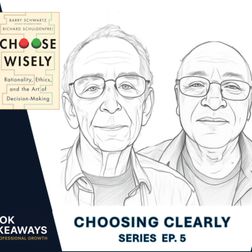
Is it the Right Choice or Just the Easy One? Choosing Clearly Series from Overwhelm to Wisdom Part 5/7
IA
Have you ever noticed the numbers say "yes," but something inside you still hesitates? In Episode 5 of Choosing Clearly, we continue our journey from overwhelm to wisdom by asking one of the deepest questions in this series: is this really the right choice, or just the easy one? This episode is built around Choose Wisely by Barry Schwartz and Richard Schuldenfrei — a choose wisely book that challenges something most of us were taught without realizing it: that good decisions come from adding up pros and cons like a spreadsheet. Marcus faces this exact tension with his promotion offer. On paper, it's an easy yes — more money, more growth. But something deeper says wait. Together, Sophia and Marcus explore the balance between rationality, ethics, and the art of decision-making. They unpack why rational-choice math misses the human side of a decision, and introduce the idea of your personal "constellation of virtues" — honesty, kindness, ambition, responsibility — arranged differently in every person. There's no universal ranking of which value matters most; a wise decision reflects your specific values, not a generic formula. Decision-making, they argue, is an art as well as a science. Whether you're a parent choosing between a client call and a school recital, or a professional weighing a big career move, this episode gives you one simple, powerful question to ask before deciding: what does this choice say about who I want to be? Chapters: 0:00 - Introduction: When the Numbers Say Yes But Something Hesitates 1:10 - Today's Question: Math vs. Meaning in Decisions 1:50 - Choose Wisely: Beyond the Pros-and-Cons List 3:17 - Your Constellation of Virtues Explained 3:59 - Decision-Making as Art, Not Just Science 4:58 - Applying It: The Promotion and the Recital 5:56 - Your Action Plan for This Week 7:16 - Closing & What's Next in Episode 6 Subscribe for more tools on choosing clearly and making decisions that truly reflect who you are! Here's the Playlist of available episodes of the Choosing Clearly Series https://youtube.com/playlist?list=PLWHCeMtwwvKE&si=xPjntxe0SNDulcCh
Think in Scenarios, not Predictions | David Spiegelhalter's The Art of Uncertainty | Choosing Clearly Series Part 4/7
IA
Do you ever wish someone would just give you a straight yes or no answer about a big life decision? In Episode 4 of Choosing Clearly, we continue our journey from overwhelm to wisdom by tackling one of the hardest parts of decision-making: not knowing what happens next. This episode is built around David Spiegelhalter's The Art of Uncertainty. His central message is a relief once you hear it: living with uncertainty isn't a personal failure — it's simply how reality works, for everyone, all the time. Marcus opens up about a real promotion offer on the table, with a return-to-office mandate that could affect his family and marriage, and no clear answer in sight. Together, Sophia and Marcus explore risk and uncertainty in decision making, drawing a key distinction: risk is something we can estimate with numbers, while deep uncertainty — like how a teenager will feel about a move in ten years — is genuinely unknowable in advance. The fix isn't more research. It's learning to think in scenarios: naming your best case, worst case, and most likely case instead of demanding a guarantee that was never coming. Whether you're a parent switching daycares or a professional weighing a career move, this episode gives you a practical tool to stop feeling frozen and start moving forward, even without certainty. Chapters: 0:00 - Introduction: The Promotion With No Clear Answer 1:17 - Today's Question: Why We Demand Certainty 2:17 - Risk vs. Deep Uncertainty Explained 3:20 - Applying It: The Daycare Switch Example 3:49 - Tool: Think in Scenarios, Not Predictions 4:15 - Building Best Case, Worst Case, Most Likely Case 4:56 - The Goal Is Reduced Paralysis, Not Zero Uncertainty 6:50 - Your Action Plan for This Week 7:54 - Closing & What's Next in Episode 5 Here's the Playlist of available episodes of the Choosing Clearly Series https://youtube.com/playlist?list=PLWHCeMtwwvKE&si=xPjntxe0SNDulcCh Subscribe for more tools on choosing clearly and turning uncertainty into confident, clear-eyed decisions!
Framing Effect in Decision Making: Social Art of Influence Book by Mikael Klintman's Framing | Choosing Clearly Part 3/7
IA
Have you ever felt a wave of panic from a short text or email, only to realize later the situation wasn't actually that serious? In this book takeaways in 10 minutes, Episode 3 of Choosing Clearly, we continue our journey from overwhelm to wisdom by exploring how words secretly shape our decisions. This episode is built around Mikael Klintman's social art of influence book, Framing. His core idea is simple but eye-opening: the same facts, described in different words, can produce completely different feelings and completely different choices. Sophia shares how a two-word school note — "falling behind" — sent her into a four-day panic spiral, while Marcus admits a one-line work message nearly convinced him he was being managed out of his job. Together, they unpack the framing effect in decision making, breaking it into four practical tools: texture (does it sound normal or alarming?), temperature (was it delivered calmly or urgently?), position (behind what, exactly, and compared to whom?), and size (is this small and temporary, or made to sound permanent?). You'll learn why these frames appear everywhere — in parenting advice, social media, and workplace feedback — and why noticing them, not avoiding them, is the real skill. Whether you're a parent reading a teacher's note or a professional decoding your manager's email, this episode gives you a simple habit: check the frame before you trust the feeling it gives you. Chapters: 0:00 - Introduction: The Two Words That Caused a Panic 1:51 - Facts vs. How They're Described: Klintman's Framing Theory Explained 3:03 - Tool 1: Texture — Smooth vs. Rough 3:54 - Tool 2: Temperature — Calm vs. Urgent 4:26 - Tool 3: Position — Behind What, Exactly? 5:24 - Tool 4: Size — Small Issue or Life-Defining? 6:34 - Your Action Plan for This Week 8:01 - Closing & What's Next in Episode 4 Subscribe for more tools on Choosing Clearly and turning everyday confusion into calm, confident decisions!
Limits are Good for You | Choosing Clearly Series Ep 2 Inside the Box David Epstein book
Do you feel like every day brings too many choices — from bedtime routines to meal planning to work decisions? In Episode 2 of Choosing Clearly, we continue our journey from overwhelm to wisdom by exploring a surprising idea: fewer choices can actually set you free. This episode dives into the David Epstein book, Inside the Box, where he argues that limits are good for you. Most of us believe more freedom and more options make life better, but Epstein shows the opposite is often true. Unlimited choice can overwhelm us — think about standing in front of a streaming app for twenty minutes and choosing nothing at all. Hosts Sophia and Marcus share real stories from their own lives: a nightly bedtime negotiation that drains all her energy, and a family calendar app that keeps adding features nobody uses. Together, they unpack why we tend to add more instead of simplifying, even when less would clearly work better. You'll learn the difference between a cage (a limit forced on you) and a guardrail (a limit you choose calmly, in advance, to protect your future self). Whether you're a busy parent managing school mornings or a professional juggling too many meetings, this episode gives you a simple, practical tool: set one clear rule now, so you don't have to negotiate everything later, when you're tired and stressed. Chapters: 0:00 - Introduction: The Bedtime Negotiation 1:28 - Why More Freedom Can Feel Worse 2:45 - The Curse of Abundance 3:13 - Real Story: General Magic and Too Many Features 4:35 - Designing for Real, Tired Humans 6:51 - Your Action Plan for This Week 8:31 - Closing & What's Next in Episode 3 Subscribe for more tools on choosing clearly and turning overwhelm into calm, confident decisions!
How to Move from Overwhelm to Wisdom | Decision Making for Professionals & Parents | Choosing Clearly Series 1/7
IA
Are you tired of feeling stressed over simple choices like what to make for breakfast or how to answer a quick work email? Welcome to Episode 1 of Choosing Clearly, a new 7-part series designed to help you move from overwhelm to wisdom. In this episode, hosts Sophia and Marcus dive into why modern life makes every small choice feel so heavy. Whether you are figuring out family schedules or managing return-to-office demands, decision making for parents and decision making for professionals has never been more exhausting. Did you know the average adult makes about 35,000 decisions a day? We explain why this mental overload is not your fault and how the structure of our modern world sets us up for decision fatigue. This episode introduces the roadmap for our entire series. We will use powerful, practical ideas from four great books to help you navigate life's endless options. You don't need more information; you need a better filter. Join us as we explore how to find balance, reduce anxiety, and feel confident in a busy world. Chapters: 0:00 - Introduction: The Panic of Small Choices 1:51 - Why Do Choices Feel So Heavy Today? 2:30 - The 35,000 Decisions a Day Problem 4:33 - It’s Not Your Fault: How the World Changed 5:54 - Series Roadmap: What to Expect in 7 Episodes 7:01 - Your Action Plan for This Week 8:15 - Closing & What’s Next in Episode 2 Subscribe for more tips on choosing clearly and transforming your daily routines. Let’s make your next choice your best one!
How to navigate the age of AI? A Roadmap in the Age of AI | Series Finale of AI and the Future of Careers Part 7/7
IA
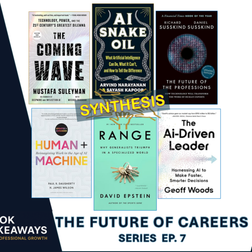
Six books. Seven episodes. One question underneath all of it: how do you prepare yourself and your children for a world moving faster than you can fully see? This is the bonus finale of our 7-part series on AI and the future of careers — and it is not a summary. It is the complete roadmap in the age of AI, built by connecting all six books and resolving the tensions between them. Does The Coming Wave contradict AI Snake Oil? Does Range conflict with Human + Machine? Your hosts Marcus and Sophia walk through each apparent disagreement and show how the six books actually form one coherent picture of technology and work — from accepting the wave is real, to thinking critically, to understanding how professions are being redesigned, to raising children with the right foundations, to leading yourself with AI as a thinking partner. This episode answers the question so many listeners have been asking: what to do in the age of AI, starting today. ⏱️ Chapters - 0:00 – What actually changed for the hosts during this series - 2:41 – The real question underneath all six books - 3:30 – Episode 1 revisited: The Coming Wave as the foundation - 4:17 – Episode 2 revisited: Resolving the first tension with AI Snake Oil - 5:13 – Episodes 3 & 4 revisited: Structural clarity meets the Missing Middle - 7:00 – Episode 5 revisited: Why Range and depth are not opposites - 7:55 – Episode 6 revisited: The final tension resolved - 8:40 – The full map: what six books say together - 10:04 – 2 actions this week — one for your career, one for your family - 11:18 – Closing: Navigation, not safety The people who move through this period with the most confidence are not the ones who found the safest path — they are the ones who understood the terrain well enough to navigate any path. 🎧 If any book in this series spoke to you, go back and read it in full. Share this series with someone carrying the same questions. AI and the Future of Careers Series features the following books: Ep 1 The Coming Wave https://youtu.be/eVukQPqiLOM Ep 2 AI Snake Oil https://youtu.be/fWyaGuNcuMA Ep 3 The Future of the Professions https://youtu.be/1e9sO9ATi3U Ep 4 Human + Machine: Reimagining Work in the Age of AI https://youtu.be/FNZs59kG0ao Ep 5 Range: Why Generalists Triumph in a Specialized World https://youtu.be/3Kc1YgO8_PA Ep 6 The AI-Driven Leader https://youtu.be/jcXqI3JpgWA Ep 7 Synthesis and Season Finale (YOU ARE HERE)
What does leadership look like in the Age of AI | Book Takeaways series on AI and the Future of Careers Part 6/7 | AI-Driven Leader by Geoff Woods
IA
You understand AI is changing everything. You've done the reading. But last Sunday, you told your kids "ten more minutes" and forty-five minutes later, you were still buried in email. Sound familiar? This is Episode 6 of our 7-part series on AI and the Future of Careers — the practical playbook after five episodes of building the big picture. Today's AI-Driven Leader book summary covers Geoff Woods's book on AI and leadership, drawn from his work helping grow a company's market value from 750 million to over 12 billion dollars. This is not about technology and work in the abstract — it's AI for managers and leaders who need something concrete to change starting this week. In this episode, your hosts Marcus and Sophia break down 4 ideas that turn understanding into a real weekly practice. ⏱️ Chapters - 0:00 – The Sunday laptop moment and the "AI readiness" gap nobody can explain - 3:01 – Operational overwhelm — why "later" never comes - 5:20 – Takeaway 1: You are the Thought Leader. AI is your Thought Partner. - 6:57 – Takeaway 2: Use AI for decisions, not just tasks - 8:11 – Takeaway 3: The AI Empowerment Flywheel — why the learning curve is normal - 9:37 – Takeaway 4: The conductor model — what leadership looks like now - 10:58 – 3 actions this week — including one question that starts the flywheel - 12:24 – What's coming in Episode 7: The bonus finale The rule is simple enough to remember on a busy Tuesday morning: you are always the Thought Leader, AI is always the Thought Partner. Practising it consistently is enough to change how you lead. 🎧 Subscribe for the full 7-part series. Share this with a manager or leader navigating AI at work. AI and the Future of Careers Series features the following books: Ep 1 The Coming Wave https://youtu.be/eVukQPqiLOM Ep 2 AI Snake Oil https://youtu.be/fWyaGuNcuMA Ep 3 The Future of the Professions https://youtu.be/1e9sO9ATi3U Ep 4 Human + Machine: Reimagining Work in the Age of AI https://youtu.be/FNZs59kG0ao Ep 5 Range: Why Generalists Triumph in a Specialized World https://youtu.be/3Kc1YgO8_PA Ep 6 The AI-Driven Leader (YOU ARE HERE)
Should I advise my child to specialize in the Age of AI? David Epstein's Range | Book Takeaways Series on AI and the Future of Careers Part 5/7
IA
Your child tries football, then swimming, then drama club, then coding — and you worry they will never "find their thing." What if that worry is exactly backwards? This is Episode 5 of our 7-part series on AI and the Future of Careers. Today's Range summary covers David Epstein's research-packed book, Range: Why Generalists Triumph in a Specialized World — and it offers real relief for parents and professionals thinking about technology and work in the age of AI. Epstein compares Tiger Woods, who specialised in golf before age one, with Roger Federer, who played six sports before committing to tennis at sixteen. The research is clear: in "wicked" environments — where rules are unclear and patterns don't repeat, which describes most real careers — broad experience beats early specialization. In this episode, your hosts Marcus and Sophia break down 4 ideas connecting Epstein's research directly to the future of professions and the Missing Middle from Episode 4. ⏱️ Chapters - 0:00 – The guilt of letting your child quit — and why it may be misplaced - 2:54 – Why "pick a lane early" is exactly the wrong advice - 5:10 – Takeaway 1: The sampling period is preparation, not delay - 6:24 – Takeaway 2: Match quality — why trying things is never wasted time - 7:40 – Takeaway 3: Analogical thinking — the skill the Missing Middle actually needs - 9:29 – Takeaway 4: Your own career detours are range, not failure - 10:43 – 3 actions this week — including one question to stop asking your child - 12:09 – What's coming in Episode 6: The AI-Driven Leader Nobel laureates in science are 22 times more likely than average scientists to have a serious creative hobby. Breadth builds the flexible thinking that thrives in the age of AI — and this episode shows exactly why. 🎧 Subscribe for the full 7-part series. Share this with a parent who needs to hear it today. AI and the Future of Careers Series features the following books: Ep 1 The Coming Wave https://youtu.be/eVukQPqiLOM Ep 2 AI Snake Oil https://youtu.be/fWyaGuNcuMA Ep 3 The Future of the Professions https://youtu.be/1e9sO9ATi3U Ep 4 Human + Machine: Reimagining Work in the Age of AI https://youtu.be/FNZs59kG0ao Ep 5 Range: Why Generalists Triumph in a Specialized World (YOU ARE HERE)
What is Meaningful Work in the Age of AI | Human + Machine | AI and the Future of Careers series 4/7
IA
Your child asks: "Mum, are robots going to take people's jobs?" Your company rolls out an AI strategy. The word "efficiency" appears forty times. The word "people" appears twice. What do you say? What do you do? This is Episode 4 of our 7-part series on AI and the future of careers — and it is the most hopeful episode in the series. Today we cover Human + Machine by Paul Daugherty and H. James Wilson from Accenture, based on research across 1,500 organizations. Their finding cuts through all the fear: the companies getting the most from AI are not replacing people. They are redesigning how people and machines work together. That space — where human judgment meets machine capability — is what they call the Missing Middle. And it is where the most valuable work in the age of AI happens. In this episode, your hosts Marcus and Sophia break down 4 ideas that give you a concrete picture of the future — not just the problem. ⏱️ Chapters 0:00 – The AI town hall nobody talked about — and a 10-year-old's honest question 3:15 – Why "AI takes jobs" is the wrong frame — and what the real fear actually is 5:28 – Takeaway 1: The Missing Middle — where the most valuable work happens 7:16 – Takeaway 2: Six hybrid roles — what human-machine collaboration looks like in practice 9:57 – Takeaway 3: The three skills that make this collaboration work 12:01 – Takeaway 4: Augmentation is a choice, not an automatic outcome 13:19 – 3 actions this week — including a real answer for your child 14:45 – What's coming in Episode 5: Range by David Epstein The future of the professions is not humans versus machines. It is humans and machines — and knowing how to work that combination well is the most durable career skill your child can build. 🎧 Subscribe for the full 7-part series. Share this with a colleague navigating AI at work. AI and the Future of Careers Series features the following books: Ep 1 The Coming Wave https://youtu.be/eVukQPqiLOM Ep 2 AI Snake Oil https://youtu.be/fWyaGuNcuMA Ep 3 The Future of the Professions https://youtu.be/1e9sO9ATi3U Ep 4 Human + Machine: Reimagining Work in the Age of AI (YOU ARE HERE)
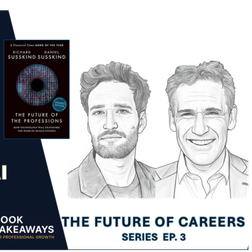
What Do I Tell My Kids to Study? | The Future of the Professions by Richard and Daniel Susskind | Book Takeaways Series on AI and the Future of Careers Part 3/7
IA
Your parents told you: "Get into medicine. Study law. Learn accounting. You'll always have work." They were right — for their generation. But what do you tell your children today? That is the question at the heart of this episode. This is Episode 3 of our 7-part series on AI and the future of careers. Today we cover The Future of the Professions by Richard Susskind and Daniel Susskind — a legal technology expert and an Oxford economist — who spent years researching exactly what technology and work are doing to the careers families have trusted for generations. This is not a story about professions disappearing. It is a story about how they are changing from the inside — task by task — and what that means for you and your children right now. In this episode, your hosts Marcus and Sophia break down 4 ideas every professional needs to understand. ⏱️ Chapters 0:00 – The career advice our parents gave us — and whether it still works 2:42 – The fear of giving your child the wrong advice 4:47 – Takeaway 1: Decomposition — what AI actually replaces inside a profession 6:46 – Takeaway 2: Three new human roles emerging in every field 8:27 – Takeaway 3: What actually protects you is not your job title 9:33 – Takeaway 4: The better question to ask for your children's future 10:47 – 3 actions to take this week — including one question that changes everything 12:19 – What's coming in Episode 4: Human + Machine The routine tasks AI replaces first are often how young professionals build their early careers. So what does the future actually need from humans — and how do we prepare our children for it? 🎧 Subscribe for the full 7-part series. Share this with a parent or professional asking the same question. AI and the Future of Careers Series features the following books: Ep 1 The Coming Wave https://youtu.be/eVukQPqiLOM Ep 2 AI Snake Oil https://youtu.be/fWyaGuNcuMA Ep 3 The Future of the Careers (YOU ARE HERE)
1 di 5