Zen and the Art of Self Publishing

Zen and the Art of Self Publishing

por Janet Margot
Temporada 1
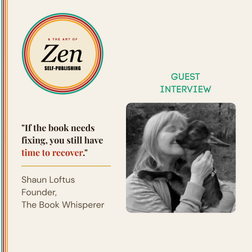
The downloads were fine, the silence wasn't: Shaun Loftus on fixing a book before it fails.
Shaun Loftus runs The Book Whisperer from a Tuscan hillside in a house she shares with an ever-changing cast of dogs, cats, parrots, hens, and a couple of opinionated goats. She came to books the long way round — through the theatre, as a director and dramaturg with fifty-odd productions behind her, and through the early web, where she taught herself to code to pay the rent. She calls it having an artist head and a nerd head, and that turns out to be a rare and useful pairing when the job is helping writers reach readers. This conversation sits right in the middle of what this show cares about: keeping the human at the center as the work gets more automated. Shaun is candid about being allergic to hustle culture — the ROI-everything, produce-produce-produce reflex she left behind when she left the States. Her aim is to carry the business weight so her authors can stay focused on the writing. When Janet named the obvious thing — that on paper the two of them might look like competitors — Shaun's answer set the tone for the hour: colleague, not competitor. It was never a zero-sum game. From there it gets practical. Shaun talks through why a cover gets a single nanosecond to sell its genre, how aggressive ARC campaigns surface problems early enough to fix them — including the time a stalled book was rewritten overnight and went on to become a bestseller — and why she'll tell half her authors to slow down and the other half to speed up. There's a clear-eyed tour of selling in translation: why the German market reads historical fiction all year, why Italy still reaches for print, and where she thinks authors quietly leave money on the table. And there's an honest accounting of what doesn't work — the genres she stays out of, and the successes that simply can't be copied. They close on the Indie Unconference, the small, generous gathering Shaun runs in Italy — why an "unconference," why it's built for participants rather than an audience, and why it's on pause until 2027. A fitting end to a conversation about doing good work at a human pace. You can find Shaun through The Book Whisperer and on Reedsy — and, as she half-jokes near the end, if you get an email from "Shaun Loftus" offering you services, it isn't her.
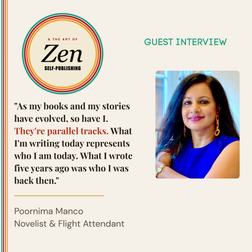
East, west, and the space between: Poornima Manco on thirty years of writing and belonging

What does it mean to write from a life that straddles two worlds? Poornima Manco grew up in Delhi, moved to London in her twenties, and has spent the thirty years since navigating the space between East and West — as a flight attendant, as a mother, as a wife, and as a writer. Her short stories have been published in the Guardian and the Telegraph, and her debut novel, A Quiet Dissonance, drew directly from her experience of arriving somewhere new and trying to figure out where she fit. In this conversation — recorded with my writing and publishing partner Victoria Dougherty — Poornima talks about the themes she keeps returning to in her fiction: identity, belonging, and the quiet question of who you are when the culture around you shifts. She also opens up about a health scare that came out of nowhere, what it's taught her about resilience, and why she does most of her best writing in hotel rooms on layovers. We also end up somewhere I didn't expect: deep in a conversation about love. Poornima's own story — an arranged marriage that took five years of mutual avoidance before it finally clicked — is one of the most quietly beautiful things I've heard in a long time. And it says something true about timing, about readiness, and about the kind of commitment that has nothing to do with romance novels. This is an episode for writers who are building something personal. Who aren't trying to write to market or kick out a twenty-book series — but who have something real to say and are figuring out how to say it. Poornima is proof that that path exists, and that it's worth taking.
The Cost of Waiting: What 200K YouTube Followers Taught Bradley Charbonneau About Perfection
Bradley Charbonneau has written 40 books, given workshops in Dutch at European conferences, done improv at Boom Chicago in Amsterdam, and built a YouTube channel to over 200,000 followers — not by having a plan, but by having a practice. This episode is about what happens when you stop waiting for perfect conditions and just press record. Bradley and Janet dig into the real mechanics of YouTube growth: how importing a back catalog strategically triggered the algorithm, why consistency beats quality in the early days, and what the "related video" feature on Shorts can do for your watch hours. They also talk through use cases for fiction versus nonfiction authors, the question of monetization versus audience building, and why YouTube — owned by Google — is a search engine first and a social platform second. But underneath all the tactics is something more essential. Bradley spent eight years not writing before a 30-day challenge finally kicked him into motion. That experience — the pain of waiting, the relief of shipping — is the entire philosophy he now teaches. And it applies whether you're writing your first book, recording your first video, or just sitting on an idea that deserves to exist in the world. If you've had a YouTube idea for 18 months and still haven't pressed record, this one's for you.
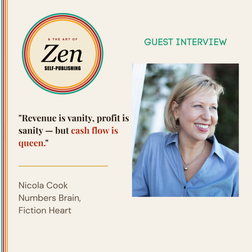
Cash Flow Is Queen: What Every Author Needs to Know About the Business of Writing with Nicola Cook
What if the thing standing between you and a sustainable author career isn't your writing, your marketing, or even your platform — but your relationship with money? Nicola Cook is a UK-based entrepreneur, sales growth consultant, and multi-genre author who has built and exited businesses, made multiple seven figures on the back of a single business book, and runs Aurora Independent Books — her own indie publishing imprint — under the fiction pen name Isabella Wiles. She also happens to be genuinely great at the stuff most authors find terrifying: the numbers. In this conversation, Nicola breaks down the financial fundamentals every author-entrepreneur needs — not as theory, but as hard-won practice from someone who has been ten days from bankruptcy and built her way back. We cover the difference between revenue, profit, and cash flow, the three personal budgets every author should know, what residual income really means for a publishing career, and the money mindset trap that keeps most people earning exactly what they've always earned. No course. No pitch. Just two decades of business expertise applied to the author life. nicolacook.com isabellawiles.com companyshortcuts.com aipbooks.com
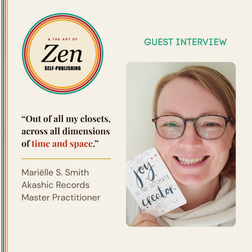
Mariëlle S. Smith: Discovering My Spiritual Path & Helping Creatives

Mariëlle S. Smith is a developmental editor, life coach, Akashic Records master practitioner, Reiki master, and author of Tarot for Entrepreneurs, 99 Writing Prompts, and the 52 Weeks of Writing series. She also coaches creatives through some of the most stubborn blocks they face — the kind that don't budge no matter how many journals you fill or therapy sessions you log. In this conversation, we talk about what the Akashic Records actually are, how she spent years in the spiritual closet while quietly helping writers anyway, and what it means to help someone connect with their book on a soul level. I'll also confess: Mariëlle did a reading for me a few years ago that cracked something open in my memoir. Full disclosure up front. Topics covered: What the Akashic Records are and how a session works How Mariëlle spent years in the "spiritual closet" as a Reiki master and tarot practitioner The 2019 Edinburgh conference that launched her tarot-for-creatives work (from a medieval sofa in a castle) Why 90%+ of creative blocks are deeper than craft — and what that means for how she coaches Tarot for Entrepreneurs, 99 Writing Prompts, and 52 Weeks of Writing The pen name question: algorithmic strategy vs. soul-level hiding Direct sales: Etsy, Payhip, and what she found she didn't expect (actual human connection) Kickstarter as community, not just funding — including an upcoming Oracle deck: The Root Awakening: Get Your Creative Shit Together Writing with the Divine: her new six-month program combining practical writing rhythm with Akashic Records sessions Website: https://mariellessmith.com Writing with the Divine: https://mariellessmith.com/writingwiththedivine Email: me@mariellessmith.com Instagram: www.instagram.com/mariellessmith YouTube: www.youtube.com/@thecoachforcreatives Insight Timer: https://insighttimer.com/mariellessmith Substack: https://mariellessmith.substack.com
From Narrator to Director: 25 Years Behind the Mic with Kristin Watson Heintz
Kristin Heintz spent 25 years narrating audiobooks — from Audible in New York to becoming a character readers refused to let anyone else voice. Now she co-runs My Audio Rocks and directs authors through narrating their own work. We talk about the craft secret that separates reading from storytelling, why memoir belongs in the author's own voice, and why her studio uses zero voice AI — on purpose. Chapters 01:24 — Singer to narrator: the Audible job that landed in her lap 03:26 — Brilliance Audio vs. Audible, and her first real director 05:57 — The craft secret: reading it "for the first time" 08:22 — Becoming the character (and the fans who proved it) 12:16 — Why she stopped "just narrating" 16:23 — The case for narrating your own book — and why publishers resist it for memoir 18:48 — Peggy DeLong, crying in the booth, and letting emotion through 21:28 — The lizard brain and the ancient pull of spoken story 23:02 — Which genres suit author narration vs. a pro 25:36 — The AI question: why My Audio Rocks uses no voice AI 28:25 — Automation vs. AI-generated audio (the distinction that matters) 32:14 — What actually happens when you sign up 35:12 — The "Rockaburton" kit and your live-directed first session 39:36 — What authors get wrong: "not all engineers are audiobook engineers" 42:47 — One piece of advice for the fence-sitters 43:22 — Where to find Kristin + the partnership rate Show Notes: myAudio.rocks
What Are You Actually Building? Tropes, Story, & the Art of Thinking for Yourself with JENNIFER HILT
Jennifer Hilt — USA Today bestselling author and creator of the Trope Thesaurus series — joins Janet to talk about story structure, creative identity, and why understanding tropes is really about understanding what makes us human. They cover how tropes got a bad reputation (and why that's changed), the difference between a trope and a cliché, why motivation is the secret sauce of any story that actually works, and what happens when authors hand over their creative judgment — to AI, to trends, or to anyone else. If you've ever felt ashamed of writing "commercial" fiction, lost momentum mid-draft, or wondered whether AI tools are helping or quietly hollowing out your voice — this one's for you. What we talk about: Why Jennifer's students reacted with shame when she mentioned tropes — and what that revealed about the indie author world's relationship with commercial storytelling Tropes vs. clichés: the distinction that changes how you think about craft Why tropes are fundamentally about human relationships, not genre formulas Mystery vs. thriller — and why the line between them keeps blurring What keeps readers coming back to a series (hint: it's an identity question) The problem with promoting secondary characters to leads How to think about tropes as a discoverability and marketing tool AI, critical thinking, and why "handing over your power" is the real risk Kate Atkinson's spiral drafting method — and why it might save your writing life Guest links: Jennifer Hilt: jenniferhilt.com Free Substack: available at her website Books mentioned: The Trope Thesaurus series (multiple volumes), A is for Alibi by Sue Grafton, Department Q series (book and Netflix)
Interview with Author Jami Albright on Finding Humor in Sadness
One of the most remarkable aspects of Jami Albright's writing is her ability to find humor amidst tragedy. Her sister's vibrant spirit influenced this approach. Jamie recounts, "My sister was funny until the very end. Even in her last days, she made us laugh with her antics." This juxtaposition of humor and grief is a hallmark of her new book, making it relatable and engaging for readers. Jamie explains, "I knew that if I was going to write this book, it had to be infused with levity. I couldn’t bear to write a completely sad story." Key Takeaways for Aspiring Writers For writers looking to explore similar themes, Jamie offers valuable insights: 1. Embrace Your Emotions: Don’t shy away from writing about difficult experiences. Allow your feelings to guide your narrative. 2. Find Balance: Infusing humor into serious topics can create a relatable and engaging story. Look for moments of levity, even in dark times. 3. Draw from Real Life: Use your own experiences and family dynamics as a foundation for your characters and plot. 4. Be Authentic: Write from the heart, and don’t be afraid to share your vulnerabilities. Authenticity resonates with readers. Read The Summer That Changed Us: https://books2read.com/u/mdZvPW Visit Jami's world: https://www.jamialbright.com/ Listen to Jami at Wish I'd Known Then... Writer podcast: https://wishidknownforwriters.com/
Trailer: Why I Started This Podcast
Trailer
A quick introduction to the idea behind this podcast. Keeping the human in an increasingly automated world.