Work is Weird Now

Work is Weird Now

por Danielle Emery
Temporada 6

E:56 Have traditional hierarchies made us too dependant? With Alex Hirst and Lizzie Penny

This week on Work Is Weird Now, we’re joined by Lizzie Penny and Alex Hirst, co-founders of Hoxby and The Workstyle Revolution, to unpack how work needs to evolve beyond industrial-age thinking. From the legacy of the 9–5 to the rise of digital, distributed work, we explore why organisations are struggling to balance autonomy with structure and what happens when people are given freedom without the skills or frameworks to use it well. We get into: • Why traditional hierarchies create a parent–child dynamic at work • The shift from presence-based to trust-based collaboration • Why “freedom within a framework” is the real unlock • How autonomy is a skill, not a perk • What organisations get wrong when they try to go “flat” Along the way, Lizzie and Alex share the deeply personal experiences that shaped their thinking — from burnout to illness to building a business around a more human way of working. This isn’t about scrapping structure. It’s about redesigning it.
Temporada 5

E55: She Shapes AI Global Awards & Conference Wrap Up
She Shapes AI: Who gets to build the future? Alice and Dan recap their experience at the She Shapes AI Global Awards and Conference at the London School of Economics an event that didn’t just celebrate innovation, but challenged who gets to shape it. The day opened with a bold Oxford-style debate asking whether AI will lead to an era of abundance and human flourishing. Arguing the opposition, Alice helped shift the room driven by one simple, cutting question: if abundance is inevitable, why aren’t we seeing it already? From there, the conversation turned refreshingly honest. Author Caroline De Cock cut through the hype, calling time on years of overpromising from the tech world—and questioning why the people building AI are still the ones defining its purpose. But the most powerful theme came from the founders themselves. Across the awards, women from around the world showcased AI solutions shaped by lived experience tackling everything from domestic abuse and healthcare inequality to environmental challenges and political conflict. Many had stepped away from traditional careers to build something better. Most had been told not to. The takeaway is clear: AI is changing who gets to participate. And for those with deep, personal understanding of a problem, that might be the most powerful advantage of all.

E54: Can AI education help level the playing field? With Anna Cejudo
Can AI education help level the playing field? This week on Work Is Weird Now, we’re joined by Anna Cejudo, co-CEO and co-founder of Founderz, to explore one of the most important questions in the age of AI: who actually gets to benefit? Anna unpacks why traditional education models are struggling to keep up — caught between exclusivity at one end and passive, disconnected online learning at the other — and how Founderz is trying to build something different. We dive into what it means to learn with AI, not just about it. From always-on AI mentors to personalised, real-time learning experiences, this is a model that shifts education from consumption to interaction. But access to tools is not the same as capability. Anna shares why so many organisations are getting AI adoption wrong, and why mindset, confidence, and practical application matter far more than simply rolling out licences. We also explore what this means for the next generation, how AI could reshape learning in schools, and the risk of a new divide emerging — not just between those who have access to technology, but those who know how to use it well. At its core, this is a conversation about opportunity. Because if education creates opportunity, then in the age of AI, the real question is: who gets to learn?

E53: WIWN x SSAI - Can AI open doors to hidden candidates? With Hannah Topler
Can AI open doors to hidden candidates? This week on Work Is Weird Now, we’re joined by Hannah Töpler, CEO of Intrare and finalist in the She Shapes AI Awards (Future of Work category). While companies struggle to fill frontline roles, millions of capable people remain locked out of formal employment — including refugees, migrants, single parents, LGBTQ+ candidates and older workers. Hannah is building a different kind of hiring system — one that uses AI not to filter people out, but to bring them in. We explore why traditional recruitment systems are fundamentally biased, how AI has often made this worse, and what it takes to design technology that actively reduces inequality rather than scaling it. From WhatsApp-based hiring journeys to AI that questions its own decisions, Intrare is rethinking what inclusive hiring looks like at scale — growing from supporting 200 people a year to over 25,000 candidates globally. But this episode goes beyond one company. It asks a bigger question: If AI reflects the world as it is, can we design it to build the world as it should be? This conversation is for anyone thinking about the future of hiring, AI bias, and who gets access to opportunity in the next era of work.

E52: WIWN x She Shapes AI - Can AI make pay fairer? With Barbara Stolorz
Can AI make pay fairer? Most companies know they have a gender pay gap. Very few measure it properly. In this episode of Work Is Weird Now, Alice Phillips and Dan Emery speak with Barbara Stolorz, co-founder of Levelly AI and a finalist in the She Shapes AI Awards. Barbara shares how her own experience returning from maternity leave and discovering her salary increases had simply been skipped led her to build a tool that helps organisations measure pay equity in seconds. As the EU Pay Transparency Directive approaches, companies will soon be required to reveal where they stand. Barbara explains how Levelly AI works, why many organisations still resist the data, and what happens when a board sees evidence of a gap and refuses to believe it.

S5E7: What is the future of pay? With Paul Vezelis
In this episode of Work Is Weird Now Podcast, Alice and Dan sit down with Paul Vezelis, CEO of Traxlo, to explore how pay is evolving as work becomes more fragmented, flexible and outcome-driven. Paul challenges one of the most embedded assumptions in modern employment: that time is the right unit of value. Instead of paying for hours, Traxlo breaks retail work into measurable tasks and pays people when outcomes are delivered. Clear expectations. Transparent outputs. No fixed shifts. But this conversation goes deeper than gig economy headlines. We explore why task-based work appeals to women seeking flexible, local income, how people are stacking multiple income streams to create resilience, and whether diversification is becoming the new form of security. If pay shifts from hours to outcomes, what happens to loyalty, identity and belonging at work? Work is weird now. And how we pay people may be one of the biggest shifts of all.

S5E6: Mid-Season Review: Portfolio Careers, AI Anxiety & What’s Next with Alice and Dan

Mid-Season Review: Portfolio Careers, AI Anxiety & What’s Next In this mid-season review of the Work Is Weird Now podcast, hosts Alice & Dan reflect on season five, one year of WIWN, and the ideas that keep resurfacing in the future of work conversation. From Dan’s early “accidental” portfolio career (four-star McDonald’s badge included) to interviewing at Sainsbury’s after leaving corporate life, the episode explores how identity, income and purpose are becoming less linear and more layered. The conversation moves from shift-based work platforms across Europe to the psychological freedom of “just doing your shift and walking away.” They also unpack AI’s double edge: creatively liberating, economically unsettling. With thousands of listeners now tuning in across the US, Canada, Europe and Australia, the hosts reflect on their top-performing episodes this season — including interviews with Ben Legg, 2026 predictions, memes and workwear — and share what’s coming next, including potential mini-series formats and their partnership with the She Shapes AI Awards. Because work is changing. Identity is changing. And we’re all figuring it out in real time.

S5E5: Why don't we trust organisations anymore? With Deborah Cohen
In this episode of Work Is Weird Now, we’re joined by Deborah Cohen, journalist, doctor and author of the new book Bad Influence: How the Internet Hijacked Our Health. We explore why trust in institutions is eroding and why people are increasingly turning to influencers, algorithms and online narratives over qualified experts. Drawing on examples from healthcare, leadership and workplace culture, Deb unpacks what really breaks trust, from not feeling heard, to overclaiming certainty, to surrounding yourself with yes-people. We also dig into parasocial relationships, the risks of “empathetic” AI, and why honesty about uncertainty is one of the hardest but most powerful leadership moves. This episode is for anyone leading, managing or working in a low-trust environment and wondering how we rebuild credibility when certainty is no longer an option.

S5E4: Do work clothes still matter? With Julietta Dexter
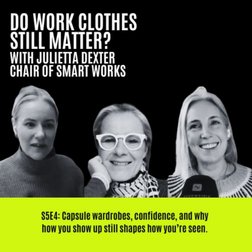
Do work clothes still matter? In this episode of the Work is Weird Now Podcast, we’re joined by Julietta Dexter, Founder of The Communication Store and Chair of Smart Works, the charity supporting unemployed women with coaching, clothing, and confidence to secure work. The question sounds simple, but it opens up something much bigger: Do work clothes still matter? Julietta’s answer is a clear yes — not because of outdated dress codes or corporate rules, but because what we wear still shapes confidence, identity, comfort, and belonging at work. Especially now, as careers become more flexible, more fragmented, and more uncertain. We talk about: Confidence dressing and first impressions (without dressing for anyone else) The unspoken “uniforms” different teams adopt at work Who decides what “appropriate” even means — and why it’s political The reality of age, fear, AI, and insecurity in today’s job market The Smart Works “magic moment” and why clothes can change how someone shows up Practical capsule wardrobe advice for real working lives (with a brilliant twist) This episode is for anyone navigating confidence at work, returning after time out, building a portfolio career, or wondering how to show up in a world where the old rules no longer apply. Because clothes still matter — just not in the way we were taught.

S5E3: How do we design a work life that’s uniquely ours? With Charlie Rogers

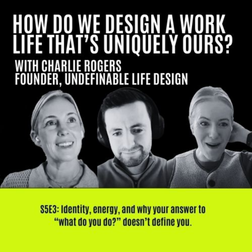
What if the safest career move right now is… refusing to be one thing? In this episode, Alice Phillips and Dan Emery are joined by Charlie Rogers, founder of Undefinable Life Design and author of a new book launching this March. Charlie introduces the idea of the “undefinable” — people whose working lives don’t fit neatly into a single job title, industry, or identity. Not because they’re unfocused, but because they’re layered. Against a backdrop of AI acceleration, job instability, and the slow collapse of the linear career ladder, Charlie argues that being meaningfully unique across several things is more resilient than being average at one. He calls it the automation of the average — and explains why your edge now lies in synthesis, lived experience, and perspective. We explore: Why traditional career labels are breaking down The Undefinable Ascent: a practical framework for designing work that actually holds up The case for being “semi-pro” in multiple things, not obsessed with one Why energy, not ambition, is the missing piece in most career advice What organisations need to learn as careers become less linear and more ecosystem-based This is a conversation about clarity without confinement — and designing a working life that’s sustainable, human, and genuinely yours.
2 de 7