Weather With a Reason

Weather With a Reason

por Weather With a Reason

How Atmospheric Rivers Carry So Much Water

Atmospheric rivers are long, narrow corridors that transport large amounts of water vapor through the sky. Explore how winds, moisture and terrain can turn that invisible flow into beneficial rain or damaging floods. Inside this episode: - A river made of moving air - Where the moisture comes from - Why a narrow band carries so much - The mountain squeezes out the water - Benefit and hazard Sources include NOAA, What are atmospheric rivers? and NOAA PSL, Atmospheric Rivers education PDF. This episode is a researched narrative summary. Historical records may be incomplete, translated differently, or interpreted differently by scholars. We distinguish documented facts, estimates, disputed interpretations, and later stories where material. Corrections are logged and incorporated into future editions. Follow Weather With a Reason for more researched stories about the physical reasons behind everyday weather.
Why Weather Forecasts Change

A forecast changes when new observations and updated model runs revise the best estimate of the atmosphere. Learn why those updates usually reflect an improving process rather than a forecaster changing course at random. Inside this episode: - A forecast starts with now - The atmosphere becomes a grid - Small differences grow - Ensembles sample possibility - New model runs are not simple replacements Sources include National Weather Service, Forecast Process, National Weather Service, Numerical Weather Prediction, and ECMWF, Quantifying Forecast Uncertainty. This episode is a researched narrative summary. Historical records may be incomplete, translated differently, or interpreted differently by scholars. We distinguish documented facts, estimates, disputed interpretations, and later stories where material. Corrections are logged and incorporated into future editions. Follow Weather With a Reason for more researched stories about the physical reasons behind everyday weather.

How Tornadoes Form Inside Severe Storms

Tornado formation begins within a much larger storm environment involving moisture, instability, wind shear and rotating updrafts. Explore what meteorologists understand and why no single visible feature guarantees a tornado. Inside this episode: - The storm needs energy - Rotation begins sideways - The supercell - Downdrafts enter the story - Tightening near the ground Sources include NOAA NSSL, Tornado Types and NOAA NSSL, VORTEX2 background. This episode is a researched narrative summary. Historical records may be incomplete, translated differently, or interpreted differently by scholars. We distinguish documented facts, estimates, disputed interpretations, and later stories where material. Corrections are logged and incorporated into future editions. Follow Weather With a Reason for more researched stories about the physical reasons behind everyday weather.

How a Thunderstorm Builds

This episode explores Instability, moisture, lift, cloud growth and the stages of an ordinary thunderstorm without offering storm-safety advice. The story keeps the mechanisms clear and the research grounded for a casual listener. Inside this episode: - Three ingredients - The updraft takes hold - Reaching the cold upper air - Precipitation creates a downdraft - Lightning inside ice Sources include NOAA thunderstorm guide, NOAA Physical Sciences Laboratory, convection in thunderstorms, and NOAA, Life Cycle of a Thunderstorm. This episode is a researched narrative summary. Historical records may be incomplete, translated differently, or interpreted differently by scholars. We distinguish documented facts, estimates, disputed interpretations, and later stories where material. Corrections are logged and incorporated into future editions. Follow Weather With a Reason for more researched stories about the physical reasons behind everyday weather.

What Makes Fog Persist

This episode explores Cooling, moisture, wind and terrain across several common fog mechanisms. The story keeps the mechanisms clear and the research grounded for a casual listener. Inside this episode: - A cloud where we live - Radiation fog - Advection fog - Sunlight and the fog top - Wind can build or destroy Sources include National Weather Service, fog, National Weather Service, fog types, and National Weather Service fog definitions. This episode is a researched narrative summary. Historical records may be incomplete, translated differently, or interpreted differently by scholars. We distinguish documented facts, estimates, disputed interpretations, and later stories where material. Corrections are logged and incorporated into future editions. Follow Weather With a Reason for more researched stories about the physical reasons behind everyday weather.

How Lenticular Clouds Form

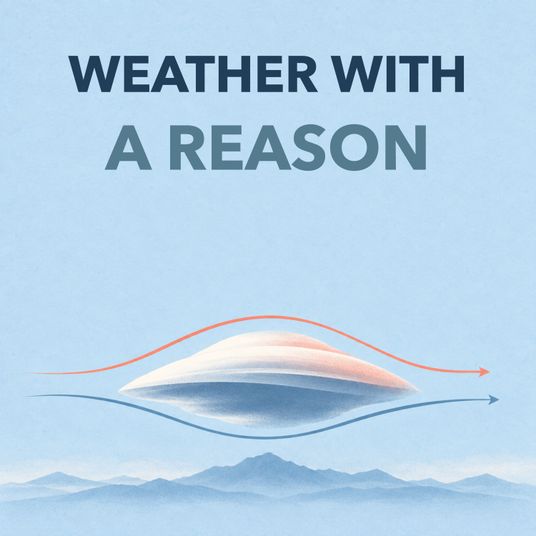
This episode explores Mountain waves, moisture and the stationary-looking clouds produced in moving air. The story keeps the mechanisms clear and the research grounded for a casual listener. Inside this episode: - Air meets a barrier - A standing wave - Condensing at the crest - Why the shape looks smooth - The role of stability Sources include United Kingdom Met Office, unusual cloud formations, Met Office, lenticular clouds, and World Meteorological Organization International Cloud Atlas. This episode is a researched narrative summary. Historical records may be incomplete, translated differently, or interpreted differently by scholars. We distinguish documented facts, estimates, disputed interpretations, and later stories where material. Corrections are logged and incorporated into future editions. Follow Weather With a Reason for more researched stories about the physical reasons behind everyday weather.

Why Sea Breezes Reverse

This episode explores Uneven heating, pressure differences and the daily movement of air near coasts. The story keeps the mechanisms clear and the research grounded for a casual listener. Inside this episode: - The land responds quickly - Pressure starts the motion - The sea-breeze front - Sunset removes the engine - Why the night breeze is often weaker Sources include National Weather Service, sea-breeze science, NOAA National Data Buoy Center, sea breeze, and National Weather Service Hawaii, land and sea breezes. This episode is a researched narrative summary. Historical records may be incomplete, translated differently, or interpreted differently by scholars. We distinguish documented facts, estimates, disputed interpretations, and later stories where material. Corrections are logged and incorporated into future editions. Follow Weather With a Reason for more researched stories about the physical reasons behind everyday weather.