Untangling Web3

Untangling Web3

por Jack Davies & Alec Burns
Temporada 1

#76 Untangling: Technology & Mental Health with Dr. Annie Zimmerman

In this episode of Untangling Web3, we're joined by Dr. Annie Zimmerman, a distinguished psychotherapist, to blend technology with mental health discussions. This episode explores how digital environments impact our psychological well-being and what the future holds for mental health in an increasingly digital world. Key highlights: Impact of Technology on Mental Health: Dr. Zimmerman sheds light on how pervasive technology use is reshaping our mental landscapes, particularly emphasizing the rise of mental health issues correlated with digital media consumption. Digital Interventions in Therapy: The conversation navigates through the potential and pitfalls of integrating technology in therapeutic practices, discussing innovative approaches like virtual reality (VR) in exposure therapy and digital platforms that facilitate remote mental health support. Technological Dependency: A critical discussion on our growing dependency on digital devices, highlighting the dual-edged nature of technology as both a tool for connectivity and a potential catalyst for isolation. The episode contemplates the ethical dimensions of integrating technology with human-centric services like mental health. Dr. Zimmerman advocates for a balanced approach where technology aids human connection without displacing the genuine human elements essential for meaningful interpersonal interactions. Our conversation together sheds light on the intersection of technology and mental health and prompts a deeper consideration of how we engage with technology daily. Learn more about Your Pocket Therapist here: Instagram: https://www.instagram.com/your_pocket_therapist TikTok: https://www.tiktok.com/@your_pocket_therapist Learn more about Web3 at: https://untanglingweb3.com/ -- Untangling Web3 is brought to you by hosts Jack Davies and Alec Burns, with music by Daniel Paigge. Got a question or topic suggestion? Send us an email at theuntanglingweb3podcast@gmail.com. Love what you're hearing? Show your support by becoming a subscriber and don't forget to leave us a stellar review. The views we express here are our own, and do not represent the views of our employers. Nothing discussed or stated in the show should be considered advice.


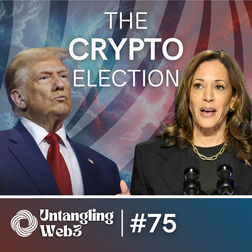
#75 Untangling: The Crypto Election

With the U.S. election just around the corner, today we delve into how cryptocurrency is influencing the political landscape as Donald Trump and Kamala Harris go head-to-head. Dubbed “America’s Crypto Election,” this campaign season has seen a record-breaking $120 million in donations from the crypto industry, sparking discussions on how each candidate’s stance could impact Bitcoin, blockchain regulation, and the broader crypto ecosystem. Join us as we explore what a Trump or Harris presidency could mean for the future of digital assets and decentralized finance. Key highlights: Crypto’s Growing Influence on Politics: The crypto industry’s impact on the election is undeniable, with major donations flowing to both candidates. This unprecedented involvement signals how significant digital assets have become in shaping public policy. We discuss the history and evolution of crypto’s role in U.S. politics and the implications of such substantial contributions, especially from high-profile donors and advocates like Sam Bankman-Fried and Robert Kennedy Jr. Candidate Stances on Bitcoin and Regulation: Donald Trump has openly supported Bitcoin, branding it “freedom money,” and promising a light regulatory approach. His running mate, JD Vance, also demonstrates a solid understanding of blockchain technology. Meanwhile, Harris leans toward cautious regulation, supporting crypto innovation but with protections for consumers and capital gains tax increases for high-value holdings. Each candidate’s stance reflects broader ideological divides on the government’s role in financial autonomy and innovation. Geopolitical and Economic Considerations: Beyond domestic policy, the U.S. must consider crypto’s role on the global stage. With nations like Russia and Iran exploring Bitcoin as a settlement currency, the U.S. faces the challenge of maintaining the dollar’s dominance or embracing digital assets to secure its influence. Trump’s pro-mining stance contrasts with Harris’s focus on sustainability, and each candidate’s approach could shape America’s economic role in a blockchain-driven world. As the U.S. election nears, the crypto industry stands at a critical juncture. Both candidates recognize the importance of digital assets, but with markedly different approaches. A Trump presidency promises robust support for Bitcoin and relaxed regulations, while Harris’s administration might lean toward cautious oversight and consumer protections. This election could define crypto’s future in the U.S. and beyond. Learn more about Web3 at: https://untanglingweb3.com/ -- Untangling Web3 is brought to you by hosts Jack Davies and Alec Burns, with music by Daniel Paigge. Got a question or topic suggestion? Send us an email at theuntanglingweb3podcast@gmail.com. Love what you're hearing? Show your support by becoming a subscriber and don't forget to leave us a stellar review. The views we express here are our own, and do not represent the views of our employers. Nothing discussed or stated in the show should be considered advice.
#74 Untangling: Meta Orion

This week on Untangling Web3, we dive into the cutting-edge developments at Meta with a focus on the recently announced Orion AR glasses and Meta's broader ambitions for the Metaverse. These innovative glasses represent a significant leap in wearable technology and the integration of AI and augmented reality (AR) into daily life. Join us as we explore Meta’s strategic moves to stay ahead of the competition and how their vision for the Metaverse is evolving through exciting hardware innovations like Orion. Key highlights: Meta’s Journey in Wearable Technology: Meta continues to push the boundaries of the Metaverse, evolving from its early Ray-Ban smart glasses to the groundbreaking Orion AR glasses. We discuss how Meta is strategically positioning itself to compete with tech giants like Apple and Samsung by blending AR, AI, and wearables. The company’s goal of creating seamless and immersive digital-physical experiences through these smart glasses is critical to the next phase of the Metaverse. Orion AR Glasses - A New Frontier: Meta's Orion AR glasses aim to combine augmented reality with everyday use, allowing users to blend the physical and digital worlds. These AI-powered glasses are designed for immersive experiences, enabling everything from hands-free navigation to real-time notifications. Although still in the prototype stage, with a high cost to produce, Meta’s vision for Orion sets the stage for mass-market AR wearables in the coming years. Metaverse, Glasses, and Privacy Concerns: As Meta continues to develop AR glasses and wearable technology, privacy concerns naturally arise. We delve into the potential implications of always-on, data-collecting devices and how Meta plans to address these issues. Balancing user convenience with security and data privacy will be crucial for widespread adoption of these innovations. The future of the Metaverse is still unfolding, and Meta's Orion AR glasses represent a pivotal step toward making immersive digital experiences a part of our daily lives. With the promise of blending AI, augmented reality, and wearables, Meta aims to redefine how we interact with both technology and the world around us. Stay tuned to Untangling Web 3 as we continue to track these developments and explore the ever-evolving landscape of Web3. Learn more about Web3 at: https://untanglingweb3.com/ -- Untangling Web3 is brought to you by hosts Jack Davies and Alec Burns, with music by Daniel Paigge. Got a question or topic suggestion? Send us an email at theuntanglingweb3podcast@gmail.com. Love what you're hearing? Show your support by becoming a subscriber and don't forget to leave us a stellar review. The views we express here are our own, and do not represent the views of our employers. Nothing discussed or stated in the show should be considered advice.

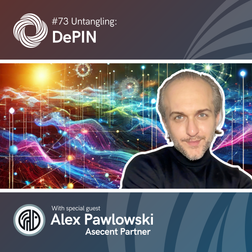
#73 Untangling: DePin with Alex Pawlowski

In this episode of Untangling Web3, we're joined by Alex Pawlowski, an expert in Decentralized Physical Infrastructure Networks (DePIN), to unravel how DePIN is revolutionizing traditional infrastructure systems through blockchain technology, enhancing both efficiency and public accessibility. Key highlights: Understanding DePIN: Alex defines DePIN as the integration of physical infrastructure with decentralized governance, which includes everything from transport systems to energy grids. By leveraging blockchain, these systems promise greater efficiency and public engagement. The Role of Blockchain: Detailed discussion on how blockchain technology underpins the decentralized aspect of DePIN, ensuring transparent and secure transactions within physical infrastructure networks. Real-World Applications: Exploration of practical implementations of DePIN, such as smart grids and decentralized energy production, where individuals not only consume but also produce and distribute resources. DePIN is set to have a significant impact in pushing forward the transition to renewable energy sources and reducing dependency on centralized power structures. In this episode, Alex highlights the importance of community involvement and the potential of blockchain to democratize access to essential services, paving the way for a more connected and sustainable future in the physical world through Web3 innovations. Learn more about Web3 at: https://untanglingweb3.com/ -- Untangling Web3 is brought to you by hosts Jack Davies and Alec Burns, with music by Daniel Paigge. Got a question or topic suggestion? Send us an email at theuntanglingweb3podcast@gmail.com. Love what you're hearing? Show your support by becoming a subscriber and don't forget to leave us a stellar review. The views we express here are our own, and do not represent the views of our employers. Nothing discussed or stated in the show should be considered advice.
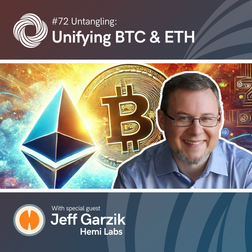
#72 Untangling: Unifying Bitcoin & Ethereum with Jeff Garzik

In this episode of Untangling Web3, hosts Jack and Alec are joined by Jeff Garzik, one of the original Bitcoin developers, who introduces his new project, Hemi. Jeff argues the need to bridge Bitcoin and Ethereum, leveraging the strengths of both to enhance Layer 2 solutions and blockchain interoperability. Key highlights: The early years of Bitcoin: Jeff shares his extensive experience with Bitcoin and his insights into its foundational technology, which led him to develop Hemi, aimed at unifying the Bitcoin and Ethereum networks. Technical Specifics of Hemi: the conversation covers the specifics of how Hemi functions to integrate the security features of Bitcoin with the programmability of Ethereum. Jeff discusses the technical challenges involved in making two distinct blockchains work seamlessly together and the potential solutions offered by Hemi. Impact on the Blockchain Ecosystem: the potential impacts of a successful integration between Bitcoin and Ethereum are examined, including what it means for developers, businesses, and end-users across the Web3 ecosystem. Jeff explains how Hemi could facilitate new forms of decentralized applications and improve scalability and transaction efficiency across both platforms. The unification of Bitcoin and Ethereum represents a pivotal development in blockchain technology, with the potential to drive broader adoption and innovation. This episode provides a detailed exploration of how Layer 2 solutions like Hemi are critical for the future scalability and functionality of cryptocurrencies and blockchain technology. Learn more about Hemi here: https://hemi.xyz/ Learn more about Web3 at: https://untanglingweb3.com/ -- Untangling Web3 is brought to you by hosts Jack Davies and Alec Burns, with music by Daniel Paigge. Got a question or topic suggestion? Send us an email at theuntanglingweb3podcast@gmail.com. Love what you're hearing? Show your support by becoming a subscriber and don't forget to leave us a stellar review. The views we express here are our own, and do not represent the views of our employers. Nothing discussed or stated in the show should be considered advice.
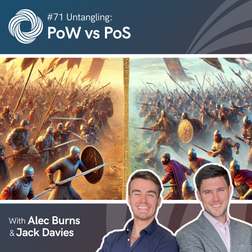
#71 Untangling: PoW vs PoS

This week on Untangling Web3, we dive into a critical aspect of blockchain technology—consensus algorithms, focusing specifically on Proof-of-Work (PoW) and Proof-of-Stake (PoS). These mechanisms are fundamental to ensuring decentralized networks agree on transactions and state without a central authority, and they lie at the heart of many discussions on blockchain scalability, security, and sustainability. Key highlights: Proof-of-Work (PoW) Overview: the original consensus algorithm used by Bitcoin. PoW relies on computational power to validate transactions, where miners solve complex mathematical puzzles. While it offers strong security through its energy-intensive nature, the environmental impact and low scalability remain major drawbacks. Despite these, Bitcoin’s PoW model has been battle-tested for over a decade, proving its resilience and decentralization. Proof-of-Stake (PoS) in Detail: PoS is highlighted as a greener alternative, used by Ethereum after its transition in 2022. Instead of energy consumption, PoS relies on validators who lock up tokens as a "stake" to participate in block validation. This system is more energy-efficient and scalable, but concerns remain about potential centralization due to the rich validators controlling the network. Ethereum’s PoS model has shown significant promise in terms of security and transaction speed. Comparing PoW and PoS: there are many advantages and disadvantages of PoW and PoS. PoW excels in security and decentralization but struggles with scalability and high energy use. PoS, on the other hand, offers improved efficiency and transaction throughput but faces criticism regarding potential centralization. The episode also touches on other variations, such as delegated PoS, and newer models like Proof-of-Authority and Proof-of-History, expanding the conversation on blockchain consensus mechanisms. Both PoW and PoS have unique strengths and trade-offs, with PoW being the more secure but resource-intensive model, while PoS provides a more scalable, eco-friendly solution at the potential cost of decentralization. As blockchain technology continues to evolve, these consensus mechanisms will play crucial roles in shaping the future of decentralized networks. Learn more about Web3 at: https://untanglingweb3.com/ -- Untangling Web3 is brought to you by hosts Jack Davies and Alec Burns, with music by Daniel Paigge. Got a question or topic suggestion? Send us an email at theuntanglingweb3podcast@gmail.com. Love what you're hearing? Show your support by becoming a subscriber and don't forget to leave us a stellar review. The views we express here are our own, and do not represent the views of our employers. Nothing discussed or stated in the show should be considered advice.
#70 Untangling: DAOs with Sunny Lu

In this week's episode of Untangling Web3, we're joined by Sunny Lu, co-founder and CEO of VeChain. Sunny brings a wealth of knowledge from his former role as CIO of Louis Vuitton China and over a decade in technology. VeChain, under Sunny's leadership, is redefining global supply chains and leveraging blockchain for sustainability initiatives like VeBetterDAO, which rewards sustainable actions. Key Highlights: DAOs and Decentralization: Sunny introduces us to the concept of Decentralized Autonomous Organizations (DAOs), explaining them as a new structure for collaboration and decision-making across diverse parties, aiming to achieve common goals efficiently. VeBetterDAO: The discussion dives deep into how VeChain uses blockchain to enhance supply chain transparency and efficiency, illustrating the practical applications of such technologies in enterprise settings. Challenges of DAOs: While DAOs promise a decentralized way of operating, they come with challenges such as ensuring widespread and knowledgeable participation in decision-making processes. Sunny's insights highlight the transformative potential of DAOs in business and beyond, advocating for a shift towards decentralized structures to tackle global challenges collaboratively. This episode not only illuminates the path forward for integrating blockchain into traditional businesses but also underscores the importance of community-driven decision making in fostering sustainable and innovative ecosystems. Learn more about VeBetterDAO here: https://vebetterdao.org/ Learn more about Web3 at: https://untanglingweb3.com/ -- Untangling Web3 is brought to you by hosts Jack Davies and Alec Burns, with music by Daniel Paigge. Got a question or topic suggestion? Send us an email at theuntanglingweb3podcast@gmail.com. Love what you're hearing? Show your support by becoming a subscriber and don't forget to leave us a stellar review. The views we express here are our own, and do not represent the views of our employers. Nothing discussed or stated in the show should be considered advice.

#69 Untangling: Web3 x Deck-building with Justin Gary

In this week's episode of Untangling Web3, we're joined by Justin Gary, the visionary behind the innovative trading card game, Solforge Fusion. With decades of experience in game design and a passion for blending physical and digital gaming experiences, Justin dives into how Web3 is revolutionizing trading card games through blockchain technology. Key Highlights: Transition to Web3: Justin shares his journey from traditional game design to embracing Web3, highlighting the unique opportunities and challenges this technology presents for trading card games. Solforge Fusion's Unique Mechanics: The game combines trading and deck-building mechanics with unique digital assets, making each player's deck a one-of-a-kind collection that can be traded on the blockchain. Economic and Community Impact: Discussion on the economic models within Web3 games and how Solforge Fusion fosters a community-driven approach, allowing players to influence game development and future content. This episode sheds light on the transformative impact of Web3 on traditional gaming, particularly in the deck-building and wider trading card game space. Justin's insights into the integration of blockchain technology highlight significant advancements in gameplay innovation and community engagement. His vision for Solforge Fusion not only enhances player ownership but also sets a new standard for interactive and immersive gaming experiences in the Web3 era. Learn more about Solforge here: https://solforgefusion.com/how-to-play Learn more about Web3 at: https://untanglingweb3.com/ -- Untangling Web3 is brought to you by hosts Jack Davies and Alec Burns, with music by Daniel Paigge. Got a question or topic suggestion? Send us an email at theuntanglingweb3podcast@gmail.com. Love what you're hearing? Show your support by becoming a subscriber and don't forget to leave us a stellar review. The views we express here are our own, and do not represent the views of our employers. Nothing discussed or stated in the show should be considered advice.

#68 Untangling: Bitcoin Mining with Kurt Wuckert Jr.

Join us in this episode of Untangling Web3 to explore the intricate world of Bitcoin mining with expert Kurt Wuckert Jr. This episode delves into the critical aspects of Proof of Work, providing a detailed examination of its mechanics, sustainability, and future trajectory in the blockchain ecosystem. Key Highlights: Deep Dive into Proof of Work: Kurt explains the technicalities of the Proof of Work process, emphasizing its role in validating transactions and maintaining the security and integrity of the Bitcoin blockchain. Economic Impacts of Mining: The discussion expands on the financial aspects of mining, including the cost of electricity and hardware, and how these factors influence the profitability and geographic distribution of mining operations. Environmental Concerns and Solutions: Kurt addresses the environmental concerns associated with Bitcoin mining, particularly focusing on energy consumption. He discusses the industry's efforts to move towards more sustainable practices, including the adoption of renewable energy sources within mining operations. Regulatory Landscape and Future Outlook: Insights into how changing regulations across the globe could impact Bitcoin mining. Kurt also speculates on future developments in the mining technology and how it could evolve to become more energy-efficient and less centralized. This episode offers a comprehensive look at Bitcoin mining through the lens of an expert, enhancing understanding of its complexities and the balance between technological advancement and environmental responsibility. Kurt's insights provide valuable perspectives on the sustainability and future of Bitcoin mining, preparing us all for the challenges and innovations shaping this crucial area of the cryptocurrency sector. Learn more about Web3 at: https://untanglingweb3.com/ -- Untangling Web3 is brought to you by hosts Jack Davies and Alec Burns, with music by Daniel Paigge. Got a question or topic suggestion? Send us an email at theuntanglingweb3podcast@gmail.com. Love what you're hearing? Show your support by becoming a subscriber and don't forget to leave us a stellar review. The views we express here are our own, and do not represent the views of our employers. Nothing discussed or stated in the show should be considered advice.

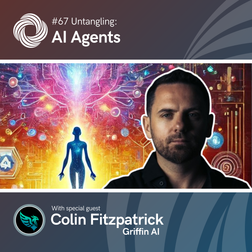
#67 Untangling: AI Agents with Colin Fitzpatrick

Dive into the world of Web3 and AI with our guest, Colin Fitzpatrick, Chief Business Development Officer at Griffin AI. This episode explores the integration of AI agents into blockchain applications, shedding light on how these technologies are not only transforming business operations but also enhancing user interactions within Web3. Key Highlights: AI Agents and their impact: Colin delves into what AI agents are and how they are poised to revolutionize technology by performing autonomous, goal-oriented tasks that simplify complex processes and enhance efficiency. Application in Web3: The discussion highlights the role of AI agents in Web3 environments, emphasizing their potential to improve transactional efficiency and user experience across decentralized platforms. Future Prospects and Innovations: Colin shares insights into the evolving landscape of AI agents, including their potential to handle more complex tasks and their integration into everyday applications, making technology more accessible and user-friendly. This episode not only illuminates the current capabilities of AI agents but also looks forward to their future developments. Colin’s expertise offers a compelling view of how AI will continue to merge with blockchain technology, promising significant advancements in how we interact with digital environments and manage automated tasks. Tune in to gain a deeper understanding of how AI agents are setting the stage for a more efficient and interconnected digital future. Learn more about Web3 at: https://untanglingweb3.com/ -- Untangling Web3 is brought to you by hosts Jack Davies and Alec Burns, with music by Daniel Paigge. Got a question or topic suggestion? Send us an email at theuntanglingweb3podcast@gmail.com. Love what you're hearing? Show your support by becoming a subscriber and don't forget to leave us a stellar review. The views we express here are our own, and do not represent the views of our employers. Nothing discussed or stated in the show should be considered advice.
7 de 14