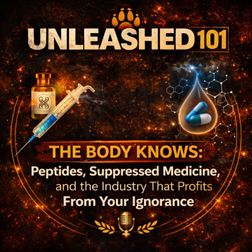
The Body Knows: Peptides, Suppressed Medicine, and the Industry That Profits From Your Ignorance
What if the most effective healing tools available to you have been sitting in the published medical literature for thirty years — and the system you trust with your health has been quietly, systematically, and deliberately keeping them out of reach?In this episode of Unleashed 101, host Jeremy Hanson examines the growing body of research behind therapeutic peptides — specifically BPC-157, TB-500, and KPV — and confronts the institutional machinery responsible for their suppression in American healthcare. This is not fringe science. This is peer-reviewed research published across multiple countries, documenting measurable outcomes in tissue repair, inflammation reduction, gut healing, neurological protection, and cellular regeneration. The evidence base is real. The suppression is equally real.What Jeremy covers in this episode:The pharmaceutical industry's fundamental business model — why a patient who recovers is a lost customer, and why chronic disease management is the most profitable product the healthcare system has ever built.The FDA's structural conflict of interest — how the Prescription Drug User Fee Act created an agency that is substantially funded by the companies it regulates, and what that funding relationship produces in practice for treatments that have no industry sponsor.The approval pathway as a financial filter — why the absence of FDA approval for peptide compounds reflects the absence of pharmaceutical industry economics, not the absence of clinical evidence.BPC-157 in depth — derived from human gastric protein, studied in over a hundred peer-reviewed publications, demonstrating accelerated healing of tendons and ligaments, neuroprotective properties, gastrointestinal repair outcomes, and anti-depressant effects with a safety profile that puts most approved alternatives to shame.TB-500 and musculoskeletal recovery — the documented outcomes in muscle fiber repair, tendon regeneration, and inflammatory response reduction that have driven widespread adoption in athletic communities and produced real-world results that mirror the controlled research.KPV and anti-inflammatory applications — why a three-amino-acid peptide that outperforms approved biologics for certain inflammatory bowel conditions in animal studies has generated no pharmaceutical development interest, and exactly what that tells you about the system's priorities.The suppression playbook — how dismissal, demonization, and regulatory capture operate in sequence to eliminate access to compounds that threaten pharmaceutical revenue, with specific reference to the FDA's escalating enforcement actions against compounding pharmacies supplying peptide therapy to legitimate medical practices.Delivery method advances — how developments in oral bioavailability and intranasal administration are narrowing the access barriers that the regulatory environment depends on to contain peptide use, and why the enforcement response has followed the accessibility research.The physicians and patients at the margin — the gastroenterologists, neurologists, and orthopedic practitioners incorporating these compounds into practice under institutional pressure, and the patients who found measurable functional recovery after years of dependence on approved treatment pathways that produced symptom management but not resolution.The liberty argument — in plain terms, why the government's authority to prevent you from accessing compounds your own body already produces, with a documented safety record and decades of supporting research, should concern anyone who takes the concept of individual autonomy seriously.This episode is not asking you to reject medicine. It is asking you to reject the framing that positions an industry-funded regulatory apparatus as a neutral guardian of public health. The evidence does not support that framing. The outcomes do not support it. The incentive structure does not support it.Unleashed 101 exists to ask the questions that the official channel