Truth about Local Government

Truth about Local Government

por Matt Masters

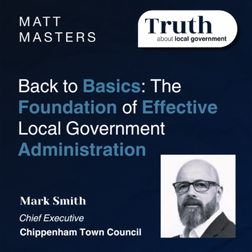
Back to Basics: The Foundation of Effective Local Government Administration with Mark Smith

Great to sit down with Mark Smith, Chief Executive of Chippenham Town Council. At the core of our conversation was advice to local government leaders on the steps to provide stability as a leader and the positive outcomes that flow from this.

Balancing Act: Parenting in Public Service with James Hewings.

James Hewings is a father, a property professional working for Surrey County Council and is studying for job related qualifications. He is a busy man and being a good father and good employee are two top priorities. Today we discussed what employees and employers can do to help support parents and get the best out of them.

How to develop a culture & heritage strategy with Dr Tim Jenkins.

Culture and heritage can sometimes be an after thought for local authorities; but, it is imperative that you get a strategy in place. Today we sat down with Dr Tim Jenkins, a culture & heritage advisor who supports local authorities define and then realise their culture and heritage ambitions. We discussed: 1. The Future of Local Authority Museums (Legislation, Funding, Societal Cohesion, Place-shaping & Identity, Interpretation of Collection) 2. Managing & Conserving Public Heritage (Managing Historic Assets, Ownership, Planning Policy, Physical and Intellectual Access, Relationships with National Bodies) 3. Importance of a Cohesive Strategy (Making the tough decisions - Asset or Liability, Disposals in best interest of Historic Asset, Place Shaping and Heritage-led Regeneration)

Navigating the Digital Frontier with Socitm ft David Ogden

Today we hosted the Director of Engagement from Socitm, David Ogden. We discussed the Public sector digital trends 2024, its implications and the position that Socitm is taking in the sector.

Revamping Success: Restructuring Organisations Without Sacrificing Results with Sarah Hayward

With so many local authorities needing to restructure to achieve cost savings, I spoke with Sarah Hayward a highly experienced Director of Change and Improvement about advice she would give to authorities going through this transition. The conversation covers, how to identify low hanging fruit, the importance of honesty and integrity, having evidence based outcomes in your financial decision making and the importance of using and collecting data to support a clearly articulate objective and mission statement.

Digital Vision Roundtable - an 'art of possible' discussion with Richard Twelvetrees

Great to sit down with Richard Twelvetrees, Experience & Value Enablement Director, from de Novo Solutions. We explored how local authorities can use brainstorming collaboration to maximise their digital investment and get continued value from their digital transformation journey. Such an important topic.

Finding the Balance: Navigating Flexible Working for Mutual Success with Rich Hanrahan

Today I sat down with Rich Hanrahan, Co Founder of RPNA, who helps leaders develop high performing teams, lead more effectively and create unstoppable momentum. We discussed the problem, around the war for talent - how to attract and retain the best people. One of the key levers that councils can utilise is flexible working arrangements. Rich talked through how we can make flexibility work for employer and employee. Our conversations answers the following questions: What do we mean by flexibility in employment? What’s happening right now in terms of attitudes to flexible working? How does flexibility sit in today’s world of work? So where are we today? And what is the benefit to employees How does this impact the employee / employer relationship? And are there benefits to employee / employer relationship of introducing greater flexibility? So what should we be thinking about when it comes to flexibility? What gets in the way of introducing flexibility? SO how should we consider and approach introducing more flexibility? If you want to reach out to Rich - his email is: Richard.hanrahan@therpna.co.uk

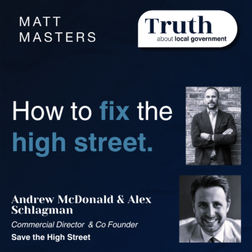
How to fix the high street with Andrew McDonald & Alex Schlagman

SaveTheHighStreet.org launched in August 2016 with the the release of a Manifesto that outlined a new vision for the high street and how we achieve it together. Today, SaveTheHighStreet.org is led by a passionate dedicated team, an Advisory Board of 200+ high street businesses and industry experts, a fast-growing community of Local Champions and dozens of other partners across both public and private sectors. Together they have supported over 25,000 local businesses in the U.K. and we’re just getting started.They focused their conversations on the need to work with the next generation of retailers, in light of diminishing occupational demand from the national multiple retail chains. Great to sit down with Alex Schlagman, Co Founder of Savethehighstreet.org and Andrew McDonald, retail property expert, where we discussed: How to fix our high streets in light of fewer larger-brand retail requirements ;and how the public and private sector can work in partnership to address the vacancy challenges in our town centres? Also, great to launch our partnership with Rich Hanrahan and RPNA. RPNA work with you to design, build and deliver leadership, wellbeing and transformation programmes that are people centred, digitally enabled and developed for the future of public service provision. They are a fantastic partner with public sector organisations across the UK.

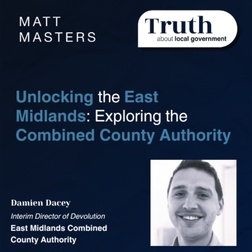
Unlocking the East Midlands: Exploring the Combined County Authority with Damien Dacey

Join us in this episode of Truth about local government, as we delve into the intricacies of the East Midlands Combined County Authority (EMCCA) with Damien Dacey - Interim Director of Devolution. As one of the UK's pivotal regions, the East Midlands is undergoing transformative changes, and understanding the role and impact of the EMCCA is essential. In this episode, we uncover the following: What is the East Midlands Combined County Authority? Where are you now on bringing devolution to the East Midlands? What can devolution offer local government trying to deliver growth/create jobs alongside all the on-demand statutory services? You've worked on devolution in other parts of the country. What is distinct/different about the EM experience so far? What's your sense about the potential for the people/communities/business that live the area? How do you see the agenda developing and over what timeframe? You've just spent 10 years working on national policy in Whitehall, latterly running the team that worked on delivering the LU White Paper and negotiating new devolution deals including the one you're working on now in the EM. What has been your experience in making the move out of Whitehall into local government?

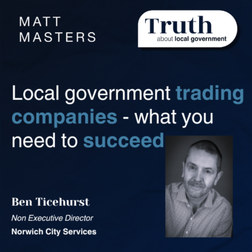
Local government trading companies - what you need to succeed. FT Ben Ticehurst.

Ben is a highly regarded local government executive director, management consultant, non-exec director and poacher/gamekeeper with almost 40 years public services experience. Throughout Ben’s substantive and consulting career he has a successful track record of managing, leading, and transforming services and commercial ventures across People, Place and Corporate Services, often in highly political and unionised environments. A bright, creative thinker, consultative and facilitative by nature, Ben is a solutions driven and outcome focussed completer-finisher. Ben’s commercial and technical expertise and acumen is underpinned by a mixed tool kit approach to change coupled with strong governance which Ben ultilises to horizon scan and mitigate risk. Ben’s innate ability to articulate viable, easy to understand solutions and outcomes to stakeholders ensures that officers, organisations, and members are brought on the transformation journey, business benefits are realised, and more robust, financially viable and sustainable public services are achieved, delivering better outcomes for all. Today we discussed, how that in some situations, a problem facing councils is that they have trading companies but realise they’re not as well equipped to manage them as they want to, or should be. Segments: How did this come about? What are typical problems? What are the things many councils didn’t know they needed to prepare for? What steps can councils take to overcome these challenges?
25 de 36