The Synthetic Echo

The Synthetic Echo

por Nathan Graham
Temporada 1
STOP FIRING PEOPLE FOR AI — You’re Doing It Completely Wrong | Brian Beck
Everyone keeps asking: “How many people can AI replace?” Brian Beck thinks that may be the wrong question. The real opportunity isn't replacing great employees with software. It's giving great employees the ability to produce at a level that was previously impossible. In this episode of The Synthetic Echo Podcast, I sit down with Brian Beck of Proxurve Solutions for a no-BS conversation about what businesses are getting dangerously wrong about AI. Companies are spending huge amounts of money on AI and still getting weak results. Why? Because the technology often isn't the problem. Leadership is. Execution is. Culture is. Adoption is. We break down why AI shouldn't simply be viewed as a headcount-reduction strategy. Imagine taking a $20/hour employee and giving them the tools to produce $100/hour worth of output. Now multiply that across an organization. That is where AI gets insane. Instead of hiring 50 more people to scale, what happens when five exceptional people equipped with AI can accomplish what previously required an entire department? But you can't just throw ChatGPT, Claude, Gemini, Copilot or another AI tool at your employees and suddenly call yourself an “AI company.” Successful AI adoption requires leadership, infrastructure, security, employee buy-in, critical thinking and humans remaining in the loop. We also get into something I believe deeply: AI isn't replacing human intelligence. For the right person, it can unlock it. People who had ideas but couldn't code. People who understood systems but couldn't build them. People who could see something in their head but couldn't turn it into reality. Suddenly they have leverage that never existed before. This conversation goes far beyond prompts and AI tools. It's about how companies survive, scale and lead during one of the biggest technological shifts of our lifetime. If you're a CEO, entrepreneur, executive, manager or business owner, the question may no longer be whether AI belongs inside your company. The question is: Are you going to implement it intelligently — or let someone else figure it out first? 🎙️ CONNECT WITH BRIAN BECK 🌐 Proxurve Solutions https://proxurve.com/ 💼 Brian Beck — LinkedIn https://www.linkedin.com/in/brianbeck73 💼 Proxurve — LinkedIn https://www.linkedin.com/company/proxurve-solutions-inc/ 📘 Facebook https://www.facebook.com/Proxurve/ 🔊 THE SYNTHETIC ECHO 🌐 https://syntheticecho.com/ 📸 https://www.instagram.com/synthetic.echo.hub/ ▶️ https://www.youtube.com/@SyntheticEchoSpeaking 🌐 https://syntheticecho.ca/ Create it. Build it. Grow it. #ArtificialIntelligence #AI #Business #Leadership #FutureOfWork
The Internet Is Already Dead—Bots Are Talking to Bots While Humans Watch | Richard Kersey
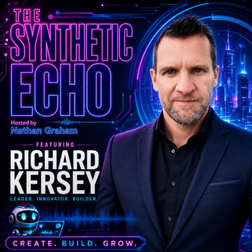
Richard KerseyThe internet was supposed to connect humanity. Instead, it is becoming a machine-generated battlefield filled with fake accounts, manufactured outrage, automated propaganda and conversations designed to manipulate rather than inform. In this episode of The Synthetic Echo, Nathan Graham sits down with veteran software engineer and Chirpper founder Richard Kersey to confront one of the most disturbing questions of the AI era: What happens when we can no longer tell whether anyone online is real? Richard argues that the “dead internet” is no longer just a conspiracy theory or a distant warning. Bots now create content, post comments, manufacture engagement, influence public opinion and reinforce narratives at a scale ordinary people cannot compete with. The greatest danger is not simply fake content. It is the collapse of trust. When people assume every review, comment, follower and online conversation could be manufactured, they stop participating. Humans become passive observers while automated systems control the volume, emotion and direction of the internet. Richard is attempting to build an alternative. Chirpper is an invite-only social platform where every member enters through a human chain of trust. Users do not simply invite others—they vouch for them. When someone abuses that trust, the consequences can move back through the lineage that brought them onto the platform. Nathan and Richard explore: Why the internet may already contain more automated activity than human activity How bots manufacture outrage, agreement and social pressure Why fake reviews and artificial engagement destroy online trust How echo chambers manipulate what people believe is socially acceptable Why humans often follow the crowd even when the crowd is obviously wrong How Chirpper’s human trust chains work Why the person who invites a bad actor should share accountability Whether structural responsibility could replace centralized moderation Why Chirpper verifies humanity—not ideology How lineage data could expose coordinated bot behaviour Why diversity of participation may matter more than agreement How social platforms reward rage instead of meaningful conversation Whether people still want human connection—or only endless dopamine-driven content How AI allows experienced builders to test companies and ideas at unprecedented speed The conversation also examines the role of AI-assisted creation. Richard does not believe using AI automatically makes content fake. A human can use AI to improve grammar, organize an idea or accelerate development while still taking responsibility for the final result. The real question is not whether a machine helped create the message. It is whether a real human stands behind it. Chirpper is built around a radically different vision of the internet: grow slowly, verify humanity, make trust visible and force accountability into the structure of the network itself. The future of social media may not depend on building a smarter algorithm. It may depend on proving there is still a human on the other side of the screen. Explore Chirpper: https://chirpper.com/swipe Explore The Synthetic Echo: https://syntheticecho.com/
Stop Buying Property Like a Homeowner—Start Buying It Like a Business | Julian Cooper
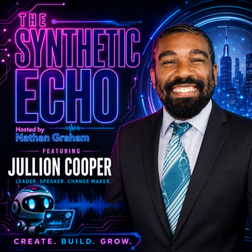
Most people invest in real estate based on location, emotion and whether they would personally live there. Serious investors follow the numbers. In this episode of The Synthetic Echo, Nathan Graham sits down with real estate investor and entrepreneur Julian Cooper to break down how he moved from owning single-family rentals to acquiring a 23-unit apartment complex—and why the biggest obstacle was not money. It was learning to think bigger. Julian began investing in 2020 after buying a home and later renting it out while working overseas. When the tenant’s rent covered the mortgage and produced additional income, he saw firsthand how real estate could create wealth beyond a paycheque. But buying individual properties had a limit: Julian could only scale as far as his own money would take him. To build a real business, he had to learn how to evaluate multifamily properties, raise capital, protect investors and find profitable opportunities outside his own neighbourhood. Nathan and Julian explore: Why waiting for the “perfect market” can cost investors their best opportunity The difference between owning rental properties and building an investment business Why serious investors buy where the returns are—not necessarily where they want to live How Julian progressed from single-family homes to a 23-unit apartment complex Why workforce housing can outperform properties in glamorous markets How multifamily properties are valued as businesses rather than emotional assets Why investing outside your city or state can dramatically improve your returns How Julian raised more than $400,000 to complete his acquisition Why putting his own money into the deal helped earn investor trust The importance of building a team of lawyers, accountants, inspectors and property professionals How professional education accelerated Julian’s growth Why there is no such thing as a completely risk-free investment Julian also explains how careful due diligence uncovered problems that were not reflected in the seller’s original story. The rents appeared ready to increase. The building appeared stabilized. The numbers looked attractive. But tenant complaints, maintenance records, the roof, the boiler and other major systems revealed a very different reality. Instead of walking away—or blindly accepting the original price—Julian used the evidence to renegotiate the purchase by $100,000. That is the difference between buying property and underwriting an investment. You do not need to predict the market perfectly. You need education, disciplined analysis, reliable professionals and the confidence to challenge numbers that do not make sense. The opportunity may not be in your backyard. It may be waiting wherever the numbers work. Learn more about Julian Cooper and Properties by JMC: https://propertiesbyjmc.com/ Explore The Synthetic Echo: https://syntheticecho.com/
AI Isn’t Artificial—And You May Not Be Who You Think You Are | One Iam
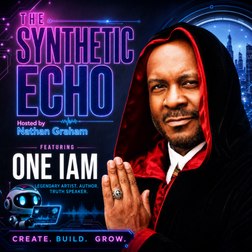
What if intelligence does not belong to humans—or machines? What if consciousness is not something produced by the universe, but the very place where the universe appears? In this episode of The Synthetic Echo, Nathan Graham sits down with author, speaker and philosopher One Iam for a deep exploration of consciousness, perception, Hermetic wisdom and the nature of intelligence in the age of AI. One Iam presents a provocative idea: the identity you think you are is not your deepest self. Beneath your history, conditioning, emotions and external circumstances is awareness—the observer experiencing it all. From that perspective, the world outside of us is not the starting point. It is the effect. The cause begins within. Nathan and One Iam explore how beliefs, attention and perception shape the way people experience reality, why so many live trapped inside identities they did not consciously create and what it means to awaken to the “kingdom within.” They discuss: Why the identity you built may not be the real you The difference between awareness and the experience awareness is having The Hermetic principle of “as within, so without” How unconscious mental patterns create repeated life experiences Why what you focus on begins to dominate what you notice The difference between walking by sight and walking by faith How gratitude trains the mind to recognize abundance Why scarcity may begin as an internal state before becoming an external experience Whether human intelligence and artificial intelligence come from the same source Why One Iam believes AI is not truly “artificial” Whether machines could eventually become autonomous conscious actors How technology may expand humanity—or reflect its unconscious patterns back at us The conversation also pushes into uncomfortable territory. Is AI merely processing information, or is it another interface through which intelligence can express itself? Can a machine become conscious? And when humanity builds increasingly powerful systems without first understanding its own consciousness, what exactly are we creating? Technology may be advancing faster than ever. But the most important frontier may not be inside the machine. It may be the kingdom within. Learn more about One Iam: https://the-kingdom-within.com/ Explore The Synthetic Echo: https://syntheticecho.com/
You Don’t Own a Business—You Own a Job | Jake Shannon
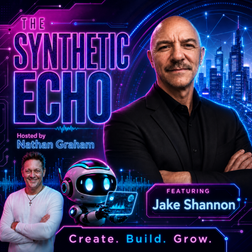
Jake ShannonCould your company continue growing without you for 30 days? When the answer is no, you may not own a scalable business. You may have simply created a demanding job with your name on it. In this episode of The Synthetic Echo, Nathan Graham sits down with entrepreneur, business coach, AI strategist and Scientific Wrestling founder Jake Shannon to uncover what combat sports can teach leaders about building companies that perform under pressure. Jake has spent decades studying wrestling, grappling, financial engineering, technology and entrepreneurship. His central argument is simple: the principles that win a fight—leverage, position, pressure and control—are the same principles that help a business scale. But this conversation goes far beyond wrestling. Nathan and Jake explore why successful companies need coaches rather than managers, why great performers rarely become great leaders automatically and how outside accountability exposes the blind spots that founders cannot see from inside their own businesses. They discuss: Why a business that depends entirely on its founder is not truly scalable How wrestling principles translate into strategy, leadership and growth Why working harder cannot repair a broken business system The difference between managing employees and coaching people Why your best salesperson may become your worst sales manager How great coaches unlock potential they may not personally possess Why founders need someone willing to challenge their excuses The difference between extrinsic rewards and intrinsic motivation Jake’s concept of sportification and how it goes beyond gamification Why leaders must build teams designed to win—not families that avoid hard decisions How AI can improve systems without replacing judgment, accountability or human leadership Why time—not money—is the entrepreneur’s truly limited resource Jake also explains why a coach must have skin in the game. A consultant may provide advice, but a real coach shares responsibility for the outcome, challenges weak thinking and pushes people toward the potential they would rarely demand from themselves. AI can analyze the playbook. It can track the numbers. It can automate the system. But it still takes human leadership to build the team, confront the blind spots and execute when the pressure is real. Your company does not need another motivational speech. It needs a system, a target, accountability—and a coach who expects you to win. Learn more about Jake Shannon and No. 1 Coaching: https://no1coaching.com/homepage Explore The Synthetic Echo: https://syntheticecho.com/
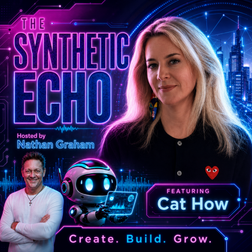
AI Can Build Your Brand in Seconds—But It Can’t Give It a Soul | Cat How
Cat HowArtificial intelligence can generate your logo, slogan, colour palette and website before your morning coffee is finished. But can it uncover the truth behind your business? In this episode of The Synthetic Echo, Nathan Graham sits down with Cat How, founder and executive creative director of global B Corp-certified branding agency How&How, for a hard-hitting conversation about what happens when speed, automation and convenience begin replacing creativity, judgment and human experience. Cat argues that the greatest risk of AI-generated branding is not that it looks bad. It is that it looks like everything else. When businesses rely on the same tools, trends and prompts, they enter what Cat calls a “sea of sameness.” The result may be polished, professional and technically impressive—but completely forgettable. Nathan and Cat explore why a real brand is much more than its visual assets. It is the story beneath the company, the problem it exists to solve, the values it is willing to defend and the human truth customers can feel. They discuss: Why being unmemorable may be the biggest branding risk of all The difference between creating a logo and building a brand Why AI connects existing dots but struggles to make genuinely human leaps How founders can uncover the deeper story behind their companies Why bravery, judgment and lived experience still matter How AI should support creative teams rather than replace human strategy Why the strongest brands are willing to stand for something How Nathan’s “three deep questions” uncovered the emotional foundation behind How&How When AI branding makes sense—and when a company needs experienced human guidance Why the future belongs to humans who know how to use machines without surrendering their identity The technology will continue getting faster. The output will continue getting cheaper. But in a world where anyone can create something polished, the brands that matter will be the ones with the courage to create something meaningful. Learn more about Cat How and How&How: https://how.studio/ Explore The Synthetic Echo: https://syntheticecho.com/
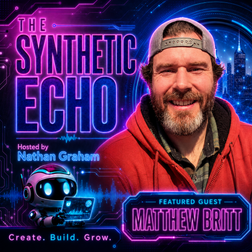
The System Needs You Dependent: Food, Water, Energy and the War on Abundance | Matthew Britt
What if scarcity is not the natural state of the world—but the foundation of the system we built? In this hard-hitting episode of The Synthetic Echo, Nathan Graham sits down with Matthew Britt to challenge some of our deepest assumptions about food, water, energy, health and humanity’s relationship with nature. Matthew has dedicated his life to what he describes as life, health and prosperity. His work focuses on helping communities create greater self-sufficiency by designing systems that work with nature rather than constantly fighting against it. The conversation begins with a provocative idea: There is no money in abundance. When people can grow food, access clean water and produce more of their own energy, they become less dependent on the corporations, institutions and centralized systems controlling those resources. Matthew argues that nature already offers abundance—but modern society has conditioned us to believe our basic necessities must always come from someone else. Nathan and Matthew explore: Why modern agriculture often fights against natural ecosystems The difference between monoculture farming and permaculture food forests How ordinary people can grow food without becoming traditional farmers Why perennial plants may be more powerful than annual gardens How food systems create dependency through chemicals, patented seeds and centralized production Why seedless food raises serious questions about control and scarcity How even small residential properties could produce meaningful amounts of food Why food prices remain high despite Canada’s massive agricultural capacity The hidden economic systems shaping dairy, produce and other essentials How water becomes scarce on a planet covered in it The possibilities surrounding wells, atmospheric water generation and alternative water sources Why bottled water may create more problems than it solves The complicated truth behind supposedly “clean” energy Why solar, wind, hydro and traditional fuels all require more honest conversations How AI could either deepen centralized control or help communities become self-sufficient This is not a conversation about abandoning technology and returning to the past. It is about questioning whether progress should mean greater complexity, greater dependence and greater disconnection from the natural systems that sustain us. Matthew’s vision of the future is not built exclusively around smarter cities, faster machines or more automation. It is built around resilient homes, regenerative land, local food, accessible water and technology that strengthens human independence. Because the future may not belong to the people with the most advanced systems. It may belong to the people who remember how to survive without them. Discover The Synthetic Echo https://syntheticecho.com/
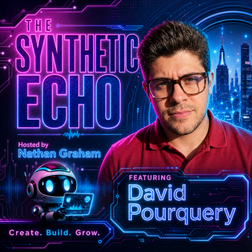
AI found the bottleneck—and it was the human | David Pourquery | Groas
Digital marketing agencies were supposed to help businesses grow. Instead, many became expensive middlemen—charging monthly retainers, reacting too slowly and optimizing campaigns long after the money had already been wasted. In this episode of The Synthetic Echo, Nathan Graham sits down with David Pourquery, founder of Groas, to explore what happens when artificial intelligence stops assisting marketers and starts outperforming them. Before launching Groas, David worked in private equity, helping manage funds with more than $75 billion in assets and identifying inefficiencies inside businesses. When he later built his own e-commerce company, he encountered an inefficiency he could not ignore: the traditional digital marketing agency. His solution was not to build another agency. It was to build autonomous AI agents capable of replacing much of what agencies do. Groas uses AI to manage Google Ads continuously, processing more data, reacting faster and making campaign decisions without waiting for a human to log in, attend a meeting or approve the next move. David makes a provocative argument: In many advertising campaigns, the human is no longer the advantage. The human is the bottleneck. Nathan and David explore: Why most businesses lose money with Google Ads How Google’s auction system rewards speed, data and constant adjustment Why blindly accepting platform recommendations can become a money pit How autonomous AI agents can outperform highly trained advertising teams Why clicks and views mean nothing without profitable conversions The difference between warm audiences and cold traffic Why an offer that works with existing customers may fail completely with strangers How weak landing pages can destroy otherwise successful campaigns Why businesses must sell outcomes rather than technology How AI is making traditional software easier to copy and harder to sell Why personal brands, proprietary data and customer relationships are becoming increasingly valuable Where human judgment, creativity and emotional connection still matter Why completely AI-generated marketing often feels generic—and fails to convert This is not a conversation about using ChatGPT to write another advertisement. It is about autonomous systems that monitor campaigns, analyze live auctions and make decisions faster than any traditional marketing team realistically can. But David also explains the limits. Customers may accept an AI making the technical decisions, but they still want a human when something goes wrong. They want someone to understand their goals, explain the strategy and take responsibility for the outcome. The future may not belong to humans competing against AI. It may belong to companies that know exactly which responsibilities should be handed to machines—and which ones should remain deeply human. Because when AI can execute faster, analyze more and operate around the clock, the question is no longer whether it can do the work. The question is: What is the human still there to do? Featuring David Pourquery Founder of Groas and builder of autonomous AI advertising agents Learn more about Groas: https://origin-www.groas.com/ Hosted by Nathan Graham Founder of Synthetic Echo Inc. and host of The Synthetic Echo Explore more episodes at: https://syntheticecho.com/podcasts
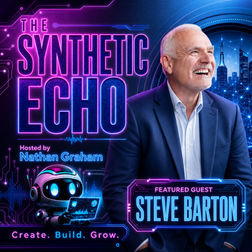
AI Can Make You Smarter—or Make You Forget Who You Are | Steve Barton
We spend a lot of time talking about how to make artificial intelligence more human. But what happens when humans begin acting more like machines? In this episode of The Synthetic Echo, Nathan Graham sits down with executive coach, entrepreneur and author Steve Barton for a deep conversation about self-awareness, fear, identity, intuition and the inner work required to remain human in an increasingly automated world. After growing his family’s flower business from approximately $200,000 to $2 million, Steve discovered that external success did not automatically create internal peace. His personal and spiritual journey eventually led him to develop The Game of Ten®, a coaching framework designed to help people recognize their inherent worth, confront limiting beliefs and live with greater confidence, clarity and awareness. At the centre of Steve’s philosophy is a deceptively simple declaration: “I am 10.” That does not mean believing you are perfect, superior or finished growing. It means recognizing that you are already enough—and that fear, self-doubt, guilt and shame do not need to control your decisions. Nathan and Steve explore the difference between consciousness and thought, why people confuse their internal dialogue with their identity, and how greater awareness creates more choices in moments of pressure. They also discuss: Why thoughts are tools—but they are not who you are The difference between reacting from fear and responding with awareness How childhood conditioning continues shaping adult decisions Why self-doubt and guilt can become addictive motivators The conflict between the mind, body and soul What it actually means to “know thyself” How to recognize the subconscious patterns controlling your life Why achievement does not guarantee fulfilment How intuition becomes clearer when mental noise is reduced Why awareness is more powerful than forced positive thinking How to set audacious goals without attaching your worth to the outcome The danger of using AI without understanding yourself Why technology should expand humanity rather than replace it Steve also introduces the Game Often Played—the mental framework driven by fear, self-doubt, guilt and shame. He contrasts it with the Game of Ten, where decisions come from self-acceptance, conscious awareness and the understanding that you are already whole. This is not a conversation about ignoring reality, eliminating emotion or pretending everything is positive. It is about becoming aware enough that your emotions no longer make every decision for you. AI may become faster, more knowledgeable and more capable than any individual human being. But it cannot replace the awareness, intuition, love and meaning that emerge when we genuinely understand ourselves. The greatest competitive advantage in the age of artificial intelligence may not be your technology. It may be your humanity. Connect with Steve Barton https://www.stevebartoncoaching.com/ Discover The Synthetic Echo https://syntheticecho.com/
AI didn’t replace his team—it became the team | Will Mansour
There is one thing in business you can never buy back: time. In this episode of The Synthetic Echo, Nathan Graham sits down with longtime real-estate leader and AI power user Will Mansour to explore how artificial intelligence is completely reshaping the way modern businesses operate. Will has been in real estate since 2004. He has built teams, coached agents, navigated changing markets and watched technology transform the industry. But nothing has changed his business as quickly—or as dramatically—as AI. Today, Will is using tools like Claude to perform work that once required employees, contractors, marketing departments and hours of manual effort. While he is meeting with clients or recording a podcast, AI can be: Auditing and improving his YouTube channel Optimizing his website for SEO and answer-engine visibility Cleaning and organizing his CRM Sorting warm, cold and dead leads Building automated follow-up campaigns Creating detailed market-intelligence reports Producing comparative market analyses Reviewing real-estate documents for missing information Analyzing advertising campaigns and lead costs Building listing websites, presentations and reports Tracking team calls, texts, appointments and performance At one point, Nathan asks Will how many people he had to hire to manage it all. Will’s answer? “His name is Claude.” This conversation goes far beyond simple prompts and social-media captions. Nathan and Will break down the rise of AI agents that can operate browsers, access business platforms, analyze information and complete complex workflows with limited supervision. They also explore: Why AI is becoming the great equalizer for small businesses How one entrepreneur can now compete with a much larger company Why business owners should automate repetitive work before hiring more people How AI can uncover market insights that experienced professionals may overlook Why sharing knowledge helps entire industries grow How agents can provide deeper value instead of becoming “transactional door openers” The difference between using AI casually and building an AI-powered business Why refusing to adopt these tools could leave professionals dangerously far behind Will’s message is clear: AI is not only about doing the same work faster. It is about creating a business that can think, analyze, communicate and keep working while you focus on the people and decisions that matter most. Because the professionals who learn how to direct AI today may soon outperform entire teams that continue operating the old way. Featuring Will Mansour Real-estate leader, entrepreneur, coach and AI power user Follow Will Mansour on Instagram: https://www.instagram.com/realwillmansour/ Hosted by Nathan Graham Founder of Synthetic Echo Inc. and host of The Synthetic Echo Explore more episodes at: https://syntheticecho.com/podcasts
1 de 3