The Dyslexic Signal

The Dyslexic Signal

Video Podcast
por Lauren Divine
Temporada 6

Why Do I Know the Material at Home but Go Blank During the Test

Video
Have you ever understood the material at home, only to sit down for a test and feel as though everything disappeared? In this episode of The Dyslexic Signal, Lauren and Harrison explain why learning information and retrieving it under pressure are not always the same. For dyslexic students, the combined demands of reading, remembering directions, organizing an answer, managing time, and worrying about mistakes can heavily load working memory. You will learn: How working memory supports test performance Why anxiety can compete for attention and make retrieval harder Why going blank does not automatically mean a student failed to study Two respectful sentences students can use to ask for help The five-part Recall Ready Plan for studying A 60-second reset for moments when the mind goes blank How the 3-2-1 Confidence Card can strengthen evidence-based confidence Why testing accommodations should be individualized and connected to what the test is designed to measure Who This Episode Is For Dyslexic teens and adults, parents and caregivers, teachers, counselors, learning specialists, and anyone trying to understand the gap between knowing the material and showing that knowledge during a test. Disclaimer This podcast provides general educational information and lived experience. It is not intended to diagnose dyslexia, anxiety, a memory disorder, or any other medical, psychological, developmental, or learning condition. It is not a substitute for an individualized evaluation or professional advice. Anyone experiencing severe, persistent, or worsening anxiety should speak with an appropriately qualified healthcare, mental-health, psychological, or educational professional. Resources Owens et al. (2014), anxiety, working memory, and cognitive test performance: https://pubmed.ncbi.nlm.nih.gov/24387098/ Nelson et al. (2015), test anxiety among students with reading disabilities: https://pubmed.ncbi.nlm.nih.gov/24153402/ What Works Clearinghouse, Organizing Instruction and Study to Improve Student Learning: https://ies.ed.gov/ncee/wwc/PracticeGuide/1 International Dyslexia Association, Accommodations for Students with Dyslexia: https://dyslexiaida.org/accommodations-for-students-with-dyslexia/ U.S. Department of Education, Section 504: https://www.ed.gov/laws-and-policy/individuals-disabilities/section-504 If this episode helps you understand a student differently, share it with one parent, teacher, counselor, or teen. Understand the signal. Reduce the shame. Make the next step possible.
Temporada 5

Why Do Dyslexic Teens Hide Their Struggles?

Video
When a dyslexic teenager says, “I don’t care,” it may actually mean, “I care so much that I cannot let anyone see me struggle.” In this episode of The Dyslexic Signal, Lauren and Harrison explore how shame and stigma can affect dyslexic teenagers at home, at school, and in social situations. Listeners will learn how hidden shame can show up as anger, avoidance, perfectionism, joking, refusing to read aloud, hiding grades, or rejecting help. The episode explains why these behaviors should be approached with curiosity rather than immediately labeled as laziness, defiance, or a lack of motivation. Parents and educators will receive practical guidance for protecting confidence without lowering meaningful expectations. The episode also includes three self-advocacy scripts teenagers can use, strategies for responding to bullying, and a simple “3-2-1 Confidence Card” exercise that helps teens recognize their abilities, identify helpful supports, and ask for what they need. Who This Episode Is For Dyslexic teenagers Parents and caregivers Teachers and school administrators Counselors and educational professionals Mentors and youth advocates Anyone supporting a young person with dyslexia Disclaimer This podcast provides general educational information and lived-experience discussion. It is not intended to provide medical, psychological, educational, legal, or diagnostic advice. Dyslexia and emotional health affect each person differently. Parents and caregivers should consult appropriately qualified educational or healthcare professionals for individualized guidance. Take statements about wanting to die, feeling hopeless, being a burden, or having no reason to live seriously. In the United States, call or text 988 for the Suicide & Crisis Lifeline. Call 911 when there is immediate danger. Listeners outside the United States should contact their local emergency or crisis service. Resources Research on learning-disability stigma: https://doi.org/10.1177/00222194221087383 Growing up with dyslexia—child and parent perspectives: https://doi.org/10.1002/dys.1729 Developmental dyslexia and mental health: https://doi.org/10.3390/ijerph20021653 School connectedness and emotional well-being: https://doi.org/10.1002/dys.1775 StopBullying.gov—Youth with disabilities: https://www.stopbullying.gov/bullying/special-needs 988 Suicide & Crisis Lifeline: https://988lifeline.org/ If this episode helps you, follow The Dyslexic Signal and share it with one teenager, parent, teacher, or counselor who needs this conversation. Understand the signal. Reduce the shame. Make the next step possible.
Temporada 4

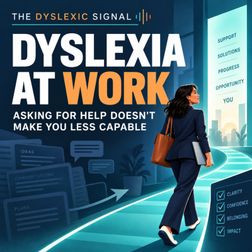
Dyslexia at Work: How to Ask for Help Without Feeling Less Capable

Video
Asking for support at work does not make you less capable. It can help your true ability show. In this episode of The Dyslexic Signal, Lauren Divine and Harrison Cole explore the hidden effort many dyslexic employees put into managing dense emails, multistep verbal directions, proofreading, meetings, training, and workplace expectations. You will learn how to identify the specific barrier affecting your work, connect it to a practical solution, and ask for support clearly and professionally. The episode includes four ready-to-use request scripts, examples of possible workplace accommodations, guidance for deciding whether to disclose dyslexia, and advice for responding when the first conversation does not go well. Managers will also learn how clear priorities, written action items, accessible technology, examples, and private feedback can help capable employees perform at their best. Who This Episode Is For Dyslexic employees and job applicants Adults who suspect dyslexia affects their work Managers, supervisors, and business owners Human Resources and workplace-support professionals Parents helping dyslexic teenagers prepare for employment Coworkers and advocates who want more inclusive workplaces Disclaimer This episode provides general educational information and lived-experience discussion. It is not legal, medical, psychological, employment, or diagnostic advice. Workplace rights and accommodations depend on individual circumstances, essential job duties, employer coverage, location, and applicable law. Consult an appropriate workplace contact, qualified professional, or attorney for guidance about a specific situation. Resources U.S. Equal Employment Opportunity Commission — Disability Discrimination and Reasonable Accommodation: https://www.eeoc.gov/disability-discrimination-and-reasonable-accommodation-medical-inquiries-leave-and-telework EEOC — Job Applicants and the ADA: https://www.eeoc.gov/laws/guidance/job-applicants-and-ada Job Accommodation Network — Free, confidential accommodation guidance: https://askjan.org/ International Dyslexia Association — Dyslexia Basics: https://dyslexiaida.org/dyslexia-basics/ If this episode helps you, follow The Dyslexic Signal and share it with one employee, manager, or family member who needs this conversation. Understand the signal. Reduce the shame. Make the next step possible.
Temporada 3

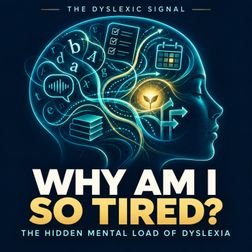
Why Am I So Tired? The Hidden Mental Load of Dyslexia. Season: Dyslexia in Everyday Life

Video
Why can an ordinary day of reading, remembering, organizing, and communicating leave a dyslexic person completely drained? Following our conversation about dyslexia and ADHD, Lauren Divine and Harrison Cole explore the hidden mental load that can accompany dyslexia. Tasks that appear simple from the outside—reading an email, following verbal instructions, taking notes, checking spelling, or organizing thoughts—may require considerable mental effort. In this episode of The Dyslexic Signal, we discuss why this invisible work can contribute to mental fatigue without suggesting that dyslexic people are less intelligent, motivated, or capable. You will learn how working memory, language processing, self-monitoring, and masking difficulties may add to the load. We also share practical ways to protect your energy: Identify the tasks that demand the most mental effort Schedule demanding work around your strongest energy periods Ask for written instructions and accessible formats Use reminders, templates, text-to-speech, and speech-to-text Build recovery time between demanding tasks Replace perfectionism with clear definitions of “finished” Explain your needs without apologizing for them Who This Episode Is For Dyslexic adults and adolescents, parents, students, educators, employers, and anyone who wants to understand the invisible effort behind everyday tasks. Important Note Mental fatigue is not the same as physical exhaustion or excessive daytime sleepiness. Dyslexia may help explain why certain language-heavy tasks require more effort, but fatigue can have many causes. Disclaimer This podcast provides general educational information and lived experience. It does not diagnose or treat dyslexia, fatigue, sleep disorders, or any other medical, psychological, developmental, or learning condition. If you experience new, persistent, severe, or unexplained fatigue—or regularly fall asleep unintentionally—please speak with an appropriately qualified healthcare professional. Resources International Dyslexia Association: Dyslexia Basics International Dyslexia Association: Accommodations for Students with Dyslexia Beyond Reading: Psychological and Mental Health Needs in Developmental Dyslexia Executive Functions and Developmental Dyslexia CDC: About Sleep NHLBI: Anemia Follow The Dyslexic Signal so you do not miss our next episode: “Dyslexia at Work: How to Ask for Help Without Feeling Less Capable.” Understand the signal. Reduce the shame. Make the next step possible.
Temporada 2

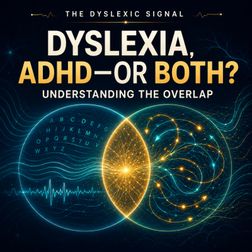
Dyslexia or ADHD—or Both? Understanding the Overlap

Video
Difficulty concentrating, forgetting instructions, avoiding reading, and struggling to complete tasks can appear in both dyslexia and ADHD—but the underlying reasons may be different. In this episode of The Dyslexic Signal, Lauren Divine and Harrison Cole explain the similarities and important differences between dyslexia and attention-deficit/hyperactivity disorder. Learn how dyslexia primarily affects reading, decoding, and spelling, while ADHD involves persistent difficulties with attention, hyperactivity, impulsivity, or a combination of these symptoms. The episode also explores how dyslexia and ADHD can occur together, why one does not cause the other, and why only a qualified professional should provide a diagnosis. Who This Episode Is For Dyslexic adults and adolescents, people with or exploring ADHD, parents, caregivers, students, educators, employers, and anyone seeking a clearer understanding of these conditions. Disclaimer This podcast provides general educational information and lived experience. It does not diagnose dyslexia, ADHD, or any other condition and is not a substitute for an individualized professional evaluation. Attention, memory, reading, organization, and behavioral difficulties can have several causes. Consult an appropriately qualified healthcare, psychological, or educational professional for personal guidance. Resources CDC: Diagnosing ADHD CDC: ADHD in Adults International Dyslexia Association: ADHD and Dyslexia International Dyslexia Association: Dyslexia Basics AAP: ADHD Clinical Practice Guideline Comorbidity of Reading Disabilities and ADHD High Rates of Comorbidity Among Neurodevelopmental Disorders Understand the signal. Reduce the shame. Make the next step possible.
Temporada 1

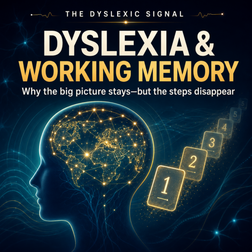
Why Can I See the Big Picture but Forget the Instructions? Dyslexia and Working Memory

Video
Have you ever understood the goal but forgotten the steps before you could begin? In this episode of The Dyslexic Signal, we explore how verbal working memory may affect directions, appointments, studying, and conversations. Learn why forgetting instructions does not necessarily mean someone is lazy, careless, or not listening. This episode explains working memory in plain language and offers practical strategies, including written directions, checklists, calendar reminders, active studying, repeating instructions, and creating more processing space during conversations. Who This Episode Is For This episode is for: Dyslexic adults and adolescents Students Parents and caregivers Teachers and school professionals Employers, managers, and coworkers Anyone who wants to understand dyslexia and working memory better Not every dyslexic person experiences working-memory difficulties, and memory problems can have many different causes. This episode presents research alongside lived experience without suggesting that one experience applies to everyone. Disclaimer: This podcast provides general educational information and lived experience. It is not intended to diagnose dyslexia, memory disorders, ADHD, or any other condition, and it is not a substitute for individualized medical, psychological, or educational advice. Anyone experiencing new, severe, or worsening memory problems should consult an appropriate healthcare professional. Resources Working Memory Profiles of Children With Dyslexia, Developmental Language Disorder, or Both Lived Experiences of Everyday Memory in Adults With Dyslexia Memory Deficits in Children With Developmental Dyslexia Phonological Working Memory and Central Executive Function in Children With Dyslexia International Dyslexia Association: Working Memory—The Engine for Learning International Dyslexia Association: Accommodations for Students With Dyslexia Understand the signal. Reduce the shame. Make the next step possible.

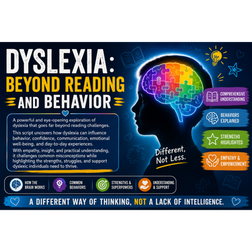
Dyslexia: Beyond Reading and Behavior

Video
Dyslexia: Beyond Reading and Behavior Dyslexia is more than a reading difficulty. In this episode, we explore how dyslexia can affect communication, confidence, memory, emotions, behavior, and everyday life. We challenge common misconceptions, explain why dyslexic behaviors are often misunderstood, and highlight the creativity, resilience, problem-solving, and unique strengths of dyslexic thinkers. Dyslexia is not a lack of intelligence—it is a different way of thinking, learning, and experiencing the world. Disclaimer This podcast provides general educational information and lived experience. It is not intended to diagnose dyslexia, memory disorders, ADHD, or any other condition, and it is not a substitute for individualized medical, psychological, or educational advice. Anyone experiencing new, severe, or worsening memory problems should consult an appropriate healthcare professional.

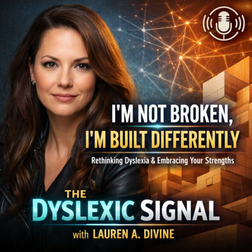
I’m Not Broken — I’m Built Differently

“I’m Not Broken — I’m Built Differently” What if the things you were told were weaknesses are actually signs you were built for a different kind of work? In this identity-defining episode of The Dyslexic Signal, Lauren reframes dyslexia—not as a learning problem to fix, but as a strategic, creative way of thinking that has been misunderstood for far too long. This episode is for the dyslexic adult who: Thinks in big pictures but struggles with linear systems Feels inconsistent, drained, or “too much” in traditional work environments Has been praised for intelligence yet criticized for execution Knows they’re capable of more—but can’t explain why things feel harder than they should Through personal insight and grounded reflection, Lauren explains what dyslexia actually looks like in a strategic, creative adult—and why many dyslexic people burn out trying to play roles they were never designed for. This is not a motivational speech. It’s a clarity episode. What You’ll Get From This Episode By the end of this episode, listeners will: Understand why dyslexia often shows up as vision, synthesis, and systems thinking Learn the difference between a work ethic problem and a role misalignment Gain language to describe their strengths to employers, teams, or family Feel validated—not fixed Begin shifting from self-blame to self-alignment Most importantly, listeners will walk away with this truth: You are not broken. You are built differently—and that difference has value. This episode is a signal—for anyone ready to stop forcing themselves into boxes that don’t fit. Ideal Listener: Dyslexic adults Neurodivergent professionals Creatives, founders, strategists, and system thinkers Anyone questioning where they belong in work or life Disclaimer This podcast provides general educational information and lived experience. It is not intended to diagnose dyslexia, memory disorders, ADHD, or any other condition, and it is not a substitute for individualized medical, psychological, or educational advice. Anyone experiencing new, severe, or worsening memory problems should consult an appropriate healthcare professional.

Rewiring the Classroom: How Schools Can Better Support Neurodiverse Students

Episode 11 – "Rewiring the Classroom: How Schools Can Better Support Neurodiverse Students." Host Lauren Divine dives deep into the heart of education reform with Dr. Peterson, an educational psychologist and neurodiversity advocate. Together, they explore how schools can move beyond basic accommodations to truly empower every kind of learner. Listeners will discover: Practical classroom strategies for teachers to support neurodiverse students Real-life success stories that show inclusion in action How policies and systemic changes can build equitable learning environments Tools and technologies that amplify learning strengths rather than highlight weaknesses This episode offers a heartfelt conversation filled with hope, humanity, and hands-on solutions—perfect for educators, parents, and anyone who believes every brain deserves to shine. What Listeners Will Gain By tuning in, you'll learn how to: Advocate effectively for neurodiverse students in schools. Use Universal Design for Learning (UDL) principles to reach more learners. Recognize and nurture the hidden strengths in dyslexic and ADHD students. Build empathy and understanding in classrooms through collaboration. Continue the Journey with Lauren's Books on Dyslexia For more insights and real-world guidance, explore Lauren's empowering books on dyslexia — both filled with stories, strategies, and hope for families and educators: Dyslexia: The Hidden Superpowerhttps: https://a.co/d/bk7FBdU Teaching the Hidden Learner: How to Unlock the Brilliance in Every Student https://a.co/d/8xpmQ4o Disclaimer This podcast provides general educational information and lived experience. It is not intended to diagnose dyslexia, memory disorders, ADHD, or any other condition, and it is not a substitute for individualized medical, psychological, or educational advice. Anyone experiencing new, severe, or worsening memory problems should consult an appropriate healthcare professional.
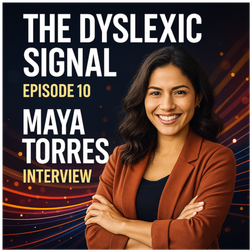
Breaking the Barriers: A Conversation with Entrepreneur Maya Torres

Title: Breaking the Barriers: A Conversation with Entrepreneur Maya Torres | The Dyslexic Signal Ep. 10 In this inspiring episode, Lauren sits down with Maya Torres, a creative entrepreneur who turned her dyslexia into her greatest strength. Hear Maya's story of resilience, innovation, and self-belief — and learn how thinking differently can become your superpower. What You'll Learn: How dyslexia can fuel creativity and leadership How to overcome fear and embrace your uniqueness Why different thinkers are shaping the future Watch now and be reminded that your difference is your gift! #TheDyslexicSignal #LaurenDivine #DyslexiaAwareness #Motivation Disclaimer: This podcast provides general educational information and lived experience. It is not intended to diagnose dyslexia, memory disorders, ADHD, or any other condition, and it is not a substitute for individualized medical, psychological, or educational advice. Anyone experiencing new, severe, or worsening memory problems should consult an appropriate healthcare professional.
1 de 3