Desirability is the new Margin - from Paris đŸ‡«đŸ‡·

Desirability is the new Margin - from Paris đŸ‡«đŸ‡·

por The Deep Dive Team
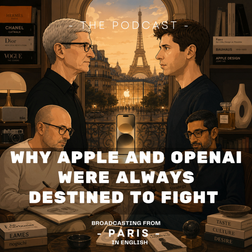
Why Apple and OpenAI Were Always Destined to Fight.
From White House state dinner partners to federal court adversaries in just ten months, why was the war between Apple and OpenAI structurally inevitable? In this episode, we break down Marc Abergel's strategic analysis and introduce The Desire Stack: a powerful framework explaining why the bottom of the tech economy pays for the future while the top collects the profits. We explore why building the world's frontier AI model won't save you if someone else owns your customer's daily ritual, why OpenAI’s $6.5 billion Jony Ive hardware pivot was a desperate "prison break" from supplier economics, and a final, mind-bending question: What happens to the entire desire economy when AI agents start doing the buying for us? On Value Capture:"Intelligence creates value, but desire captures it." On Tech Economic Gravity:"The bottom of the stack pays for the future, but the top of the stack collects it." On Supplier Economics:"OpenAI accepted the economics of a supplier. Inside the iPhone, ChatGPT could answer the question, but Apple still owned the moment in which the question was asked." On the Risk of Invention:"The bottom of the stack is where cost and risk pool like water in a basement." On Indispensability vs. Profit:"Being indispensable is not the same thing as capturing the profit." On Jony Ive & Ecosystem Moats:"Jony Ive designed inside a cathedral that Apple spent 50 years building. He didn't own the congregation." The Steering Wheel Metaphor:"Jony Ive designed the steering wheel, but Apple owns the entire highway infrastructure. You can't just drop a steering wheel into a user's life and expect them to change their commute." On Muscle Memory vs. Taste:"Taste is an input. Desire is an accumulated relationship—the muscle memory of a billion thumbs reaching for a glass rectangle every morning." On OpenAI’s Hardware Strategy:"It wasn't random diversification. It was a desperate, textbook attempt to pull off a $6.5 billion prison break from the basement of tech economics." The Final Paradox:"What happens to the Desire Stack when AI agents start doing the buying for us?"
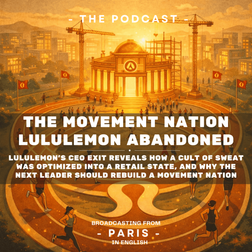
The Movement Nation Lululemon Abandoned: Lululemon CEO Calvin Mcdonald's exit reveals how a cult of sweat was optimized into a retail state, and why the next leader should rebuild a Movement Nation
What happens when a CEO triples revenue, builds a flawless omnichannel machine, cracks 30 new markets
 and still gets fired while $35 billion in market value evaporates? In this episode, we use Lululemon and Calvin McDonald as a case study in how operational brilliance can quietly hollow out a “movement nation” and turn it into a sterile retail state. Drawing on Marc Abergel’s analysis, we unpack why infrastructure without mythology is just expensive asphalt, how Mirror, loyalty programs and store design were treated as utilities instead of nation-building tools, and why the next generation of leaders must be cultural architects, not optimization gurus. “When you fire a CEO who successfully tripled your revenue, what were they really being fired for?” “Infrastructure without mythology is just expensive asphalt.” “The cost of tripling the revenue was that desire died—the product stopped being a sacred object.” “Who does the board ultimately serve: the financial citizens on Wall Street, or the Lululemon citizens who wear the brand as an extension of their identity?” “Those manifesto bags shifted the question from ‘What are you buying?’ to ‘What are you becoming?’” “Today, the roads are immaculate—but they lead to a nation with no sacred centre, only a retail state.” “Mirror should have been Lululemon cinema—a theatre for mythology, not just another discounted piece of hardware.” “You don’t need more categories; you need sovereignty—vertical depth into the science of feel.” “Loyalty must be earned, not purchased; you trade administrative simplicity for cultural sovereignty.” “Lululemon’s stock collapse wasn’t a failure to hit targets—it was the market finally pricing in cultural bankruptcy.” Full analysis: The Movement Nation Lululemon Abandoned - by Marc Abergel Lululemon CEO Calvin Mcdonald's exit reveals how a cult of sweat was optimized into a retail state, and why the next leader should rebuild a Movement Nation https://marcinparis.substack.com/p/the-movement-nation-lululemon-abandoned
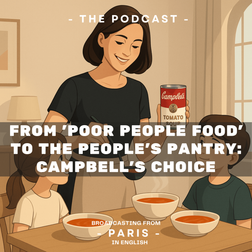
From 'Poor People Food' to The People's Pantry: Campbell's Choice. How Campbell's Can Turn a Scandal into a new Social Contract where Dignity Becomes Profit
In this episode, we open your pantry and your politics by asking a simple question: what happens when the brand that quietly fed America for 155 years suddenly seems ashamed of the people it feeds? Using the recent Campbell’s VP scandal as our entry point, we treat that infamous “poor people food” comment not as mere PR drama, but as a diagnostic of something deeper: a crisis of dignity in mass-market capitalism. Guided by Marc Abergel’s analysis “From Poor People Food to The People’s Pantry”, we reframe Campbell’s as a “Cultural Nation” – alongside Costco, IKEA, even Hermùs – and explore how affordability, when owned with pride, can be as sovereign as any luxury price tag. From Costco’s $1.50 hot dog to IKEA’s democratic design, we build a four-pillar playbook for how Campbell’s could turn shame into sovereignty and rebuild trust with the people who count every dollar. If you’ve ever reached for that red-and-white can on a hard night, this conversation is about you, and about why the next great corporate innovation might be engineered, affordable constancy. “How do you steward dignity when your primary design constraint is affordability?” “That simple red and white can isn’t about aspiration—it’s about continuity.” “Campbell’s has functioned as a quiet piece of national infrastructure.” “For 150 million Americans, Campbell’s isn’t just on the shelf; it’s carried in their emotional memory banks.” “Campbell’s doesn’t ask you to reach for it, it asks you to rely on it.” “The problem isn’t the affordability; it’s the shame of the affordability.” “Costco’s $1.50 hot dog isn’t a loss leader; it’s a social contract written in mustard and bun.” “Affordability isn’t a failure of design, it’s the ultimate design challenge.” “The message, whether it’s IKEA or Campbell’s, is: you deserve beauty and comfort, even on a budget.” “The greatest corporate innovation today may not be new premium products, but engineered, affordable constancy that protects the dignity of the most financially constrained customer.”
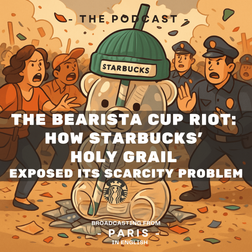
The Bearista Cup Riot: How Starbucks’ Holy Grail Exposed Its Scarcity Problem
A $30 glass teddy bear mug caused riots, police calls, and a secondary market listing cups for up to $50,000. Drawing on Marc Abergel's analysis, we unpack the Starbucks Bearista Cup launch as a live-fire experiment in modern desirability – and how a mass coffee chain accidentally moved like Hermùs, then apologized for it. We show how Starbucks behaves less like a coffee shop and more like a “cultural nation”: 75 million rewards members, seasonal rituals like Pumpkin Spice and Red Cup Day and decades of collectible nostalgia. We break down the brutal math of the launch – where resellers made more than three times Starbucks’ own revenue – and diagnose the four “sovereignty failures” in access, resale, narrative, and data that turned a coronation into a street fight. Then we flip it: a concrete “desirability playbook” for any brand with a fanbase, from Nike to Trader Joe’s, on how to choreograph access, own the aftermarket, author the story, and reward the people who camp out at 3 a.m. This isn’t just about coffee; it’s about who owns desire in your category. Top quotes: “Starbucks proved they have the cultural power of a luxury brand – they just don’t yet have the infrastructure to steward it.” “That 75 million rewards list isn’t a customer file, it’s a constituency.” “The people lining up at 3 a.m. didn’t just want the cup – they wanted to be first. Access equals status.” “You’ve got a $30 glass bear triggering the same behavior as a multimillion-dollar Birkin at auction; the psychology is identical, the difference is control.” “Starbucks did all the work to build the desire, then watched other people walk away with more than three times the profit. That’s the brutal math.” “It was a battlefield, not a ceremony – a luxury brand would never treat its inner circle that way.” "The narrative of the launch was dictated by the TikTok algorithm, not by the brand.”
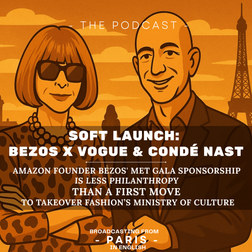
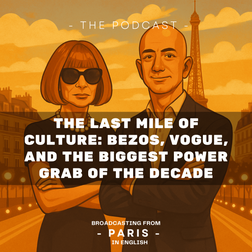
Soft Launch: Bezos x Vogue & CondĂ© Nast | Amazon Founder Bezos' Met Gala sponsorship is less philanthropy than a first move to takeover fashion’s Ministry of Culture
Jeff Bezos doesn’t just want boxes at your door, he wants the last mile of culture. In this episode, we unpack the persistent rumour, through the analysis of Marc Abergel, a luxury executive based in Paris, that Amazon’s founder is coming for CondĂ© Nast and Vogue, not as a media trophy, but as the ultimate cultural operating system. We break down why this would be the biggest power grab in luxury and media in a generation: the king of logistics fusing with fashion’s Ministry of Culture, Anna Wintour as “cultural general” to Bezos’ empire and what it means when taste itself becomes a cloud service optimized for conversion. For CEOs, CMOs and creative leaders, this is not about magazines. It’s about who owns desire, who writes the canon of taste and whether LVMH, Chanel, HermĂšs and Kering can defend their cultural sovereignty in a world where desirability is the new margin. Full analysis here: https://marcinparis.substack.com/p/soft-launch-bezos-x-vogue-and-conde Selected quotes from episode: “This isn’t a media deal, it’s the biggest cultural power grab of the decade.” “Bezos has already conquered the last mile of commerce; now he wants the last mile of culture.” “Amazon knows what you buy. Vogue knows what you aspire to buy. This is the vertical integration of influence.” “To own Vogue is to own the compass that orients aspiration for the entire industry.” “If Bezos becomes Caesar, Anna Wintour is his cultural general, his infrastructure, her authority.” “Under Bezos, Vogue could become a cultural AWS: taste on demand, provisioned at scale, rented by any brand that wants instant legitimacy.” “Luxury houses risk becoming vendors inside someone else’s cultural nation of taste, negotiating from occupied territory.” “This rumour signals a new reality: culture is the ultimate infrastructure, because it generates demand in the first place.” “Luxury can’t answer this with another seasonal campaign; it needs a sovereign stack for culture and taste.” Read more Soft Launch: Bezos x Vogue & CondĂ© Nast | Amazon Founder Bezos' Met Gala sponsorship is less philanthropy than a first move to takeover fashion’s Ministry of Culture
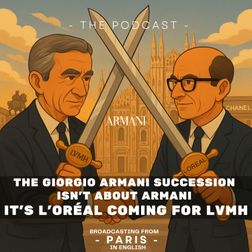
The Giorgio Armani Succession isn't about Armani: It's about L'Oréal Coming for LVMH
Paris Fashion Week just became the opening act of a new empire war. In this episode we unpack Marc Abergel (Luxury Executive based in Paris) analysis of the strategic chess match between LVMH and L’OrĂ©al, a clash not just for Armani, but for the future architecture of luxury itself. (Read Marc Abergel's article here: The Armani Succession Isn't About Armani. It's L'OrĂ©al Coming for LVMH) It’s The Vatican of Desire vs. The Colosseum of Access: scarcity versus scale, mystique versus mass aspiration. From the quiet corridors of Dior to the open-air spectacle of L’OrĂ©al Paris, we explore how data, beauty licenses and public theater are rewriting the balance of power in global luxury. And why the winner may not be the one you expect. Listen as we decode how one acquisition could turn L’OrĂ©al from a beauty powerhouse into a $50 billion fashion sovereign by 2030 and why Bernard Arnault may already have Barbarians at his gates. Selected quotes: “It’s the Vatican of Desire vs. the Coliseum of Access.” “Armani isn’t the prize—it’s the test.” “LVMH bets that distance creates desire; L’OrĂ©al bets that access creates loyalty.” “L’OrĂ©al isn’t bidding on an asset—it’s completing a system.” “$7 billion isn’t a price tag; it’s a down payment.” “Beauty licenses aren’t just revenue—they’re Trojan horses of data.” “Sephora proves LVMH can run a Coliseum; it just keeps it walled off from fashion.” “This is an operating-system war, not a bigger-check contest.” “Rome watched Persia; the Barbarians sacked the city.” “Will LVMH notice the rival empire before it’s already inside the gates—drinking their champagne?” https://marcinparis.substack.com/p/the-armani-succession-isnt-about
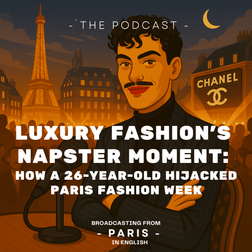
Luxury Fashion’s Napster Moment: How Lyas, a 26-Year-Old Hijacked Paris Fashion Week
What happens when a single content creator outsmarts the world’s most powerful luxury Maisons? Based on the analysis of Marc Abergel, luxury executive in Paris, this episode unpacks the phenomenon of Lyas Medini: the 26-year-old Parisian who turned rejection from Dior into a revolution. In just four months, he went from watching shows on a bar TV to commanding thousands at live “watch parties” that drew bigger crowds than Chanel itself. But this isn’t just a viral story, it’s a wake-up call. Luxury’s entire system of control, from access to data, narrative, and distribution, is being rewritten in real time. Drawing on Abergel’s essay “Fashion’s Napster Moment,” this conversation explores how Lyas exposed the industry’s soft underbelly: its dependence on platforms it doesn’t own, and its fear of seeming “anti-democratic.” It’s not just about fashion anymore, it’s about sovereignty, storytelling, and who truly owns desire. “Lyas didn’t democratize fashion—he hijacked it.” “Fashion’s Napster Moment isn’t coming. It’s here.” “He kicked the door down and showed them the room was full of people waiting to get in.” “The Maisons create the million-euro show. Lyas captures the audience, the data, and the future customers.” “Luxury was never just about who gets inside the show. It was always about who controls the door itself.”
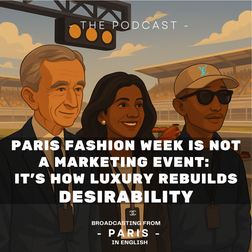
Paris Fashion Week is Not a Marketing Event: it's how Luxury Rebuilds Desirability
In this episode, Marc Abergel, luxury executive based in Paris, reframes Paris Fashion Week not as a marketing spectacle but as a battleground for cultural sovereignty. Through the lens of Dior’s billion-view paradox and Formula 1’s reinvention, he lays out a five-act Coronation Playbook for Maisons to reclaim authorship, pricing power, and direct audience control. This is not marketing chatter. It’s a C-suite strategic briefing on how to build moats of aura, command a sovereignty premium, and turn Fashion Week into civilization’s cultural calendar. Executives across luxury, media, and finance will find a provocative roadmap for what it takes to win not the season, but to win culture itself. “The paradox lies in the immediate surrender of authorship. Maisons spend millions to stage sacred rituals, only to hand them over to algorithmic chaos.” “Formula 1’s revolution wasn’t just on the track, it was a masterful sovereignty play in culture itself.” “Access in luxury is not exclusion, it is elevation. The most loyal are ushered from the antechamber into the throne room.” “A handbag becomes more than leather and hardware. It becomes an artifact of a cultural coronation, a vessel of ritual and memory.” “The choice is stark: surrender sovereignty to the feed, or rebel by becoming authors of culture, not tenants of the algorithm.”
The Last Mile of Culture: Bezos, Vogue, and the Biggest Power Grab of the Decade
What happens when the man who mastered the last mile of commerce sets his sights on the last mile of culture? In this episode, we unpack Jeff Bezos’s rumored bid for CondĂ© Nast and Vogue, not as a trophy purchase, but as what Marc Abergel, luxury executive from Paris, calls “the biggest cultural power grab of the decade.” Through the lens of Abergel’s "After Anna: Bezos’ Quest to Redefine Taste, will Luxury Surrender or Rebel?" article, we trace how Vogue has long acted as a cultural nation, defining desire for over a century, and why its potential merger with Amazon’s infrastructure could redraw the boundaries of influence. What’s at stake is nothing less than sovereignty over taste itself. Luxury Maisons: LVMH, Chanel, HermĂšs, face a stark choice: remain tenants in Bezos’s empire of desire, or reclaim their role as sovereign cultural nations. We explore Abergel’s proposed Sovereign Stack: Embassies, Rituals, Sacred Texts, and Diplomats; as luxury’s blueprint for survival in this looming Cold war for culture. This isn’t just about media or fashion. It’s about whether myth-making, the last true luxury, remains in the hands of Maisons and Brands, or gets folded into Bezos’s algorithmic canon. “Bezos isn’t buying Vogue for its balance sheet. He wants to command the very channel through which meaning itself is delivered, one-click desirability.” “Vogue has acted as a sovereign cultural nation, dictating taste and status for generations.” “If Bezos owns the authority to define desirability, luxury Maisons risk becoming mere vendors inside someone else’s cultural nation of taste, negotiating from occupied territory.” “The canon is the moat. Cultural assets, magazines, archives, foundations - are immune to algorithmic decay.” “In an age where AI can generate taste on demand, human-led myth-making may be the last true luxury.”
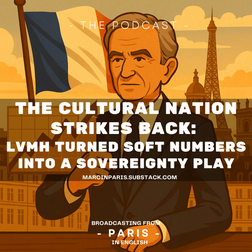
The Cultural Nation Strikes Back: LVMH Turned Soft Numbers into a Sovereignty Play
What happens when the world’s largest luxury group posts a soft quarter, yet its stock rallies? In this episode, we unpack Marc Abergel’s provocative article: The Cultural Nation Strikes Back, exploring how LVMH flipped weak financials into a flex of cultural statecraft. From Versailles with a ticker symbol to Olympic myth-making and quiet luxury diplomacy, this isn’t just about handbags: it’s about heritage, narrative power, and the sovereign currency of desire. We break down LVMH’s cultural sovereignty plays over the last few months (Dior, MoĂ«t Hennessy Private, the Olympics, and Sephora), and explain why the market might be waking up to a new valuation paradigm: one where legacy outperforms virality, and storytelling is the strategy. If cultural capital is the new margin, LVMH may already be the world’s most powerful organization. “It wasn’t a retreat. It was a sovereignty move.” On how LVMH’s Q2 results weren’t a dip, but a strategic investment in cultural dominance. “Versailles with a ticker symbol: where heritage commands.” Abergel’s thesis in one bold line. “LVMH doesn’t follow eras. It defies them.” Reframing time, relevance, and taste as levers of power. “Cultural Sovereignty is the new margin.” A new KPI for luxury: not just profit, but narrative control. “While others make noise, LVMH is defining taste.” On why quiet luxury, myth, and legacy trump trend-chasing.
1 de 3