The Clinical Next Step

The Clinical Next Step

por Ahmed Gaweesh
Temporada 1
Heart Murmurs: Innocent Sound or Structural Disease?
IA
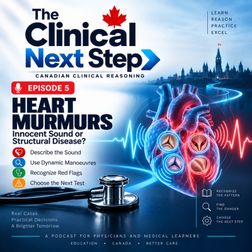
A murmur is a finding—not a diagnosis. Some systolic murmurs are physiological. Others reveal important valvular, congenital or myocardial disease. The clinical task is to describe the sound accurately, connect it to physiology, identify complications and decide who needs investigation or specialist care. In Episode 5 of The Clinical Next Step, we work through a practical approach to heart murmurs and abnormal heart sounds. You will learn how to: • Describe a murmur by timing, shape, location, radiation, intensity and response to manoeuvres • Interpret abnormal S1, S2, S3 and S4 findings • Use inspiration, standing, Valsalva, squatting and handgrip to refine the differential • Distinguish reassuring innocent patterns from pathological findings • Recognize patterns associated with aortic stenosis, mitral regurgitation, aortic regurgitation, mitral stenosis, tricuspid regurgitation and obstructive hypertrophic cardiomyopathy • Identify concerning pediatric findings and abnormal S2 splitting • Recognize complications such as heart failure, atrial fibrillation and infective endocarditis • Choose appropriate investigations, including ECG and echocardiography • Decide when urgent assessment or specialist referral is required • Apply endocarditis prophylaxis only when indicated The central reasoning sequence: Describe the sound. Determine whether the patient is stable. Identify the likely mechanism. Look for severity and complications. Choose the investigation that resolves the next decision. Recognize the pattern. Find the danger. Choose the next step. For medical education and exam preparation only. This episode does not replace patient-specific assessment, current clinical guidelines, local protocols or professional medical judgment. The Clinical Next Step is an independent educational project and is not affiliated with or endorsed by the Medical Council of Canada.
Dyspnea: Cardiovascular Causes and the Next Clinical Step
IA
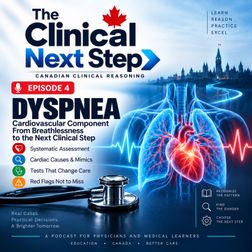
When a patient is short of breath, what should you recognize first—and what changes your next decision? In Episode 4 of The Clinical Next Step, we explore dyspnea through a cardiovascular lens: recognizing instability, assessing congestion and perfusion, and distinguishing heart failure from its dangerous mimics. This episode focuses on the cardiovascular component of breathlessness, connecting assessment to investigation, treatment and disposition. Topics include: • Recognizing threatened breathing and impaired circulation. • Using history and examination to distinguish cardiac causes from competing diagnoses. • Understanding what ECG, chest imaging, natriuretic peptides and echocardiography can—and cannot—tell you. • Approaching acute pulmonary edema, shock, valve emergencies and tamponade. • Connecting heart-failure phenotype to continuing care after stabilization. • Recognizing when improvement is insufficient for discharge and building a practical follow-up plan. Throughout, we examine common reasoning traps: assuming wheeze means asthma, treating a preserved ejection fraction as proof against heart failure, or relying on a reassuring resting oxygen saturation alone. For physicians and medical learners seeking practical, Canadian-focused clinical reasoning. Recognize the pattern. Find the danger. Choose the next step. The Clinical Next Step provides independent medical education. Content is for learning and does not replace individualized clinical assessment or current local guidance.
SYNCOPE — From Brief Collapse to Critical Red Flags
IA
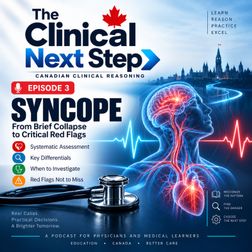
A brief loss of consciousness can have very different causes. The challenge is recognizing who needs urgent assessment and who can safely follow a lower-risk pathway. In Episode 3 of The Clinical Next Step, we approach syncope through practical Canadian clinical reasoning for MCCQE preparation, connecting the history, examination and ECG to the next clinical decision. Topics covered: • Initial assessment and recognition of instability • Distinguishing syncope from other causes of transient loss of consciousness • Reflex, orthostatic and cardiac causes • Red flags in the history, examination and ECG • Choosing targeted investigations and rhythm monitoring • Disposition, follow-up and patient counselling Recognize the pattern. Find the danger. Choose the next step. The Clinical Next Step is an independent educational podcast. It is not affiliated with or endorsed by the Medical Council of Canada. Content is provided for medical education and does not replace current clinical guidelines, institutional protocols or professional medical judgment.
PALPITATIONS – From Common Causes to Critical Red Flags
IA
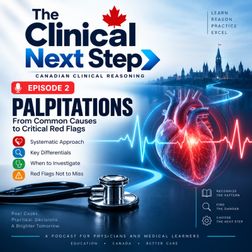
Palpitations are common. The challenge is determining when the sensation represents a dangerous rhythm or underlying disease. In Episode 2 of The Clinical Next Step, we approach palpitations using practical Canadian clinical reasoning for MCCQE preparation. This episode focuses on the decisions that matter: assessing clinical stability, characterizing the patient's symptoms, recognizing important arrhythmias and underlying causes, selecting the appropriate cardiac investigation or monitoring strategy, and identifying patients who require urgent intervention. Topics covered include: • Initial assessment and recognition of instability • Characterizing palpitations by onset, duration and associated symptoms • Cardiac and non-cardiac causes • Tachyarrhythmias and bradyarrhythmias • ECG interpretation in the clinical context • Choosing Holter, event and longer-term rhythm monitoring • Laboratory and targeted investigations • Syncope, chest pain and other important red flags • Immediate management of unstable arrhythmias • Common MCCQE clinical-reasoning traps • Disposition, follow-up and patient counselling Recognize the pattern. Find the danger. Choose the next step. The Clinical Next Step is an independent educational podcast. It is not affiliated with or endorsed by the Medical Council of Canada (MCC). Content is provided for medical education and does not replace current clinical guidelines, institutional protocols, or professional medical judgment.
CHEST PAIN - Don’t Miss the Dangerous Diagnosis
IA
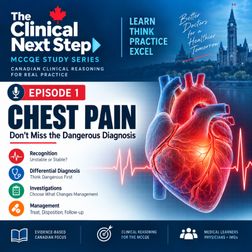
Chest pain is common. The dangerous diagnosis is the one you cannot afford to miss. In Episode 1 of The Clinical Next Step, we work through chest pain using a practical Canadian clinical-reasoning approach for MCCQE preparation. This episode focuses on the decisions that matter: recognizing an unstable patient, building a dangerous-first differential diagnosis, selecting targeted investigations, choosing the appropriate next step in management, and planning safe disposition and follow-up. Topics covered include: • Initial assessment and recognition of instability • Acute coronary syndrome • Aortic dissection / acute aortic syndrome • Pulmonary embolism • Tension pneumothorax • Pericarditis and cardiac tamponade • Essential investigations and interpretation • Immediate management priorities • Common clinical-reasoning traps • Prevention, disposition, follow-up and patient counselling Recognize the pattern. Find the danger. Choose the next step. The Clinical Next Step is an independent educational podcast. It is not affiliated with or endorsed by the Medical Council of Canada (MCC). Content is provided for medical education and does not replace current clinical guidelines, institutional protocols, or professional medical judgment.