Taller Together

Taller Together

por Tamzin Lovell
Temporada 1
The Raphael That Wasn't | Dr. Carina Popovici
In the art world, authenticity has never been a purely scholarly question. It sits at the intersection of expertise, market value, institutional authority, and reputation. Decisions about who or what gets believed can reshape careers, collections, and histories. Into this already complex system, artificial intelligence has entered as both a promise and a disruption. Speaking with Tamzin Lovell on Armature’s Taller Together, Carina Popovici, CEO and co-founder of Art Recognition, makes a careful case for AI as something that works with traditional expertise, not in place of it. In her view, it adds another way of looking at the long and often contested question of artistic truth.
Indigo, Bone & Seabed | Christine Dixie
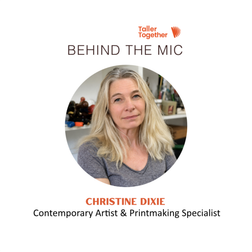
Christine Dixie lives and works in Makhanda, the Eastern Cape town renamed in 2018 after the Xhosa warrior and prophet Makhanda ka Nxele, who led an 1819 attack on the British garrison at what was then Grahamstown. Two years after that battle, around four thousand British settlers were shipped into the Zuurveld to act, in the words of colonial planners, as "a human barrier" between the Cape and the amaXhosa. Dixie's own ancestors were among them. "That very problematic history became much more apparent to me," she tells Tamsen Lovell on Taller Together. Her first response was the exhibition Frontiers, dealing directly with the settler ancestry. The line of inquiry has refused to close; Hide, Bathurst Street, Makhanda, and the more recent Bathurst Street installations all set the Georgian architecture of the settler town against cellphone images of the same streets now. The friction is the work.
Art Crime Exposes Cultural Power | Noah Charney
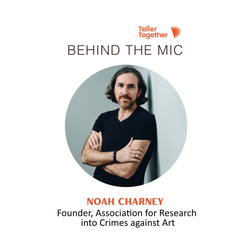
Art crime is usually sold to the public as a scene: a broken case, a night guard, a motorbike, a painting gone from a wall. Noah Charney's account of the field is less cinematic and more unsettling. The crime is not always the removal. Often it is the prior condition that made removal possible: weak records, diffused authority, untested expertise, a discreet market, and an institution that trusts an alarm before it trains the person who must answer it. In this conversation with Tamzin Lovell, Charney treats art crime as a way of reading cultural power. The useful question is not simply who stole the object. It is who could move it, sell it, ignore it, insure it, authenticate it, or fail to notice its absence.
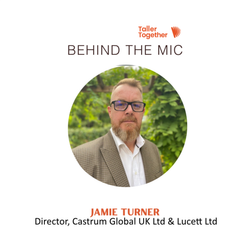
The Work Between Doors | Jamie Turner
In fine art transport, the work is often judged by how little it disturbs the room. A crate arrives. A painting is unpacked. A sculpture is placed. The client sees calm, not the route planning, condition checks, customs details, insurance sensitivities, or the compressed decisions made on site. Jamie Turner's point is that this calm is not a mood. It is a product. As Managing Director of Castrum Global and founder of Lucett®, he works in the part of the art world where trust must survive physical contact: packing, loading, storage, movement, delivery, installation, and handover. In his conversation with Tamzin Lovell for Taller Together, he is not sentimental about that trust. He treats it as something built through behaviour, restraint, records, and the ability to say no. As he puts it, "They were buying the trust."
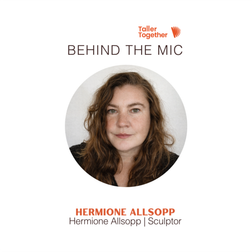
The Memories of Objects | Hermione Allsopp
Hermione Allsopp’s sculpture begins where ownership thins out. Charity shops, discarded furniture, worn household fittings: these are the materials she returns to, not because they are quaint or sentimental but because they have already absorbed use. They have been sat on, polished, stored, moved, neglected, kept for too long, and then given away. In conversation with Tamzin Lovell, Allsopp describes them as a “vessel of someone else’s memory”. That phrase is useful, but only up to a point. Her work is not about preserving intact stories. It is about what happens when memory becomes unstable in material form.
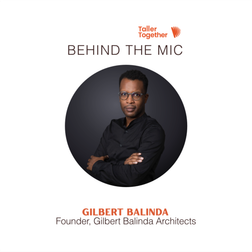
Beyond the Monument Museum | Gilbert Balinda

In conversation with Tamzin Lovell for Armature Magazine's Taller Together, Gilbert Balinda treats architecture as a public language of trust. Balinda, whose practice describes him as a Rwandan-Belgian architect and the founder and lead architect of Gilbert Balinda Architects, is less interested in spectacle than in what a building asks of its visitors: awe, caution, belonging, and distance. The conversation sits neatly beside the 2022 ICOM museum definition, which places accessibility, inclusion, ethics and community participation at the centre of museum work.
When Vendors Vanish, Collections Still Move | Anthony Watson & Guy Krige
Museums already know how to protect objects. They monitor light, temperature & movement and keep insurance and valuations current. But the day-to-day record of what an artwork is, where it is, what can be done to it, and who can touch it increasingly lives inside software the institution does not own and cannot fully inspect. In a Taller Together conversation hosted by Tamzin Lovell, EscrowSure’s Anthony Watson and Guy Krige treat that as a governance problem, not an IT footnote. The point lands because it is boring in the right way. The risk is ordinary. Vendors fail. Contracts end. Priorities shift. People disappear. A collection still has to move.
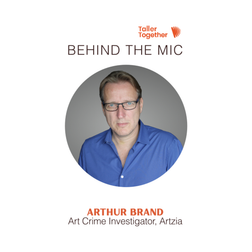
Museum Security Lessons from An Art Detective | Arthur Brand
Art theft gets sold as theatre. Velvet ropes, lasers, a billionaire in a white suit. Arthur Brand talks about the parts that do not photograph well. Phone numbers. Missing inventory records. And the small window of time it takes to cross a gallery, hit a case, grab an object, and be out the door. Brand is a Dutch art detective. Speaking with Tamzin Lovell on Taller Together, he describes the work as investigation and negotiation, but mostly risk management. You need people to talk. You also need them to survive having talked.
The Archive In Motion | Salma Uche-Okeke
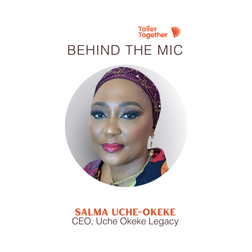
The conversation between Tamzin Lovell and Salma Uche-Okeke keeps returning to a simple, uncomfortable fact: an artist’s work doesn’t automatically survive the artist. It survives when somebody builds the conditions for it to survive.
What We Keep | Heidi Erdmann
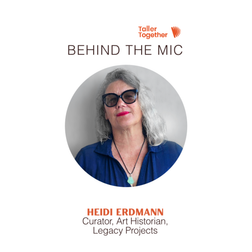
Heidi Erdmann speaks about the art world as a set of systems rather than a cast of personalities. In this episode, the conversation returns to the quiet labour that determines what survives: classification, storage, description, access, and the authority of whoever writes the first record. The result is a practical guide to legacy-building that refuses glamour and still feels urgent.
1 de 2