Talk Black & Give Back

Talk Black & Give Back

por Jennifer Nickerson-Turner
Temporada 3
Beyond the Blindfold: Why an Injury to One Is an Injury to All
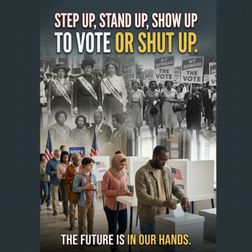
We have to clear out the people who are further dividing this country for political gain while calling it "making America great." Power concedes nothing without a demand, and our vote and our collective organizing are our demands. We have to stop letting politicians and this Supreme Court divide the Black community by separating "native-born" issues from "immigrant" issues. Take off your blindfolds and join the fight to remove power from undeserving people. An injury to one of us is an injury to all of us. For the folks who want to stand on the pulpit on Sunday and support policies that tear families apart on Monday, let me remind you of the Word. The Bible mentions the treatment of immigrants and strangers over thirty times. God looked at His own chosen people and said, "Don't you dare mistreat the outsider, because you were once immigrants in the land of Egypt." If you want to get real technical about who "belongs" here, Leviticus 25 tells us that the land belongs to God, and we are all just temporary residents and strangers passing through.
Colorblind or Blindfolded
Welcome back to Talk Black & Give Back. I’m your host, Jennifer Nickerson-Turner. This month, I want us to look at a question that has been weighing on me. In fact, I want you to help me talk through this today. Here is the question: Whose Supreme Court is this? Are we living in an America that is truly colorblind? Or are we living in an America that is intentionally blindfolded?
The Affordability Loophole: Reclaiming Fair Housing in 2026
Fifty-eight years ago, on April 11th, 1968, President Lyndon Baines Johnson picked up a pen and signed the Civil Rights Act—specifically Title 8, which we know as the Fair Housing Act. He signed it just seven days after the world lost Dr. Martin Luther King Jr. It was meant to be the final great achievement of the civil rights era. It told us: "You cannot be turned away because of your race, your religion, your national origin, or your gender." Later, it added protections for people with disabilities and for family status. It was supposed to end the era of "Not in my neighborhood." But as we sit here in 2026, I have to ask: Is a house truly "available" to you if you can’t afford to buy? Is the act truly "Fair" if the market has become the new "No Vacancy" sign for people with lower incomes?
We Started at Greatness: The Battle for Our Narrative
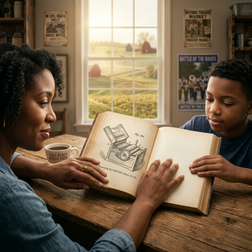
In this powerful late-March reflection, host Jennifer Nickerson-Turner moves us from the high-energy joy of February’s HBCU celebrations to the "Bridge of Truth"—the International Day of Remembrance of the Victims of Slavery. Jennifer shares a deeply personal journey, reflecting on her own experience as a young Black girl in the South during the ’80s and ’90s, and a shocking more recent encounter at the dinner table with her son. From the halls of Hawfields Middle School to the floor of the United Nations, this episode explores why truthful history isn't a "divisive concept"—it is the only map our children have to dream the big dreams they were born to carry. In This Episode, We Discuss: The "Bridge of Truth": Moving from the celebration of Black History Month into the deep honor of our ancestors’ resilience. The Battle for the Narrative: A breakdown of the 2026 UN vote on slavery as a "crime against humanity" and the impact of the "Restoring Truth and Sanity" executive order. The Dinner Table Wake-Up Call: Why a 7th-grade lesson on Eli Whitney proved that the fight for accurate history is far from over. Grassroots Warriors: A call to action to support the North Carolina organizations standing in the gap for our children’s education. Grassroots Warriors: Call to Action We challenge every listener to visit one of these sites and "Give Five" ($5) or an hour of your time: The Dudley Flood Center: Supporting youth-led social justice through "History Counts." Village of Wisdom: Protecting "Black Genius" and empowering parents in Durham. BCDI Greensboro: Bridging the literacy gap with culturally centered after-school care. Talk Black & Give Back: Join our virtual home for truth, business directories, and peer support. Key Quote: "We didn’t start at slavery. We started at greatness. If our children don’t have the full story to reflect on, they can’t dream the big dreams they were born to have." Connect with Us: Instagram: @TalkBlackGiveBack Facebook: Talk Black & Give Back Website: https://talkblackgiveback.org Phone: (336) 343-8694
THE BLUEPRINT OF LOVE
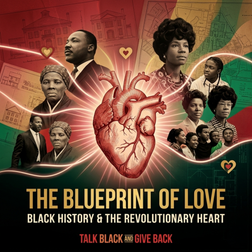
When we think about the journey of the Black community in this country—the progress we've made, and the grace with which we’ve made it—romantic love, as beautiful as it is, doesn't quite cover it. What is the love that got us here? We know it was a powerful,… it was sacrificial, and it was robust. It was Agape love. The Greek definition describes this as the highest form of love: a selfless, unconditional, and sacrificial love for humanity. It’s not just a feeling; it’s a choice. A strategy. A blueprint. For the next few minutes, we are going to look at the historical figures who utilized that Revolutionary Heart. We’re going to discuss the love they had to possess in their actions, just to make sure we were all better off. This isn't just going to be a history lesson; it’s going to be the very definition of love we need right now.
Temporada 2
'I Have a Dream", The Cost of Our Vision
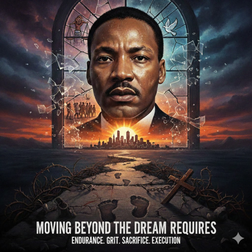
Wake up, everybody! How many of you know that this year would have marked the 97th birthday of Dr. Martin Luther King jr.? We know his name, we know the holiday, and we certainly know the 'I Have a Dream' speech delivered in 1963. But I want to start this episode with a hard truth: A dream, without the test of endurance, is merely static. It’s a beautiful picture of 'what could be,' but it has no momentum, no weight, and no breath. It’s not tangible—just an idea just floating in the air with nothing to anchor it to the ground. What separates a dream from a reality is a single, rugged word: Grit. Grit is the execution phase. It is the commitment to push forward when the 'what could be' is blocked by the 'what actually is.' Today, we honor Dr. King not just for his dream, but for his willingness to pay the cost of his vision.
Today is a Gift!
A cornerstone principle found in many major counseling and psychological theories, and a profound truth is that dwelling too much on the past creates depression, and worrying too much about the future creates anxiety." In this month’s podcast, I want to explore that, talk about why this moment, right now, is the most precious gift we have, and discuss how I've learned to appreciate it. We also remember one of my favorite people on the planet, Mark White.
Fright Night Special: The Crimson Collectors: The Policy of Poison
Last Halloween, the world of Saxonville Creek faced the Rickety Old Man and survived the chaos of the immediate vanishing. But the creature was only covered up, not killed. Join us for our Fright Night Special as we investigate the chilling return of the darkness—not as a spectral monster, but as a systemic, quiet terror. This year, the horror lives in the budget spreadsheets, the bureaucratic indifference, and the cold logic of The Crimson Collectors. We detail the institutional strangulation of our food, healthcare, and history, culminating in a final, defiant call for quiet resistance. DISCLAIMER: This episode is part of our annual Halloween Fright Night Special and is designed to be a terrifying fictional narrative. It's all in good fun—or is it?
A Call for the United State of Man
Let's stop and remember a simple premise of fairness—a lesson we learned in childhood, perfectly illustrated by the old folk tale, "The Little Red Hen." You know the story. The Hen asks, "Who will help me plant the grain? Who will help me grind the flour? Who will help me bake the bread?" And the Pig, the Cat, and the Dog all say, "Not I!" But when the delicious, fresh bread is finally ready, and the Hen asks, "Who will help me eat the bread?" They all shout, "I will!" The lesson of the story is not about bread; it’s about effort, contribution, and reward. The simple premise of fairness is this: If you work for it and you help build it, then you should reap the benefits. It's that simple. The greatness of America is not something that just happened. It was planted, it was worked, it was built by every single person who has contributed—Black America, Latin Americans, Asian Americans, and every American who has put in the effort. The benefits of this nation should go to those who helped make the bread, not just those who show up at the table asking for a slice. The greatness of America is not exclusive. It is not an exception for any group. It is the sum of all Americans who have worked to build it. Our call to action today is to Join Hands. Let's move beyond the divisive rhetoric. Let's stop checking the boxes that elected officials have tried to put us in. Instead, let's focus on creating the United State of Man—a mindset where we all work for unity and realize that our power is not in our division, but in our collective efforts. Don't wait for permission from the top. Because we are never going to get it. Let's build our own foundation, let's support our own builders, and let's ensure that the house we're building will last for generations to come. Join the conversation. Find a Black-owned business to support today, and let’s realize our shared vision: to build a stronger, more sustainable community, together, from the bottom up. Thanks for joining us. We’ll see you next month.
Black Philanthropy
Fact Checks & Sources from this months Podcast because "Truth" matters! This document provides sources for the historical claims made in the podcast script to ensure accuracy and provide listeners with a credible foundation. Claim: "August is Black Philanthropy Month." · Verification: This is correct. Black Philanthropy Month is a global celebration of giving and community investment within the Black community, celebrated annually in August. · Source: City Teaching Alliance, "Give 8/28 and Black Philanthropy Month." Claim: "Our story in America... began in August 1619 with the arrival of the first enslaved Africans in Virginia." · Verification: This is correct. The first documented arrival of enslaved Africans in Virginia occurred in late August 1619 at Point Comfort. · Source: National Park Service, "First Africans in Virginia Marker." Claim: "This spirit of resistance shows up again and again in August. From Nat Turner's rebellion in 1831..." · Verification: This is correct. · Source: Encyclopedia Virginia, "Nat Turner's Revolt (1831)." Claim: "...to Emancipation Day in 1834..." · Verification: This is correct. The Slavery Abolition Act of 1833 came into effect on August 1, 1834, leading many former British colonies to celebrate Emancipation Day on that date. · Source: British Online Archives, "Emancipation Day." Claim: "The tragic murder of 14-year-old Emmett Till in August 1955 became a turning point..." · Verification: This is correct. · Source: The FBI's official page on "Emmett Till." Claim: "...the March on Washington in August 1963, where a quarter of a million people spoke with one voice..." · Verification: This is correct. · Source: National Park Service, "March on Washington for Jobs and Freedom." Claim: "This movement's victories continued in August 1965 with the signing of the Voting Rights Act." · Verification: This is correct. President Lyndon B. Johnson signed the Voting Rights Act of 1965 into law on August 6, 1965. · Source: U.S. Senate, "The Senate Passes the Voting Rights Act." Claim: "The Watts Uprising in August 1965..." · Verification: This is correct. · Source: Britannica, "Watts Riots of 1965." Claim: "...the session of black panther George Jackson in prison was another tragic reminder of the ongoing struggle for freedom and justice." · Verification: The date is correct. · Source: Black Lives Matter, "The Legacy of George Jackson."
1 de 4