StrangeSpotting

StrangeSpotting

por Nick Montelupo
Temporada 1

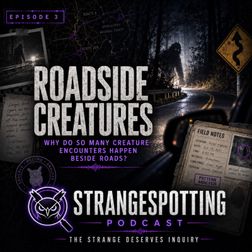
Why Do So Many Creature Encounters Happen Beside Roads?

Why do so many alleged creature encounters happen beside roads? From the Beast of Bray Road to Mothman and the Loveland Frogman, some of the strangest creature reports share the same setting: a dark road, a passing vehicle, a few seconds of visibility, and an animal that seems to defy easy identification. In this episode of StrangeSpotting: The Pattern Atlas, Nick Montelupo examines why roadside encounters recur so often in cryptid reports. Are roads genuine hotspots for unusual animals? Or do wildlife movement, roadkill, headlights, poor visibility, perspective, memory, and cultural expectations help create the pattern? We compare several famous cases, look at what road ecology and perception can explain, and ask what evidence would be needed before a recurring roadside pattern could support anything more extraordinary. Facts first. Conclusions after.
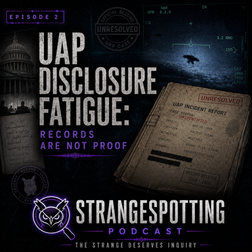
UAP Disclosure Fatigue: Records Are Not Proof

A new wave of UAP records, archives, portals, hearings, and official releases has created the feeling that disclosure is always happening — and yet never quite arriving. In this episode of StrangeSpotting, we examine the problem of UAP disclosure fatigue: the exhaustion caused by repeated partial revelation, ambiguous files, unresolved cases, redacted documents, and public expectations that no archive can automatically satisfy. A record is not proof. But a record is not nothing. We separate witness reports, government documents, sensor data, institutional interest, unresolved classifications, and actual evidence. We look at why many UAP cases remain inconclusive, how “unidentified” gets misused, why disclosure headlines often outrun the material itself, and what serious anomalistics should demand before treating any case as strong evidence. No blind belief. No blind dismissal. No fake neutrality.

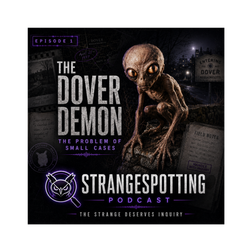
The Dover Demon and the Problem of Small Cases

The Dover Demon is not the strongest case in anomalistics — but it is one of the most useful. In this first StrangeSpotting podcast episode, we examine the 1977 Dover, Massachusetts sightings as a test case for serious anomalistics: how do we handle a small, strange, fragile case that has too little evidence for certainty, but too much structure to dismiss lazily? Was it a misidentified animal? A teenage hoax? A local legend in formation? A small humanoid encounter that still refuses to become simple? This episode is not about blind belief. It is not about ridicule either. It is about method: separating testimony from legend, evidence from proof, and mystery from mythology. The strange deserves inquiry.