SmartRolePath Radio

SmartRolePath Radio

por Gene Godin
Temporada 1

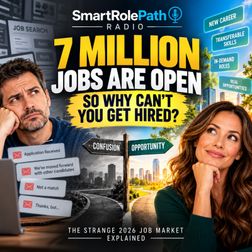
7 Million Jobs Are Open So Why Can’t You Get Hired?

There are about 7.1 million unemployed Americans — and roughly 7.1 million job openings. So why does getting hired feel harder than ever? In this episode of SmartRolePath Radio, Marcus and Elena break down the strange 2026 job market: slow hiring, long job searches, stale listings, “ghost jobs,” and the growing gap between the number of jobs posted and the opportunities that actually fit individual workers. The latest U.S. jobs data shows just 29,000 payroll jobs were added in September, while about 1.9 million Americans have now been unemployed for 27 weeks or longer. At the same time, millions of job openings remain listed across the country. Marcus and Elena explore why both things can be true — and why sending more applications may not be the answer. They discuss: • Why economists are calling this a “low-hire, low-fire” labor market • Why millions of job openings do not mean millions of equally accessible jobs • What “ghost jobs” and stale job listings really mean • Why applying to dozens of loosely matched positions can backfire • How transferable skills can uncover career options hidden behind unfamiliar job titles • Why career changers should focus on adjacent opportunities instead of assuming they must start over • Three practical ways to make your job search more targeted You’ll also meet Denise, a construction project coordinator trying to navigate hundreds of seemingly similar project-management jobs, and Luis, a warehouse supervisor who discovers that his experience may qualify him for far more careers than his current job title suggests. The biggest takeaway? Stop asking, “Where are all the jobs?” Start asking, “Where are the jobs that make sense for what I already know how to do?” If you're asking yourself what careers you're already qualified to move toward, you can run a free analysis at SmartRolePath.com. Sources include the U.S. Bureau of Labor Statistics, the Federal Reserve Bank of Cleveland, and current employer-job-listing data reviewed for this episode. SmartRolePath Radio explores career change, job-market trends, AI and the future of work, transferable skills, layoffs, hiring, and practical ways to build a better career. Disclosure: SmartRolePath Radio uses AI-generated voices. Research and editorial content are reviewed before publication.

The $100 Start and Reaching $1 Million by 55!

IA
Start with $100 a month at 20, double it every 5 years, and you can realistically cross $1 million by 55. Here's the exact math. Full show notes description What if reaching $1 million didn't require a huge income, just a head start? In this episode, we break down a simple savings plan: start at $100 a month at age 20, double the contribution every five years as your income grows, and let compound growth do the rest. Invested at a typical 7 to 8% average return, that plan crosses $1 million around age 55, a full decade before a traditional retirement age. We cover: The exact five-year doubling schedule, from $100 a month at 20 to $2,000 a month at 45+ What the plan actually adds up to by age 50, 55, and 60 How a college student with no steady income can fund the first step Where the money for each stage realistically comes from (hint: it's not a raise) What happens if you double every number in the plan and retire even earlier This isn't a get-rich-quick pitch. It's the real math behind starting early, worked out month by month. Q&A block Q: How much do you need to save monthly to reach $1 million by 55? A: Starting at $100 a month at age 20 and doubling that amount every five years (reaching $2,000 a month by 45), a 7 to 8% average annual return crosses $1 million by around age 55. Q: Can a college student with no income start this plan? A: Yes. The starting amount, $100 a month, can come from a part time or gig job, redirected gift money, or a tax refund rather than a full time salary. Q: What if I want to reach $1 million even earlier than 55? A: Doubling every contribution amount in the plan moves the $1 million milestone to around age 47 to 48. million dollars by 55, retire early, how to save a million dollars, compound interest explained, personal finance for beginners, saving money in your 20s, early retirement plan, financial independence, investing for beginners, Roth IRA contributions, money saving tips, retire comfortably

The 1.9 Million Jobs Nobody Is Applying For

IA
American manufacturers are projected to need 3.8 million skilled workers by 2033. Research from Deloitte suggests roughly half of those positions may go unfilled without a major expansion in training. That is close to 1.9 million jobs where the employer is the one getting ghosted. Marcus and Elena dig into why almost nobody is applying, and land on the same answer every time: the picture in most people's heads is about thirty years out of date. The roles actually driving the shortage are not manual. They are robotics, automation systems, quality engineering, and additive manufacturing. The modern production floor looks closer to a lab than an assembly line. This episode also covers the launch of Foundry School, a new federal training program built as a workforce partnership with Stanford University and seven other institutions, and why the existence of that program is itself a signal worth reading. IN THIS EPISODE (00:00) The number that stops the conversation (01:10) The outdated picture keeping people out of work (02:20) What an advanced manufacturing floor actually looks like today (03:15) Foundry School, and why a national training program is a distress signal (04:05) Three things that happen when employers cannot fill roles (05:20) Who this career path suits, and who it does not (06:00) Two free steps to test the idea this week KEY TAKEAWAY A worker shortage is not a promise of employment. It is a probability shift. When employers cannot fill roles, wages move faster, entry requirements loosen, and companies start funding the training themselves through apprenticeships and paid certifications. That last shift moves the cost of retraining off the worker and onto the employer. QUESTIONS ANSWERED How many manufacturing jobs will open by 2033? Do you need a degree for advanced manufacturing work? Which backgrounds transfer into manufacturing careers? Is a manufacturing career change realistic at 40 or 50? What is Foundry School? SOURCES Deloitte and The Manufacturing Institute, 2024 manufacturing talent study U.S. Department of State, Foundry School announcement under the Pax Silica initiative DISCLOSURE This episode uses AI-generated voices and was produced with AI assistance. The research and reporting behind it are real. Nothing in this episode is career, financial, or legal advice. Free career tools, including a skills-based career quiz and a career transition calculator, are at smartrolepath.com

The Jobs Report Says Hiring Fell — Here's What It's Not Telling You

IA
Nonfarm payrolls fell by 23,000 in July 2026 — missing expectations by nearly 100,000 jobs, with May and June both revised sharply downward. On the surface, that sounds like bad news. But the number hides real unevenness: private sector payrolls actually grew, healthcare kept adding jobs, while government employment and retail pulled back hard. In this episode, Marcus and Elena break down what the July jobs report actually shows once you look past the headline — rising temporary layoffs, the slowest wage growth since 2021, a labor force participation rate at a five-year low, and why a falling unemployment rate isn't automatically good news. Topics covered: Why payrolls missed expectations by nearly 100,000 jobs What the downward revisions to May and June really mean Why the unemployment rate can drop for the wrong reasons Which sectors actually grew while the headline number fell What this data means if you're planning a career change right now Free career tools: SmartRolePath.com | New episodes twice weekly.

Is a Four-Year Degree Still Worth It in 2026? What Employers Actually Want Now

IA
Traditional education is falling behind how fast careers change. Marcus and Elena break down why more than two-thirds of tech roles now sit outside tech companies, why 79% of organizations are running skills-gap initiatives, and what to do if the path you chose no longer matches the market.

Why Is Everyone Unhappy at Work? The Truth About AI and Entry-Level Jobs in 2026

IA
In this episode, Marcus and Elena break down what's actually happening in the 2026 job market: why roughly 1 in 3 workers say they feel "stuck" in their current job, why entry-level hiring has dropped sharply in AI-exposed fields, and why getting a first job is harder than getting promoted once you have one. Topics covered: The real data behind workplace dissatisfaction in 2026 Why AI is shrinking entry-level hiring specifically — not jobs overall What "seniorization" means and why entry-level postings now require experience How to build a realistic career transition plan in this market Free tools to help: SmartRolePath's Job Loss Help, Career Discovery Quiz, Career Transition Calculator, Career Analyzer, and full career roadmap Whether you're feeling stuck in your current role, worried about a layoff, or trying to break into a new field, this episode gives you the real numbers not hype, not doom and a clear next step. Free career tools: SmartRolePath.com | New episodes twice weekly.