Shipping Excellence

Shipping Excellence

por Andrew Duncan

Building AI-Friendly Cultures w/ Malvika Jethmalani

In this episode of the Shipping Excellence Podcast, Andrew Duncan speaks with Malvika Jethmalani about the importance of building AI-friendly cultures within organizations. They discuss the critical role of trust in AI transformations, tactical approaches to fostering trust, and the impact of AI on employee experience. The conversation also covers how organizations can navigate AI transformations successfully, the significance of power skills in the age of AI, and the future of human connection in a technology-driven world. Takeaways Culture is about how leaders manage the business. Trust is essential for successful transformations. Engagement is linked to trust and productivity. AI can enhance employee experience significantly. Organizations need to define the business problem before adopting AI. Power skills will be crucial in the future job market. Human connection is vital in a tech-driven world. AI can help HR focus on human aspects. Leaders must align their actions with their words. Building trust requires transparency and consistency. Chapters 00:00 Building AI-Friendly Cultures 03:24 The Role of Trust in AI Transformations 06:18 Tactical Approaches to Building Trust 09:02 AI's Impact on Employee Experience 11:56 Real-World Applications of AI in HR 15:13 Navigating AI Adoption Challenges 18:00 Power Skills in the Age of AI 21:03 The Future of Work and AI 24:04 Human Connection in an AI World 36:20 New Chapter


Transforming Real Estate sales w/ Jason Macht

Jason Macht discusses the transformative role of AI in the real estate sector. He shares real-world examples of how technology and data are being leveraged to optimize marketing, sales, and operational efficiency. From enhancing lead scoring to improving call monitoring, Jason emphasizes the importance of AI in driving business growth and efficiency. The conversation also touches on the future of AI in customer interactions and the ongoing evolution of technology in the business landscape. Takeaways AI can significantly improve the efficiency of engineering teams. The future of customer interactions may increasingly involve AI agents. Driving for dollars is a traditional real estate practice that can be optimized with AI. Using AI for lead scoring can help prioritize sales efforts effectively. AI can transform unstructured data into actionable insights for businesses. Call monitoring with AI can enhance quality assurance in customer interactions. The integration of AI into existing workflows can lead to substantial productivity gains. Chapters 00:00 Introduction to AI in Real Estate 03:17 Driving for Dollars: AI in Property Assessment 06:10 Optimizing Marketing Efforts with AI 08:59 Lead Scoring: Prioritizing Sales Efforts 12:03 Enhancing Sales Processes with AI 15:05 Operational Efficiency: Call Monitoring and QA 19:06 The Future of AI in Customer Interactions 24:56 Integrating AI into Business Workflows 29:46 Conclusion and Future Outlook 36:51 New Chapter

Harnessing AI for Business Success

In this conversation, Assaf Weinberg discusses the practical applications of AI in building technology and software products. He emphasizes the importance of understanding AI's capabilities and limitations, the role of proprietary data in business, and how AI can enhance operational efficiency and content generation. The discussion also highlights the need for businesses to identify their unique processes and data to leverage AI effectively. Takeaways AI has the potential to revolutionize business processes. Understanding AI's limitations is crucial for effective implementation. Proprietary data is a key differentiator in the age of AI. AI should complement human tasks, not replace traditional computing. Businesses must identify unique processes to leverage AI effectively. AI can automate content generation and marketing strategies. AI can help in mapping data fields and automating processes. The integration of AI in business requires a clear understanding of value add. AI can enhance operational efficiency in various industries. Collaboration between AI, humans, and traditional software is essential for success.

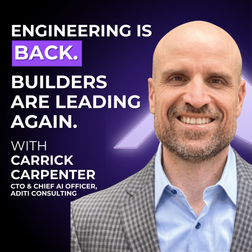
Engineering Is Back

Coding is figured out. Engineering is back. That's the shift, and it's already showing up in who excels and who gets stuck. Carrick Carpenter, Chief Technology and AI Officer at Aditi Consulting, sits down with Andrew Duncan for a peer conversation about what actually changes inside a services firm when AI rewires the delivery model. Aditi runs 2,000+ employees, 70+ Fortune 500 clients, three continents. Andrew runs Vertice Labs at the boutique end. Same tension, different scale. They go past "AI-native" positioning into the mechanics: why roles are collapsing, what a 90-pull-request engineer looks like in practice, why the people best at AI burn out fastest, and what Carrick got wrong in his first four months on the job. Topics Why engineering is back and what that actually means The 90-pull-request engineer and how to scale the pattern Cycle time as the new delivery metric The capacity paradox inside services firms Full stack leaders and collapsing roles What AI-native actually looks like at Fortune 500 scale Burnout risk for AI-native teams Outcome-based contracts and enterprise procurement SaaS in the agentic era Guest Carrick Carpenter, Chief Technology & AI Officer at Aditi Consulting LinkedIn: https://www.linkedin.com/in/carrickcarpenter Aditi Consulting: https://www.aditiconsulting.com Resources mentioned Claude Code: https://claude.com/product/claude-code OpenClaw: https://en.wikipedia.org/wiki/OpenClaw Gong: https://www.gong.io MCP: https://modelcontextprotocol.io Salesforce: https://www.salesforce.com Slalom: https://www.slalom.com Vertice Labs: https://www.verticelabs.io Connect Andrew Duncan: https://www.linkedin.com/in/andrew-b-duncan/ Vertice Labs: https://www.verticelabs.io Subscribe Spotify: https://open.spotify.com/show/64yoHwDdhBd0vik2sev6xs Apple Podcasts: https://podcasts.apple.com/gh/podcast/shipping-excellence/id1794200466 YouTube: https://www.youtube.com/@shippingexcellence RSS: https://media.rss.com/shippingexcellence/feed.xml

The Art of Validation in Software Development

In this episode of the Shipping Excellence Podcast, Chris Jaynes, a former VP of product and fractional CTO, shares his journey and insights into product management, the importance of validation in software development, and the role of AI in modern business. He discusses the challenges of navigating legacy systems, the significance of customer feedback, and the iterative process of building scalable software. Chris emphasizes the need for curiosity and customization in leveraging technology to solve real-world problems, while also reflecting on the personal challenges of being a fractional CTO. Takeaways Chris emphasizes the importance of exploring various experiences to foster innovation. Product management is fluid and adapts to the organization's needs. Validation is a critical phase that often gets overlooked in product development. AI can help bridge the gap in legacy systems by providing insights and solutions. Building scalable software requires a clear understanding of business goals and user needs. Feedback from users is essential for improving software and ensuring it meets their needs. Curiosity drives the exploration of new technologies and solutions. Customization of SaaS products is key to addressing specific business challenges. Constraints can foster creativity and innovation in problem-solving. The journey of being a fractional CTO involves balancing technical delivery with personal freedom. Books Range: Why Generalists Triumph in a Specialized World Kill It with Fire: Manage Aging Computer Systems (and Future Proof Modern Ones) AI North Star Playbook Chapters 00:00 Introduction to Chris Jaynes and His Journey 04:58 The Product Management Philosophy 10:08 The Importance of Validation in Product Development 15:19 Leveraging AI in Legacy Systems 20:57 Navigating the AI Landscape for Businesses 26:39 Balancing Technical Delivery and Leadership 32:08 Conclusion and Future Aspirations
2 de 2