SEO Deep Dive

SEO Deep Dive

por Indepth SEO
Temporada 1

Build Content Moats to Survive AI Search

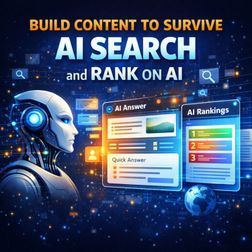
📝 Episode Description Search is no longer just about rankings and clicks. AI systems now read, summarize, and synthesize content before users ever see a webpage. In this episode, we break down how content needs to be designed for AI answers, not traditional Google rankings. We explore why traffic is declining even when rankings look stable, how AI Overviews and answer engines consume content, and what actually makes a brand visible in an AI-first search world. If you’re still optimizing content only for keywords, pages, and blue links — this episode explains why that playbook is breaking and what replaces it. 🎯 What You’ll Learn in This Episode Why ranking ≠ being selected as an answer How AI search systems consume and evaluate content What “designing content for extraction” really means The difference between page-first SEO and topic-first knowledge design Why zero-click searches are increasing — and how brands still win Which SEO metrics matter when traffic is no longer the goal 🧠 Key Concepts Covered AI Overviews & answer-first search Answer Engine Optimization (AEO) Zero-click search behavior Topic depth vs keyword optimization Content clarity, structure, and consistency Visibility without clicks ⏱️ Episode Breakdown 00:00 – 03:00 → Why rankings no longer guarantee traffic 03:00 – 08:00 → How AI search actually works behind the scenes 08:00 – 20:00 → Designing content for AI answers (frameworks & principles) 20:00 – 30:00 → What traditional SEO gets wrong today 30:00 – 40:00 → Metrics that matter in an AI-first search world 40:00 – End → The future role of SEO & content teams 📌 Key Takeaway Search engines no longer just rank pages — they generate answers. If your content isn’t clear, structured, and trustworthy enough to be reused by AI systems, it won’t matter how well it ranks. Modern SEO is no longer about chasing clicks. It’s about designing knowledge that machines trust.
Surviving the Zero-Click Era with GEO

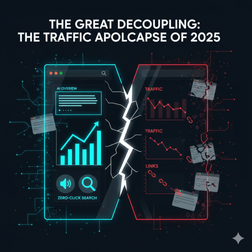
The rules of the internet are being rewritten in real-time. In this deep dive, we explore "The Great Decoupling"—a phenomenon where search engine usage is at an all-time high, but clicks to actual websites are in freefall. We break down the "Traffic Apocalypse" of 2025, examining how Google’s AI Overviews (AIO) and Zero-Click searches have fundamentally shifted the discovery landscape. We analyze high-profile case studies like HubSpot, which reportedly saw a 70% to 80% decline in organic traffic, and discuss why the old SEO playbook of chasing generic keywords is no longer enough to survive. Join us as we explore the new frontier of Topical Authority, Generative Engine Optimization (GEO), and the strategies brands are using to build "content moats" that AI cannot cross. -------------------------------------------------------------------------------- Key Takeaways • The 60% Rule: Roughly 60% of all Google searches now end without a single click to a website (rising to 77% on mobile) as AI summaries satisfy user intent directly on the results page. • The HubSpot Lesson: Even world-class SEO teams are vulnerable. Generic, top-of-funnel content is easily summarized by AI, leading to massive traffic losses for brands that don't own a specific niche. • SEO vs. GEO vs. AEO: Traditional SEO is evolving. Success now requires Generative Engine Optimization (GEO) and Answer Engine Optimization (AEO)—the art of ensuring your brand is the cited source behind AI-generated answers. • Brand as a Moat: Google’s Navboost system and the rise of Share of Search suggest that real-world brand demand is now a primary signal for authority. If people aren’t searching for you by name, AI might not see you as a "real" entity. -------------------------------------------------------------------------------- Topics Covered • [00:00] Introduction: What is the "Traffic Apocalypse"? • [02:15] The Great Decoupling: Why search volume is up while website clicks are down. • [05:45] AI Overviews (AIO): How AI summaries have cut click-through rates by 47%. • [09:30] The HubSpot Case Study: Why "generic" informational content is dying. • [14:20] Topical Authority: Moving from "keywords" to "topic libraries". • [18:50] GEO and AEO Explained: Being the answer, not just a result. • [23:10] The Content Moat: Using unique experience and proprietary data to become AI-proof. • [28:00] Final Strategy: Why visibility is now about being "understood well" rather than "ranking well". -------------------------------------------------------------------------------- Resources Mentioned • 2025 Organic Traffic Crisis Report: An analysis of why organic visibility is collapsing for many publishers. • The Koray Framework: A semantic SEO strategy focused on content clusters and topical graphs. • E-E-A-T Guidelines: Google’s framework for Experience, Expertise, Authoritativeness, and Trustworthiness. • Navboost & site_quality: Insights into how Google uses human interaction data to rank brands.
2 de 2