Dangelo68⚔️🔥

Dangelo68⚔️🔥

por JDangelo
Temporada 1

David ✨A Case in Repentance✨Psalm (51)V1-6 Part 1

There is no "Son chapter 51" in the Bible, but you are likely thinking of Psalm 51 or Isaiah 51. Both feature famous opening sequences (verses 1-6) that offer powerful themes of mercy and restoration. [1, 2, 3, 4] Here are summaries of both to help you find what you are looking for: Option 1: Psalm 51 (Verses 1–6) This chapter is King David’s desperate, heartfelt prayer of repentance after the prophet Nathan confronted him about his affair with Bathsheba. [1, 2] Verses 1–2: David pleads for God to show mercy, blot out his transgressions, and wash him completely clean of his guilt. Verses 3–6: David fully owns up to his sins, acknowledging that he has rebelled against God. He recognizes that his flawed, sinful human nature has been present since birth, but humbly asks for God's wisdom and a clean heart. Read the full text on Bible Gateway. [1, 2, 3, 4, 5] Please see Psalm (51)Vv1-6–online summary 🥹I ran outta room- In Description 👼🏻


Barren✨Judges (13)

In the Bible, barrenness primarily refers to the literal inability to conceive children, which was viewed in ancient times as a profound personal tragedy and societal shame. Theologically, these narratives highlight God’s sovereignty, illustrating that He is the ultimate giver of life and can intervene in seemingly impossible situations. [1, 2, 3] Key aspects of the barrenness theme in scripture include: 1. Prominent Biblical Examples Throughout the Old and New Testaments, God miraculously opens the wombs of several women to fulfill His redemptive promises and showcase His power: [1, 2, 3, 4, 5] Sarah (Genesis): The wife of Abraham, whose barrenness into advanced age made the birth of Isaac a clear miracle and the starting point of God's covenant. Rebekah (Genesis): Isaac prayed for his wife, resulting in the birth of twins, Jacob and Esau. Rachel (Genesis): After struggling with infertility, she eventually gave birth to Joseph. Hannah (1 Samuel): She poured out her grief in prayer and conceived the prophet Samuel, whom she dedicated to the Lord. Elizabeth (Luke): In the New Testament, she conceived John the Baptist in her old age. [1, 2, 3, 4, 5, 6] 2. Spiritual Metaphor Beyond the literal, the term is used metaphorically by prophets to describe spiritual unfruitfulness or a nation separated from God. For instance, in Isaiah 54:1, the prophet tells the "barren woman" to sing and shout for joy, symbolizing the ultimate restoration, fruitfulness, and inclusion of God

✨DIVINE VOWS✨Judges (11) V29-40NKJV

Judges 11:29-40 (see it in its entirety below) is a section of Scripture I struggled with for some time. In this passage, Jephthah, a Judge, vows to God that he will sacrifice whatever comes first out of his house if God grants him victory in a coming battle. God does grant victory. His daughter is the first to come out of his house. Thus, he despairs, for he has sworn to God to sacrifice her. She is obedient, and asks only that she is given time to mourn that she is unmarried before Jephthah does “as [he] promised”. Why is this passage difficult? A number of questions arise: Do these verses imply that God condones human sacrifice? Did Jephthah actually kill his daughter? Did God really want Jephthah to kill his daughter? Often web sites that feast on Bible difficulties will point to these verses to “demonstrate” that God condones human sacrifice (interestingly, they often cite the near-sacrifice of Isaac also, ignoring the fact that God would have known the outcome in advance, and so was clearly not condoning it to begin with–but that’s something for a different post, I suppose). I think there is more here than meets the eye. Commentary These verses questions have a couple different ways to answer. The first answer is perhaps the simplest. Jephthah did indeed kill his daughter because of his vow to God. A vow to God is higher than any other law, so this is what had to happen. Thus, Jephthah simply offered his daughter as a burnt offering. I think this answer is unsatisfactory. It doesn’t seem to fit the text. A better solution is offered, I think, by Norman Geisler and Thomas Howe in The Big Book of Bible Difficulties. They argue that Jephthah would have been aware of the law prohibiting human sacrifice (see Leviticus 18:21). Further, Jephthah could have offered his daughter as a living sacrifice, not a burnt offering. The Hebrew word is olah, one meaning of which is “sacrifice” (Brown-Driver-Briggs Lexicon). This helps explain why Jephthah’s daughter doesn’t mourn her coming death, but rather that she will remain unmarried. The concept of living sacrifice entails remaining unmarried for one’s life. Another answer that fits the text is to simply say that yes, Jephthah did offer his daughter as a burnt offering. But this doesn’t somehow mean that God condoned the action. One could very well vow to God that one would murder as many people as is physically possible, if only God would let the sun rise tomorrow. This doesn’t somehow mean that the sun rising means God condones the action of murdering as many people as physically possible. The text never states God’s position on the matter. As far as I can tell, it is simply reporting what happened. Jephthah told God he’d offer a sacrifice of whatever came from his house, he did so, the end. It doesn’t say that God wanted this to happen or that God approved of the action.

✨Come To Me ✨

✨COME TO ME ✨ With a teachable spirit, eager to be changed. A close walk with Me is a life of continual newness. Do not cling to old ways as you step into a new year. Instead, seek My Face with an open mind, knowing that your journey with Me involves being transformed by the renewing of your mind. As you focus your thoughts on Me, be aware that I am fully attentive to you. I see you with a steady eye because My attention span is infinite. I know and understand you completely; My thoughts embrace you in everlasting Love. I also know the plans I have for you: plans to prosper you and not to harm you, plans to give you hope and a future. Give yourself fully to this adventure of increasing attentiveness to My Presence. You have said, “Seek my face.” My heart says to you, “Your face, LORD, do I seek.” —PSALM 27:8 ESV Do not conform any longer to the pattern of this world, but be transformed by the renewing of your mind. Then you will be able to test and approve what God’s will is—his good, pleasing and perfect will. —ROMANS 12:2 “For I know the plans I have for you,” declares the LORD, “plans to prosper you and not to harm you, plans to give you hope and a future.” —JEREMIAH 29:11

Good news for the oppressed- Isaiah 61(1-10)

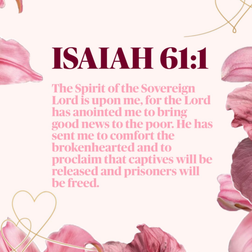
✨THE GOOD NEWS 🗞️ OF SALVATION ✨ 1 “The Spirit of the Lord God is upon Me, Because the Lord has anointed Me To preach good tidings to the poor; He has sent Me to heal the brokenhearted, To proclaim liberty to the captives, And the opening of the prison to those who are bound; 2 To proclaim the acceptable year of the Lord, And the day of vengeance of our God; To comfort all who mourn, 3 To console those who mourn in Zion, To give them beauty for ashes, The oil of joy for mourning, The garment of praise for the spirit of heaviness; That they may be called trees of righteousness, The planting of the Lord, that He may be glorified.” 4 And they shall rebuild the old ruins, They shall raise up the former desolations, And they shall repair the ruined cities, The desolations of many generations. 5 Strangers shall stand and feed your flocks, And the sons of the foreigner Shall be your plowmen and your vinedressers. 6 But you shall be named the priests of the Lord, They shall call you the servants of our God. You shall eat the riches of the Gentiles, And in their glory you shall boast. 7 Instead of your shame you shall have double honor, And instead of confusion they shall rejoice in their portion. Therefore in their land they shall possess double; Everlasting joy shall be theirs. 8 “For I, the Lord, love justice; I hate robbery for burnt offering; I will direct their work in truth, And will make with them an everlasting covenant. 9 Their descendants shall be known among the Gentiles, And their offspring among the people. All who see them shall acknowledge them, That they are the posterity whom the Lord has blessed.” 10 I will greatly rejoice in the Lord, My soul shall be joyful in my God; For He has clothed me with the garments of salvation, He has covered me with the robe of righteousness, As a bridegroom decks himself with ornaments, And as a bride adorns herself with her jewels. (‭‭‭Isaiah‬ ‭61‬‬:‭1‬-‭10‬ ‭NKJV‬‬)

Fractured Yet Whole With Jesus

Fractured Yet Whole in Jesus Healing rarely looks the way we imagined it would. You can feel broken and somehow held together at the same time, fractured in places that still ache yet not completely falling apart. Memories surface without warning. Emotions catch you off guard in the middle of an ordinary moment. A sound, a smell, a tone in someone's voice, and suddenly you are back there again, wondering if anything in you has actually changed. But you are still here. And that matters more than you know. Healing was never meant to look like forgetting. It was always meant to look like surrender. The hardest part of that surrender is almost always forgiveness. Not because you do not want freedom, but because of what was lost and who took it. These were people you trusted. People who were supposed to be safe. And now you are left carrying something that was never meant to be yours alone. Forgiveness is not pretending it did not happen. It is not calling it okay. It is placing what was done into God's hands and refusing, even when it still hurts, to keep carrying it on your own. The longing for closure, for answers, for things to finally make sense, that is deeply human. But peace does not come from figuring it out. It comes from trusting Him with what you cannot fix. And in that surrender, the weight begins to loosen, little by little, in ways you can barely explain but can slowly feel. There will still be hard days. Healing does not move in a straight line. It comes in waves, and that is not failure. You are not meant to rush it. You are simply invited to come to God as you are, every day, without having it together, and let Him meet you there. Over time, something changes. What once felt like it would define you starts to lose its grip. The mark of it may still be there, but it no longer has authority over who you are becoming. God did not bring you through what broke you to leave you hardened by it. He is shaping you through it, quietly and carefully, into someone softer, stronger, and more anchored in Him than you were before. You are not who you were in that pain. You are not defined by what happened to you. Even now, He is carrying you forward. And in Jesus, you are not just surviving your story. You are being made whole through it.

A Cobble~Stone Path Through Psalms

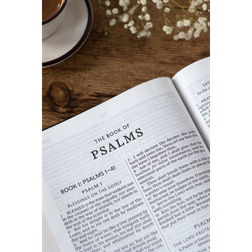
BOOK I (PSALMS 1-41) THE TWO WAYS 1 How happy is the one who does not walk in the advice of the wicked or stand in the pathway with sinners or sit in the company of mockers! Instead, his delight is in the LoRD's instruction, and he meditates on it day and night. He is likea tree planted beside flowing streams that bears its fruit in its season who and its leaf does not wither. Whatever he does prospers 4 The wicked are not like this; instead, they are like chaff that the wind blows away. * Therefore the wicked will not stand up in the judgment, nor sinners in the assembly of the righteous. 6 For the Lord watches over the way of the righteous, but the way of the wicked leads to ruin. CORONATION OF THE SON (Whydo the nations(rage) and the peoples plot in vain? 2 The kings of the earth take their stand and the rulers co onspire together against the LORD and his Anointedone: 3 "Let's fear off their chains and throw their ropes off of us." • The erthroned in heaven laughs; the Lord ridicules them. Then he speaks to them in his anger andterrifies them in his wrath: 6 "I have installed my king on Zion, my holy mountain." I will declare in Lord decree. He said to me, "You are my son ;") today I have become your Father. Ask of me, and 1 will make the nations your inheritance and the ends of the earth our nossession. 1 - GOD'S WAYS PREPARE TO MEET GOD 91. Would you describe your life as truly "happy" Why or why not? 2. How is happiness linked to what you refrain from doing (v. 1)? › 3. Do you merely read or study Cod's Word, or do you genuinely delight in it (v,2)? 4. What is a person like who delights in God's Word and meditates on it (v. 3)? DID YOU NOTICE? Psalm 1 is a wisdom psalm.} 2. The book of Psalms begins by talking about happiness (v. 1) it invites people to discover how to live a truly happy ate. 3. True happiness stems from decisions to avoid specific behaviors 4. Deep-seated joy comes from letting Ced's Word penetrate deeply into your heart and mind y. 2)) 5. Godly people are like well-watered fruit trees, while ungodly people are like windblown chatt (vv. 3-4 2 - GOD'S WAYS PREPARE TO MEET GOD 1. Are any nations so powerful and wealthy that they could withstand God's judgment against them (vv. 1-5)? 2. Through whom does Go d work to establish his ways on the earth? 3. How does God view people and nations that oppose him (v. 4)) 4. Do you pray for the nations (V. 8) 5. With what attitude do you serve the Lord (v. 11)?

The Gift Hidden in the Heartache

The Gift Hidden in the Heartache After opening your heart to God and renewing your mind, the next step is learning to live fully in His strength even when the struggle continues. Life will still have hard days, and challenges will not disappear overnight, but there are ways to intentionally lean into God so that His power carries you through . First, acknowledge your limits. You were never meant to carry every burden on your own. Recognizing where your strength ends is not defeat but a doorway to His power. Write down the areas where you feel weak, uncertain, or overwhelmed, and hand them over to God in prayer. Each honest acknowledgment becomes a point where His strength can enter. Second, take each moment to pause and breathe in His presence. Stress often tells us to rush, fix, or control, but God calls us to rest in Him. Set aside a few minutes each day to sit with Jesus, breathe deeply, and invite the Holy Spirit to fill the spaces your fear and frustration once occupied. Even short moments of intentional presence can reshape your perspective and refill your heart with courage. Third, act with faith despite fear. Strength is not the absence of struggle; it is moving forward while relying on God’s power. When fear rises, remind yourself of the truth in Joshua 1:9: “ Be strong and courageous. Do not be afraid; do not be discouraged, for the Lord your God will be with you wherever you go.” Let His presence guide your steps, even when the path feels uncertain. Fourth, build spiritual habits that reinforce strength. Prayer, Scripture reading, journaling, and worship are tools that anchor your heart in God’s truth. Use them intentionally to redirect your mind when worries creep in. Speak God’s promises out loud, rehearse His faithfulness, and let His words shape your reality. Finally, extend grace to yourself. True strength grows through consistency, not perfection. Celebrate the small victories, receive God’s forgiveness when you stumble, and turn to Him in repentance. Remember that His power shines most brightly in your weakness. As you practice these steps, you will find your heart steadier, your mind clearer, and your spirit increasingly anchored in His presence .Life in God’s strength means you never have to face the struggle alone. Step by step, prayer by prayer, thought by thought, His power becomes real in your daily life. Your weakness becomes the place where His strength shines brightest, and your ordinary days are transformed into opportunities for His glory to be revealed.
30 de 30