Practical for Your Practice

Practical for Your Practice

por The Consortium for Defense Psychology
Temporada 8
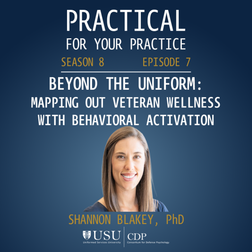
Beyond the Uniform: Mapping out Veteran Wellness with Behavioral Activation
IA
The first 12 months after leaving the military can be an incredible window of opportunity, but it is also a uniquely high-risk time for a service member’s mental health. When the uniform comes off, Veterans don't just leave a job; they lose a built-in mission, a tight-knit community, and a structured way of living. In this episode, hosts Dr. Jenna Ermold and Dr. Kevin Holloway sit down with licensed psychologist and researcher Dr. Shannon Blakey to flip the script on how we support transitioning veterans. Instead of waiting for clinical distress or pathology to surface, Dr. Blakey shares how clinicians can use Behavioral Activation (BA) as a proactive super-tool for wellness promotion. Tune in to discover how to help Veterans build an internal "compass," translate rigid military strengths into civilian life, and navigate the unexpected identity shifts of life after service. Shannon Blakey, PhD, is a Research Clinical Psychologist at RTI International and co- founder of Redstart Psychological Services, PLLC. Dr. Blakey’s research focuses on the nature, prevention, and treatment of mental health problems and suicide risk, especially among military and veteran populations. Her research has been supported by the National Institutes of Health and U.S. Department of Defense (DoD), including an ongoing DoD-funded project to adapt Behavioral Activation strategies into an upstream well-being promotion and suicide prevention program for use during the military-to- civilian transition. Dr. Blakey has published over 100 scientific articles and book chapters and serves on multiple journal editorial boards. She is a North Carolina Licensed Psychologist and maintains an active clinical practice delivering evidence- based psychotherapies to veterans and service members. Resources mentioned in this episode: Blakey, S. M., et al (2026, September 16). How to improve military transition outcomes through values-based activities. Blakey, S. M., et al (2025). Bringing veteran mental health promotion and suicide prevention efforts upstream: The THRiVE study protocol. Contemporary Clinical Trials, 158, 108100. Castro, C. A., & Dursun, S. (Eds.). (2019). Military veteran reintegration: Approach, management, and assessment of military veterans transitioning to civilian life. Academic Press. Lejuez, C. W., et. al (2011). Ten year revision of the brief behavioral activation treatment for depression: Revised treatment manual. Behavior Modification, 35(2), 111–161. Calls-to-action: Share your impactful moment in the comments or via https://www.speakpipe.com/cdpp4p Subscribe to the Practical for Your Practice Podcast Subscribe to The Center for Deployment Psychology Monthly Email

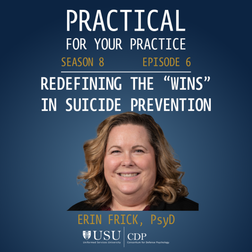
Redefining the "Wins" in Suicide Prevention
IA
Clinical work with clients at high risk for suicide can make providers feel they are on a conveyor belt. One reason for this is that, sadly, so many people are struggling with crises and safety concerns; the demand for services seems never-ending. But another reason is more insidious: the risk of provider burnout. On today’s episode, Dr. Erin Frick shares her perspective from working as a clinician and educator in the field of suicide prevention. Listen in as she encourages us to remain hopeful and connected with the “humanness” behind the crises. And if you have thoughts about how to “redefine the ‘wins’ “ in this work, share them with us. Erin Frick, Psy.D., is a clinical psychologist and an Associate Director at the Consortium for Defense Psychology (CDP), located at the Uniformed Services University of the Health Sciences.. At CDP, Dr. Frick leads the VA-Safeguard Suicide Prevention Project, where her team works to identify and implement best practices for suicide prevention among special veteran populations by leveraging evidence-based psychotherapies and VA standards of care. She also leads the DoD Child Collaboratory, a team dedicated to researching and implementing training and best practices for utilizing telehealth and digital tools to enhance healthcare and support for military youth and families. Resources mentioned in this episode: Therapeutic Risk Management Tool, available on the Rocky Mountain MIRECC website: https://www.mirecc.va.gov/visn19/trm/ The benefits of mindfulness for stress reduction: Ameli R, Sinaii N, West CP, Luna MJ, Panahi S, Zoosman M, Rusch HL, Berger A. Effect of a Brief Mindfulness-Based Program on Stress in Health Care Professionals at a US Biomedical Research Hospital: A Randomized Clinical Trial. JAMA Netw Open. 2020 Aug 3;3(8):e2013424. doi: 10.1001/jamanetworkopen.2020.13424. PMID: 32840621; PMCID: PMC7448827. CDP’s CBT for Suicide Prevention workshops: https://cdp.usuhs.edu/training-schedule Calls-to-action: For example: Attend CDP’s CBT for Suicide Prevention (CBT-SP) training Regularly implement self-care Share your impactful moment in the comments or via https://www.speakpipe.com/cdpp4p Subscribe to the Practical for Your Practice Podcast Subscribe to The Center for Deployment Psychology Monthly Email
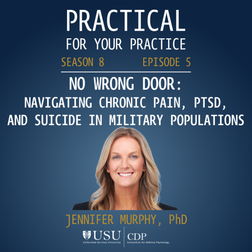
No Wrong Door: Navigating Chronic Pain, PTSD, and Suicide in Military Populations
IA
In this episode, hosts Drs. Jenna Ermold and Carin Lefkowitz sit down with clinical psychologist and national pain management expert Dr. Jennifer Murphy to dismantle the traditional, "find it, fix it" biomedical approach to chronic pain. Drawing from her extensive background, including five years as the National Director of Pain Management for the VA, Dr. Murphy highlights why addressing persistent pain is a critical piece of mental health advocacy, particularly for Veterans. The conversation explores the complex intersections of chronic pain with PTSD, sleep disturbances, and elevated suicide risk. While providers often feel ill-equipped to ask about pain, Dr. Murphy demystifies the treatment process, revealing that evidence-based protocols (like CBT for Chronic Pain) rely heavily on foundational behavioral health skills clinicians already possess. Because military-connected clients can often be more comfortable entering care to address physical versus behavioral health symptoms, treating a patient’s pain can act as a pivotal therapeutic gateway to addressing trauma and PTSD down the road. Ultimately, validating a patient's lived experience is the first step toward restoring autonomy and opening the door to deeper clinical healing. There is no wrong door and the most important thing we can do as providers is keep as many of them open as possible. Did this episode spark your interest in expanding your chronic pain practice toolkit? Did it bring up a question or underscore an impactful moment you experienced? Reach out to us via email or leave us a message on Speakpipe. And remember to stay curious and mind your EBPs! Dr. Jennifer Murphy is a clinical psychologist who has specialized in pain management for twenty years. She is CEO of Pain Expert Consulting and Senior Clinical Strategist for Applied VR. From 2020-2025, Dr. Murphy served as the National Director of Pain Management for the Department of Veterans Affairs. She is lead author of the VA’s Cognitive Behavioral Therapy for Chronic Pain Manual, a book entitled Chronic Pain and Opioid Management: Strategies for Integrated Treatment, as well as numerous peer-reviewed publications. Resources mentioned in this episode: AppliedVR: Explore immersive, FDA-authorized virtual reality healthcare technology designed to help patients manage chronic pain. Learn more at AppliedVR. Consortium for Defense Psychology (CDP) Training: CDP offers evidence-based protocol training in CBT for Chronic Pain (CBT-CP) multiple times a year. Check out the upcoming training schedule on our upcoming trainings page Calls-to-action: Take a CBT for Chronic Pain (CBT-CP) workshop through CDP Share your impactful moment in the comments or via https://www.speakpipe.com/cdpp4p Subscribe to the Practical for Your Practice Podcast Subscribe to The Center for Deployment Psychology Monthly Email
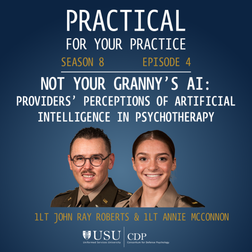
Not Your Granny's AI: Providers Perceptions of Artificial Intelligence in Psychotherapy
IA
In this episode of Practical for your Practice, hosts Dr. Kevin Holloway and Dr. Jenna Ermold dive into the rapidly evolving landscape of artificial intelligence in mental healthcare. They are joined by 1LT John Ray Roberts and 1LT Annie McConnon, rising graduate students in the clinical psychology program at the Uniformed Services University (USU). Together, they explore how clients and clinicians are currently navigating AI - from automated note-taking to therapeutic chatbots - and discuss ongoing research tracking provider and patient perceptions. The conversation balances the exciting potential of AI as a resource extender with the indispensable, human elements of the therapeutic relationship. AI is already in the therapy room. Tune in to find out how you can participate in this vital research and ensure provider perspectives aren't left behind. Annie Mcconnon, 1LT, USA is a rising 4th year clinical psychology doctoral candidate at the Uniformed Services University. She earned her master's degree in Clinical Counseling and Sport/Performance Psychology from Boston University. She is currently the Health Psychology Extern at Walter Reed National Military Medical Center and an Operational Psychology Extern at the Marine Corps Embassy Security Group. Her research interests include performance psychology interventions and artificial intelligence. John-Ray Roberts, 1LT, USA is a rising 3rd-year clinical psychology doctoral student at the Uniformed Services University. He earned his Master of Divinity (M.Div.) at Louisville Seminary in 2017. Prior to his time at USUHS, he served as a chaplain in the United States Army Reserve. His current research interests center on the intersection of artificial intelligence and human expertise, with particular attention to applications in clinical psychology. Resources mentioned in this episode: Sentio University (AI and Mental Health Course): https://sentio.org/free-ai-course-therapists Stanford AI Index: https://hai.stanford.edu/ai-index/2026-ai-index-report Military Medicine Journal (2025): Ann D McConnon, Airyn J Nash, John Ray Roberts, Shmuel Z Juni, Ashley Derenbecker, Patrice Shanahan, Andrew J Waters, Incorporating AI Into Military Behavioral Health: A Narrative Review, Military Medicine, Volume 190, Issue 9-10, September/October 2025, Pages e1870–e1881, https://doi.org/10.1093/milmed/usaf162 Calls-to-action: Take the survey here: https://forms.gle/ZBiSDf4FwXK4RQqw6 (Questions? Contact john.roberts@usuhs.edu) Share your impactful moment on our SpeakPipe at https://www.speakpipe.com/cdpp4p or via email cdp-podcast-ggg@usuhs.edu Subscribe to the Practical for Your Practice Podcast Subscribe to The Center for Deployment Psychology Monthly Email
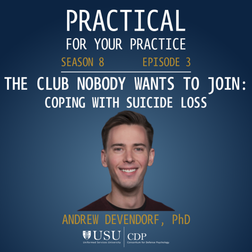
The Club Nobody Wants to Join: Coping with Suicide Loss
“What signs did I miss?” “Are people judging me?” “Should I even be in this field?” The suicide of a loved one triggers many thoughts and emotions in survivors. When the survivor is a mental health professional, those thoughts and emotions can be even more complicated, leading them to question their own skills and capabilities. On this episode we are joined by Dr. Andrew Devendorf, a psychologist who is also a survivor of suicide loss. He and Carin share their experiences in coping with the suicide of a loved one, how it impacted their professional lives, and how silencing the stigma can be. Our Actionable Intel provides resources for healing and connection. Andrew Devendorf, Ph.D., is a Military Behavioral Health Psychologist with the Henry M. Jackson Foundation for the Advancement of Military Medicine. He serves as a subject matter expert in suicide prevention for the VA SAFEGUARD project. Resources mentioned in this episode: American Foundation for Suicide Prevention: www.afsp.org National Alliance for Mental Illness: www.nami.org My Brother Went Missing, And The Search For Him Turned My World Upside Down, an article by Andrew Devendorf: https://www.huffpost.com/entry/missing-brother-search_n_5d67e1a5e4b063c341fc2782 Surviving the Impossible: Reflections on Suicide Loss, an article by Andrew Devendorf: https://www.psychologytoday.com/us/blog/deeper-mental-health/202502/surviving-the-impossible-reflections-on-suicide-loss The Hilliest Course I’ve Ever Run, a blog by Carin Lefkowitz: https://deploymentpsych.org/blog/staff-perspective-hilliest-course-i%E2%80%99ve-ever-run-coping-suicide-loved-one An Afterword to “The Hilliest Course I’ve Ever Run,” a blog by Carin Lefkowitz: https://deploymentpsych.org/blog/staff-perspective-afterword-%E2%80%9C-hilliest-course-i%E2%80%99ve-ever-run%E2%80%9D Calls-to-action: Keep the conversation going. If you’re a survivor or suicide loss, reach out to trusted friends, colleagues, or organizations. Don’t grieve alone. If you know a survivor, reach out to them. Share your impactful moment in the comments or via https://www.speakpipe.com/cdpp4p Subscribe to the Practical for Your Practice Podcast Subscribe to The Center for Deployment Psychology Monthly Email
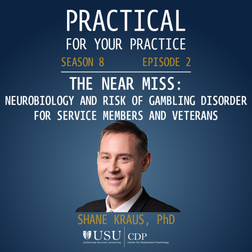
The Near Miss: Neurobiology and Risk of Gambling Disorder for Service Members and Veterans
In this episode, hosts Dr. Jenna Ermold and Dr. Kevin Holloway tackle a critical "blind spot" in military mental health with Dr. Shane Kraus, Director of the Behavioral Addictions Lab at UNLV. While we often screen for alcohol and PTSD, there is a "hidden" addiction quietly devastating the lives and careers of Service members and Veterans. From the high-tech lure of AI-driven sports betting apps to the surprising presence of slot machines on overseas bases, gambling disorder is a rapidly growing crisis that often goes undetected until it’s too late. Dr. Kraus joins us to explain the "banana analogy" and the dangerous neurobiology of the "near miss" that keeps the brain hooked. We discuss why military culture might make this addiction so difficult to spot, the staggering link between "chasing losses" and Veteran suicide, and the simple questions you aren't asking that could save a life. If you’ve ever wondered why a patient with stable PTSD suddenly spirals into a crisis, this conversation on the first-ever recognized behavioral addiction is a must-listen. Shane W. Kraus is a licensed clinical psychologist and expert in psychopathology, substance use disorders, gambling disorders, and compulsive sexual behavior disorder (CSBD). He is an associate professor of psychology who has published over 250 scholarly works on substance use disorders/behavioral addictions (e.g., gambling), psychopathology, compulsive sexual behavior, and trauma. Dr. Kraus received his PhD in clinical psychology from Bowling Green State University in 2013. He completed his addiction fellowship at the VA Connecticut Healthcare System and Yale School of Medicine, Department of Psychiatry in 2015. Resources mentioned in this episode: National Council on Problem Gambling: ncpgambling.org UNLV Behavioral Addictions Lab: Reach out for validated screening tools and research. https://ba.sites.unlv.edu/ State Councils on Problem Gambling: Check your local state chapter for clinician training and toolkits. Calls-to-action: Ask about financial stress and obtain additional training on gambling disorder Share your impactful moment via email (cdp-podcast-ggg@usuhs.edu) or via https://www.speakpipe.com/cdpp4p Subscribe to the Practical for Your Practice Podcast Subscribe to The Center for Deployment Psychology Monthly Email
The Moments That Changed Us
Your hosts are back for season 8 of P4P! This season we’ll have more conversations with experts in the field of evidence-based practice. But we want to get back to the personal stories behind their professional accomplishments. This season we’ll highlight the “impactful moments” that shaped them and keep them engaged in this difficult work. We’re kicking off the season by sharing our own impactful moments. Listen in as we discuss the unexpected interactions that uncovered our own biases and changed our perspectives about clinical practice. Calls-to-action: Notice your own “impactful moments” and call on them when the work gets hard Notice when you might be catastrophizing and use those impactful moments to recalibrate Share your impactful moment in the comments or via https://www.speakpipe.com/cdpp4p Subscribe to the Practical for Your Practice Podcast Subscribe to The Center for Deployment Psychology Monthly Email
Temporada 7
And the Nominees Are... EBP "Sins" On The Red Carpet
After 11 episodes of talking about the “sins” of evidence-based practice, we’re wrapping up season 7 by finding out “what’s in the box?” Our guests this season have covered a wide range of topics related to EBPs, including reducing suicide risk, and working with maternal mental health, OCD, and nightmare disorders. While the individual topics may have spanned the broad field of clinical practice, there was a surprising amount of overlap in the “sins” that our guests have encountered. On our final episode of season 7, your P4P hosts notice the common themes between these sins and which ones we’d invite to our own private awards show. Tune in to find out who the nominees are! Resources mentioned in this episode: Provider Self-Assessment Checklist (PSAC): A checklist your hosts created based on the “sins” discussed this season. It’s a quick way to check in on your own knowledge and comfort in broad areas of evidence-based practice. Calls-to-action: Use the Provider Self-Assessment Checklist to assess your own vulnerability to EBP “sins” Subscribe to the Practical for Your Practice Podcast Submit your comments or questions on our social media pages or via https://www.speakpipe.com/cdpp4p Subscribe to The Center for Deployment Psychology Monthly Email
How Are You Really Doing? Prioritizing Self-Care
The world feels a bit cray-cray right now and your hosts are feeling fatigued, on edge, and crispy. We took a moment to ask, “how are you really doing?”, and didn’t allow each other to answer “fine.” It’s a challenge for many of us in the helping professions to acknowledge our own distress, make time for self-care, and accept help from others. On this episode, we practice what we preach by acknowledging how stress is affecting our personal and professional lives. We explore what gets in the way of good self-care and how we’ve tried to be authentically and imperfectly present with ourselves, each other, and the people we help.
It's Not the Principal's Office! The ABCs of EAPs
In this episode of Practical for Your Practice, hosts Jenna Ermold and Carin Lefkowitz sit down with Dr. Randy Martin, Clinical Director of the Employee Assistance Program (EAP) for the New York Presbyterian Hospital System. Despite being a fixture in most large organizations, EAPs often remain "under the radar" for many behavioral health providers. Dr. Martin demystifies the "ABC of EAPs," explaining how these programs serve as the "mental health equivalent of a primary care physician" by providing short-term counseling, assessment, and organizational support. The conversation explores the parallels between EAP work and military mental health, the importance of proactive outreach during life transitions, and how providers can partner with EAPs to expand their own practices. Dr. Randy Martin is a highly accomplished licensed psychologist and Clinical Director of the New York Presbyterian Hospital System’s Employee Assistance Program. As a dynamic thought leader, executive, and training specialist, he has impacted the productivity and profitability of Fortune 1000 companies, educational institutions, and healthcare systems through psychoeducational webinars, seminars, and on-site crisis management interventions. A frequent media contributor seen on CNN Radio and in the Wall Street Journal, Randy is a recognized expert in short-term counseling, assessment, and organizational wellness. His career is defined by a passion for mentoring professionals and improving client well-being, earning him the Caron Foundation’s EAP Award. Resources mentioned in this episode: Employee Assistance Professionals Association (EAPA): Link to EAPA Website Calls-to-action: Subscribe to the Practical for Your Practice Podcast Submit your comments or questions on our social media pages or via https://www.speakpipe.com/cdpp4p Subscribe to The Center for Deployment Psychology Monthly Email
1 de 10