
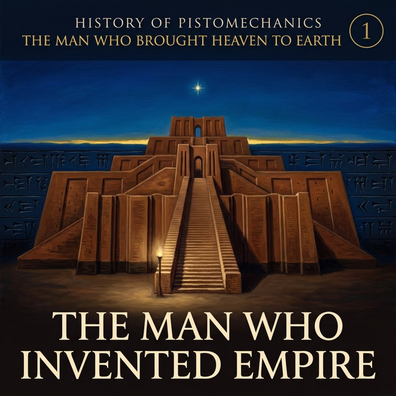
Notas del episodio
Have you ever heard the story of the baby found in the river, destined for greatness? A priestess gives birth in secret, seals the basket with tar, sets it on the water. A man drawing water finds him and raises him. The boy becomes king. Everybody says that is Moses. This one is from Mesopotamia, around 2300 BC, and the boy is Sargon, the first emperor in history, way before Moses.
So why does everyone know one of those two boys and nobody knows the other? Sargon's story was copied by scribes for fifteen hundred years, and then nobody wanted it any more. Moses' story never stopped. History did not keep the best story. It kept the one that fixed what was wrong with the one before. That is the bet this series makes.
This is the first episode of History of Pistomechanics: The Man Who Brought Heaven to Earth, ten episodes on the engineering of belief in religion and the state. Pistomechanics is the engineering of belief; a pistomechanic is an engineer of belief, and Sargon is one of the first in civilisation. Nothing here is about God, or about any saint or teacher. It is about men who needed to be obeyed and what they installed in people so that people would obey them. Every government that has ever existed has done this. Yours does. Seeing how a belief got into you does not make it false; it tells you who put it there.
Around 2300 BC there were two great powers, the way there are two today. Egypt had one river and a king who was a god by birth, and the question of whether he should rule had no meaning: you do not vote on the sun. One pharaoh renamed himself after the disc of the sun, closed the old temples, and when he died the priests cut his face and his name out of every monument they could reach. You cannot vote a god out. You can only erase him.
Mesopotamia had no Nile, so it built something else. A gardener's son who had been a cupbearer took the throne of Kish, beat the king of Uruk, and inherited the claim that the god Enlil had given him all the land from the lower sea to the upper sea. He called himself Sharru-kin, the rightful king, a name he made up and then made everyone from the Gulf to the Mediterranean answer to. Once he claims it, every king after him has to claim it, and he has to prove it, or the next man takes the claim and proves it. His capital, Akkad, has never been found. What he installed in people outlived everything he built.
At Ur he did not burn the temple. He put his daughter in it. Enheduanna became high priestess of the moon god, and the hymns coming out of the conquered city favoured the house of Sargon, which is why the first author in history with a name on the page was a political appointment. It is cheaper to take the priests than to kill them. Every empire since has copied the format.
His grandson Naram-Sin went one step further and had the sign for god written before his own name, and carved that the people had asked for it. You cannot install in people the memory of asking when they remember they did not. Five hundred years later Hammurabi worked out the fix: put the law on a stone in public, under a carving of the sun god handing it down, so that it could not be changed and did not depend on him. A king dies. A stone stays. Nobody in Babylon would have understood a traffic light. Every one of them would have understood why you stop.
And then the flaw: if heaven picks the king, somebody on earth has to speak for heaven. The second half is about those men, the priests of Marduk, who had a job, a building and a calendar, who struck the king across the face once a year and made him swear he had not harmed the protected citizens, and who in 539 BC handed the god's own appointment to a foreign conqueror in writing. A ceremony you can refuse one man and grant another is not a ceremony. It is an instrument, and somebody is holding it.
Full framework, sources and essays: pistomechanics.org. What can be studied... can be learned.