Lecture Notes in Genome Bioinformatics

Lecture Notes in Genome Bioinformatics

por Prof. Subhashini Srinivasan

Chapter 3.1: Lecture Notes in Genome Bioinformatics

“With close to gene-expression data from one million biological contexts in the public repositories, researchers can identify disease trends without ever having to enter a laboratory.” Monya Baker. Although the excitement of NGS technologies and the promise of transcriptome sequencing to both detect and discover novel genes is becoming trendy, there is no disagreement on the usefulness of the millions of gene expression profiles from microarrays in public repositories in biomarker discovery. As rightly described by Monya Baker, perhaps, one can identify disease trends without entering a laboratory as demonstrated by researchers at Stanford.
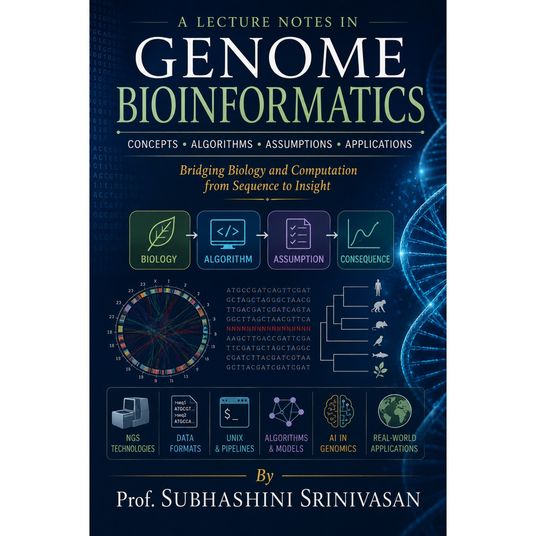
Introduction to the book Lecture Notes on Genome Bioinformatics by Subhashini Srinivasan

IA
The advent of next-generation sequencing (NGS) between 2005 and 2009 transformed biological research. Modern sequencing platforms can now generate terabytes of data in a single run, with experiments completed within hours to days depending on the technology. Equally transformative has been the dramatic reduction in sequencing costs, which has democratized genomics and created bioinformatics as a discipline under life sciences. Individual investigators can now sequence the genome or transcriptome of virtually any organism of interest—a capability that was once limited to large international consortia or well-funded research institutions. As sequencing throughput increased exponentially, bioinformatics evolved from a specialized discipline into an indispensable component of modern biological research. New algorithms, software tools, databases, and analytical pipelines have continuously emerged to keep pace with the data deluge and the rapidly expanding range of applications. The speed of these developments has been both exciting and challenging, leaving educators, students, and researchers struggling to remain current in an ever-changing technological landscape. NGS has also transformed scientific research in developing nations by reducing dependence on Western research priorities. However, old habit dies hard. The launch of GenomeIndia project mimicking the West in addressing genetic diversity across India is one such example. Also, although countries such as India can now address their own biological and societal challenges using NGS, including protein malnutrition, crop improvement, infectious diseases such as malaria, biodiversity conservation, and the characterization of human genetic variation arising from centuries of endogamy and/or cousin marriages; the challenge is in training the work force with a different mindset. Unfortunately, the pace of technological innovation has made it increasingly difficult for academic curricula and research laboratories to keep pace. The book details a fifteen-year educational journey (2010–2025) of building and delivering India's earliest comprehensive next-generation sequencing (NGS) data analysis curriculum at the Institute of Bioinformatics and Applied Biotechnology (IBAB). During this period the curriculum was dynamically updated as the research programs at IBAB kept evolving to keep pace with emerging sequencing technologies, computational methods, and burgeoning applications. The curriculum was designed around experiential learning, where classroom instruction was tightly integrated with active research projects. Rather than treating bioinformatics as a rigid set of software utilities, the book focuses on aligning experimental design with appropriate computational pipelines, analyzing genomic variations, and highlighting the limitations of current analytical tools. Its core scope bridges the gap between fundamental molecular biology and high-throughput computational algorithms.
3 de 3