Why Should We Care About the Indo-Pacific?

Why Should We Care About the Indo-Pacific?

por Ray Powell & Jim Carouso

Why Should We Care About Myanmar's Civil War?

Ray & Jim talk about an Asian civil war and human rights disaster that many have never heard of with former U.S. Ambassador to Myanmar, Scot Marciel. Myanmar is a southeast Asian country of 55 million people strategically located between Thailand, China, India, and Bangladesh, which experienced a military coup in 2021. The ruling junta has been responsible for massive human rights violations and a humanitarian crisis, while a growing resistance has recently gained significant ground. China has strategic interests in Myanmar, and has supported both the military and some ethnic armed groups. The Association of Southeast Asian Nations (ASEAN) has struggled to address the crisis. The best hope for Myanmar's is for the resistance to prevail and negotiate a new federal system, but there are risks of balkanization among the ethnic groups. At the end, special guest Biak Tha Hlawn--now a student at Stanford University--shares her personal experience as a member of the persecuted Chin ethnic group, and the losses her family has suffered due to the conflict. Those who wish to support her relief efforts can contact Hlawn at bhlawn@stanford.edu.

Why Should We Care About America's Indo-Pacific Allies?

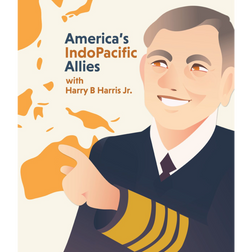
Ray and Jim welcome retired Admiral Harry B. Harris, Jr., former commander of U.S. Indo-Pacific Command and former Ambassador to South Korea, to discuss how alliances are crucial to U.S. national security. They touch on each of the five Indo-Pacific treaty alliances--Japan, South Korea, Australia, the Philippines, and Thailand--and discuss why some are coming together in a new "latticework", replacing the "hub-and-spoke" model of the past. Admiral Harris explains why he has come to advocate for replacing the decades-long U.S. policy of "strategic ambiguity" toward Taiwan and replacing it with one of "strategic clarity". He also discusses the roles of several new Indo-Pacific groupings such as the Quad--U.S., Japan, Australia and India.

Why Should We Care About the Defense of Taiwan?

Jim and Ray welcome retired Major General Mick Ryan, Royal Australian Army and retired Rear Admiral Mike Studeman, U.S. Navy to discuss the importance of defending Taiwan. They highlight the profound consequences of a Chinese takeover of Taiwan and its implications for the United States, Australia and the region. They emphasize the need to communicate the significance of Taiwan to the public, and to strengthen deterrence against China's aggression. The conversation explores the challenges of deterrence in the modern age and the need for a comprehensive approach that goes beyond military capabilities. Mick discusses his recent book about a hypothetical war over Taiwan and the importance of land operations in the defense of Taiwan.

Why Should We Care About Southeast Asian Economies?

Jim & Ray interview former U.S.Ambassador Ted Osius--now the President and CEO of the US-ASEAN Business Council--about the importance of Southeast Asia's rapidly growing economies, especially as companies seek to de-risk away from China's deteriorating business environment. They discuss the growth and potential of Southeast Asia, the opportunities for US investment in the region, and the continuing challenges faced by American companies who want to operate there. They also touch on America's failed involvement with the Trans-Pacific Partnership, and how that has negatively affected its economic opportunities and strategic position in Asia. They further discuss ASEAN's role in regional politics--what it can and can't do in the economic, diplomatic and security arenas. In this episode's "There I was..." segment, Jim recalls how as diplomats in Jakarta he and Ted would meet regularly with a wealthy Indonesian businessman who often had an axe to grind.

Why Should We Care if China is Harassing Philippine Ships?

Jim and Ray interview the Philippine Coast Guard's spokesperson for the West Philippine Sea, Commodore Jay Tarriela, about China's continuing harassment of Philippine ships at a time when the mist of the previous day's water-cannoning near Scarborough Shoal was still dissipating. They discuss the importance of countering Chinese aggression and protecting the international rules-based order. They ask Jay to weigh the benefits of the Philippines' transparency campaign against its risks, and to comment on ASEAN's reluctance to publicly back Manila in its maritime struggles and its inability to produce a South China Sea Code of Conduct. They also laugh and lament over the accusations by Beijing's propagandists about Ray's supposed manipulation of Jay and the Philippine government. Finally in "There I was...", Ray tells the story of the eruption of Mount Pinatubo in 1991, when he and his new bride were evacuated from the Philippines.

Why Should We Care About Beijing's Cyber Aggression?

Ray and Jim are joined by retired Lieutenant General Lori Reynolds, former U.S. Marine Corps Deputy Commandant for Information, who provides insights into China's recently uncovered "Volt Typhoon" cyber operation and its implications for national security, both within the U.S. and across the free world. They discuss Beijing's shift from simple snatch-and-grab intellectual property theft to now conducting high-level cyber espionage and embedding its operatives within a nation's critical infrastructure. They also talk about the data security and cognitive threats posed by TikTok and the need for free countries to become more resilient, and to leverage their own asymmetric advantages by exposing the Chinese Communist Party's cyber aggressions. 00:00 Introduction and Background 05:12 China's Shifting Cyber Strategy: From Intellectual Property Theft to Critical Infrastructure Embedding 11:58 The Threat of TikTok: Data Access and Manipulation 22:23 The Threat of TikTok and the Need for Divestment 28:04 Leveraging Asymmetric Advantage: The Power of Truth and Strategic Narratives 32:44 Contesting Chinese Influence: Exposing and Countering Manipulation in Various Industries

Why Should We Care if China has the World's Biggest Navy?

Ray and Jim are joined by Brent Sadler, author of "U.S. Naval Power in the 21st Century", to talk about China's rapidly growing naval power, including its ability to exercise power globally, coerce other countries and undermine Western influence. They discuss whether China's numerical superiority equates to superior capability and the growing vulnerability of surface vessels. They examine the situation in the South China Sea and examine how counterinsurgency tactics may be necessary to deal with China's paramilitary coast guard and maritime militia. The conversation then moves on to the US presence in the region and the need to develop maritime statecraft. They discuss the severe challenges facing US shipbuilding, including the lack of public shipyards and the shortage of shipyard workers and naval architects. The conversation concludes with the potential of the AUKUS alliance and the importance of Australia's investment in naval shipbuilding. At the end, Ray and Jim introduce their new "There I was..." segment, in which they trade stories from their military and foreign service careers. Ray goes first by sharing his first crisis after arriving in Australia, when he realized he had no idea how to get the Secretary of Defense on the phone.

Why Should We Care About the U.S.-Japan-Philippines Trilateral Summit?

Ray and Jim discuss the upcoming 11 April 2024 Trilateral Leaders' Summit between the Philippines, Japan and the United States with their guests Chris Johnstone, Japan Chair at the Center for Strategic and International Studies in Washington DC, and Victor "Dindo" Manhit, Founder and Managing Director of the Stratbase Group in Manila. They highlight the importance of this meeting in demonstrating a united front against China's assertiveness in the region. They also discuss the potential for increased military cooperation between the Philippines and Japan and the need for economic incentives to strengthen the relationship. The conversation ends by taking on the question of whether these efforts are sufficient to deter China's aggression. Overall, the conversation emphasizes the importance of collective action and cooperation in addressing regional security challenges.

Why Should We Care About the Indo-Pacific? (Pilot)

The pilot episode of 'Why Should We Care About the Indo-Pacific?' explores why people should pay attention to current developments in this vast, dynamic and increasingly turbulent region. Hosts Ray Powell and Jim Carouso draw from their decades of military and diplomatic experience in Asia and the Pacific as they discuss the region's geographic scope, expanding population and economic dynamism. They also delve into the growing military concerns, particularly the U.S. competition with China and the potential for armed conflict. The conversation delves into the importance of alliances and partnerships, the role of ASEAN and other new groupings like AUKUS and the Quad, and the need for ensuring free and open commerce.

Chinese Aggression Fuels Indo-Pacific Gray Zone Wars: Bonus Crossover Episode

In this illuminating bonus crossover episode, co-hosts Ray Powell and Jim Carouso joined the "At the Boundary" podcast from the Global and National Security Institute to discuss the critical importance of the Indo-Pacific region for global security and implications for the second term of the Trump administration. Explore key issues, including China's territorial ambitions, the strategic importance of the Indo-Pacific, and how these dynamics influence U.S. foreign policy and global stability - because China’s approach in the South China Sea is only becoming more aggressive. "At the Boundary" with Jim Cardoso and Tad Schnaufer II features global and national security issues found to be insightful, intriguing, fascinating - maybe controversial - but worth talking about. The mission of the Global and National Security Institute (GSNI) is to provide actionable solutions to 21st-century security challenges for decision-makers at the local, state, national, and global levels. 👉 Subscribe and watch more episodes of "At the Boundary" here, and follow GSNI on X, @USF_GNSI, LinkedIn, or YouTube 👉 Follow our podcast on X, @IndoPacPodcast, LinkedIn, or BlueSky 👉 Follow Ray Powell on X, @GordianKnotRay, or LinkedIn 👉 Follow Jim Carouso on LinkedIn
17 de 18