In The Garden

In The Garden

por Gordon Clinton Williams, M.Ed.
Temporada 1

Genesis 41: Faith That Builds Granaries

A prison dream interpreter becomes the architect of an empire’s survival. Genesis 41 reveals a faith that doesn’t just pray — it plans, prepares, and builds. In this episode of In The Garden, we walk through the dramatic rise of Joseph from dungeon to palace and explore what true, integrated faith looks like under pressure. Pharaoh’s troubling dreams of cows and grain expose the limits of Egypt’s wisdom. When Joseph is summoned, he does not claim credit. He boldly declares, “It is not in me; God will give Pharaoh a favorable answer.” Before he offers strategy, he offers worship. Revelation begins with humility. But Joseph doesn’t stop at interpretation. He presents a practical economic plan: appoint overseers, collect one-fifth during years of abundance, centralize storage, and prepare for famine. Faith becomes administration. Spiritual insight becomes public policy. God’s revelation produces responsible stewardship. Joseph’s wisdom saves Egypt — and eventually the surrounding nations. The promise given to Abraham that “all families of the earth” would be blessed through his offspring begins to unfold in grain silos and supply chains. Blessing looks like stored wheat. Yet Genesis 41 also carries a quiet warning. Pharaoh renames Joseph Zaphenath-paneah, gives him an Egyptian wife, and absorbs him into imperial power. Joseph builds a system that preserves life — but also centralizes authority. By the end of the famine, Egypt’s land, wealth, and labor belong to Pharaoh. The machinery of national control is firmly established. And centuries earlier, God had already told Abram that his descendants would be strangers in a foreign land and enslaved for four hundred years. The infrastructure Joseph strengthens will one day make Israel’s bondage administratively possible. The blessing and the bondage grow in the same soil. Joseph may or may not have fully understood the prophecy given to Abram. But whether he knew or not, he models something essential: faithfulness in the present without attempting to control the centuries. He cannot prevent a future Pharaoh who “did not know Joseph.” He cannot stop the unfolding of God’s sovereign plan. But he can steward abundance wisely. Genesis 41 teaches us that trusting God and building granaries are not opposites. Wise stewardship is practical faith. Planning is not unbelief. Preparation is not panic. It is obedience. Faith hears God’s voice. Wisdom builds the storehouse. Humility gives God the glory. And history rests in God’s hands. If you are in a season of abundance — spiritually, financially, relationally — this episode invites you to ask: How am I preparing? How am I stewarding? What structures am I building that will bless others long after me? Listen, reflect, and share this episode with someone who needs encouragement to trust God enough to plan wisely. Scriptures referenced: Genesis 41:1–57 Genesis 41:16 Genesis 41:34–36 Genesis 41:38 Genesis 41:45 Genesis 47:13–26 Genesis 12:3 Genesis 15:13–14 Exodus 1:8

Genesis 40: Joseph and the Only True God

Ever wonder if the future can be known? Who can speak with absolute truth about what is to come? In this episode of In The Garden Podcasts, we explore Genesis 40 and the story of Joseph in the Egyptian prison. When Pharaoh’s cupbearer and baker each have troubling dreams, Joseph reminds them — and us — of a profound truth: interpretation belongs to God alone. Dreams come and go, but only the One who declares the end from the beginning speaks with perfect accuracy. We unpack how God reveals truth about the future through Joseph, demonstrating that divine insight is not human intuition, courtly magic, or lucky guesswork. This story foreshadows God’s sovereignty over history, His ability to fulfill prophecy, and ultimately points to Jesus, who foretells events with certainty so that we may believe. Listeners will discover: How Joseph’s faith in God shaped his gift for interpreting dreams. Why true revelation belongs only to the Lord. The difference between human speculation and divine foresight. How trusting God’s word about the future transforms the way we live today. This episode encourages you to lean not on your own understanding or the predictions of men, but on the only God who speaks truth about the future. Let Genesis 40 inspire your faith and remind you that God’s promises are precise, reliable, and eternal. Listen, reflect, and share this story of divine authority and fulfilled prophecy. Comment your thoughts and experiences — how has trusting God’s word about the future shaped your life? Scriptures referenced in this episode: Genesis 40:5, 8 Isaiah 41:22–23 Isaiah 46:9–10 Daniel 2:10, 28 Deuteronomy 18:21–22 John 13:19 John 14:29

Genesis 39: Joseph and Potiphar's Wife

What does it take to grow from a dreamer into a man of integrity and influence? Joseph’s journey from favored son to slave, and eventually to the ruler of all Egypt, shows how God develops character through service and trial. In this episode, we explore Genesis 39, where Joseph serves faithfully in Potiphar’s house, resists temptation, and remains steadfast even in prison. Each step of his journey reveals how God works behind the scenes to shape our skills, wisdom, and moral character. Listeners will discover how faithfulness in everyday responsibilities, perseverance through trials, and unwavering integrity prepare us for the greater purpose God has for our lives. Key themes include: Faithfulness in service: How Joseph’s diligence in Potiphar’s household earned trust and responsibility. Integrity under temptation: How refusing compromise builds inner strength and honors God. God’s presence in trial: How even in prison, God’s guidance and favor allowed Joseph to succeed. Character development over time: How consistent obedience and trust prepare us for larger responsibilities. This episode encourages you to view your own trials, work, and temptations as opportunities for God to shape your character. Like Joseph, what you do in the small and hard places matters. God’s hand is at work, building your integrity and preparing you for the life He has planned. Take a moment this week to reflect: Are you faithful in the small responsibilities God has entrusted to you? Are you trusting Him in the trials and temptations you face? Every act of obedience and every moment of integrity matters in the story God is writing in your life. Call to Action: If this episode encouraged you, share it with someone who needs hope and perspective today. Subscribe to the podcast so you never miss a story of God’s faithfulness. Consider journaling your own journey of faithfulness, integrity, and trust in God’s plan. Scriptures referenced: Genesis 39:3, 6, 8, 23 (ESV)

Genesis 38: The Outcast who Carries the Promise

Genesis 38: The Outcast Who Carries the Promise Some stories in the Bible make us uncomfortable—and Genesis 38 is one of them. It’s a story of scandal, shame, and human failure, but it also reveals God’s unexpected grace and the way He works through the overlooked and marginalized to fulfill His promises. In this episode, we dive into the life of Tamar, the widow and outcast who secures the lineage of Judah. We explore her bold actions, her patience, and the surprising birth of her twins, Perez and Zerah. The midwife marks Zerah with a scarlet thread to signify the firstborn, but God chooses the one who breaks through: Perez, whose name means “breach” or “breakthrough.” This moment is a vivid reminder that God’s plans are not determined by human order or expectation, but by His sovereign purposes. We also reflect on Tamar’s role. Though Judah’s name appears in genealogies, it is Tamar who acts with courage and faithfulness, preserving the covenant line that will lead to David and, ultimately, Jesus. Tamar is a reminder that God often works through those society overlooks—the marginalized, the outcast, the brave who risk everything for what is right. This episode challenges us to see how God uses unlikely people to carry forward His promises. Where are you in a situation that seems impossible or shameful? Genesis 38 shows that faithfulness, courage, and risk can place us at the center of God’s plan—even when the world doubts us. Key Themes & Keywords: Tamar, Judah, Genesis 38, Perez, Zerah, scarlet thread, firstborn, breach, breakthrough, marginalized, outcast, God’s sovereign plan, courage, faithfulness, divine purpose, lineage of Jesus, biblical genealogy. Call to Action: Take a moment to reflect: who are the Tamar-like figures in your life, and how might God be working through them? Subscribe to In the Garden and follow along as we continue to explore the hidden ways God moves through brokenness to bring life and redemption. Scripture References: Genesis 38:1–30 ESV Genesis 38:14 ESV (Tamar veiled) Genesis 38:26 ESV (Judah acknowledges Tamar’s righteousness) Luke 3:23–38 ESV (genealogy tracing line through Judah and Perez) Matthew 1:3 ESV (Tamar mentioned in the genealogy of Jesus)

Genesis 37: Joseph the Dreamer

What if God speaks not only in waking words, but in dreams? Genesis 37 introduces Joseph as a young dreamer—and reveals that the God of heaven and earth is also Lord of the conscious and unconscious alike. In this episode, we step into the strange and beautiful world of biblical dreams through the life of Joseph, long before he was a ruler in Egypt. Before the pit, the prison, and the palace, Joseph was simply a young man who dreamed—and whose dreams stirred jealousy, confusion, and hatred among his own brothers. Genesis 37 shows us that God sometimes reveals truth before we are ready to understand it. Joseph’s dreams of sheaves bowing and heavenly bodies paying homage were real revelations from God, yet they arrived without explanation or timing. The dreams were true, but the dreamer still needed shaping. This episode explores how the Bible treats dreams not as superstition or fantasy, but as one of the ways God has chosen to communicate. From Joseph to Job, Scripture assumes that the Creator of land, sky, and sea is also the sovereign Lord of the inner life—the imagination, the sleeping mind, and the hidden places of the heart. We consider why God speaks in symbols, why dreams often precede suffering, and why fulfillment is usually delayed. Joseph’s story reminds us that God does not rush to fulfill what He reveals. Instead, He forms character, humility, and faith in the long space between promise and realization. This reflection also invites us to slow down our own interpretations. Not every dream is a message, but no part of our inner world is beyond God’s reach. The same God who spoke light into darkness is present in the night watches, guarding truth He will one day bring to light. Keywords: Genesis 37, Joseph the Dreamer, biblical dreams, God speaks, unconscious mind, divine revelation, suffering and formation, dreams in the Bible, God’s sovereignty, spiritual maturity Call to Action: Take time this week to read Genesis 37 slowly. Sit with Joseph’s dreams without rushing to conclusions. Share this episode with someone who is waiting on God’s promises—and join us as we continue tracing the one story that leads to Jesus. Scriptures Referenced: Genesis 37:1–11 Job 33:14–15

Psalm 6: How Long, O Lord?

Ever felt weary, broken, or overwhelmed by sorrow? Psalm 6 gives voice to those moments, showing us how to bring our deepest struggles to God with honesty and faith. In this episode, we walk through Psalm 6, one of the penitential psalms of David, exploring how he cries out to God in distress, asks for mercy, and finds assurance that God hears his prayer. We examine the tension between God’s discipline and His steadfast love (hesed), the honesty of bringing our grief before the Lord, and the turning point when David declares that God has heard him. Listeners will discover: How to pray openly and authentically when life feels heavy. The difference between God’s discipline and His wrath, and why His correction is an expression of love. How God’s covenant love provides hope even before circumstances change. The power of believing God hears and accepts your prayers, even in the midst of pain. This episode is perfect for anyone experiencing exhaustion, grief, or spiritual struggle, as well as those who want to see how Scripture models honest prayer in the face of suffering. We also reflect on the words of Jesus in Matthew 7:9–11, connecting David’s cry to the promise of a loving Father who hears our prayers. Call to Action: Take a moment this week to pray Psalm 6 for yourself. Bring your heart, your sorrow, and your questions to God. Notice how it feels to declare that the Lord hears your prayer. Share this episode with a friend who might need encouragement, and join us next Sunday as we continue exploring the Psalms together. Scriptures Referenced: Psalm 6:1–10 ESV Matthew 7:9–11 ESV

Genesis 36: Family that Shapes the Promise

Genesis 36 feels like a pause—but it’s actually a turning point. Before the story narrows to Joseph, Judah, and the road to Jesus, Scripture shows us how every surrounding family line shapes the destiny of the promise. Genesis 36 opens with a genealogy—Esau, also called Edom. At first glance, it seems like the Bible is simply closing the book on a brother who was not chosen. But this chapter does something deeper. It reminds us that God’s redemptive plan does not develop in isolation. The line of promise is shaped by brothers, cousins, uncles, tribes, and nations growing up right beside it. Esau is not the son of the covenant, yet God blesses him with land, descendants, chiefs, and kings. Edom becomes a nation quickly—strong, organized, visible—while Jacob’s family grows slowly, dependent on God’s provision. The contrast matters. Power is not the same as promise. As Genesis continues, the focus shifts to Joseph, Jacob’s most loved son. His life will preserve the family during famine and carry Israel into Egypt. Yet Joseph is not the one through whom the covenant flows. That honor belongs to Judah—the unlikely brother whose line will lead to King David and, ultimately, to Jesus. Along the way, other family lines continue to shape the story. Some protect the promise. Some oppose it. Some refine it through hardship. And some—unexpectedly—are woven into redemption itself. God uses faithfulness and failure, blessing and betrayal, obedience and resistance to move His plan forward. Jesus later spoke directly to this pattern when He said, “The stone that the builders rejected has become the cornerstone.” God’s purposes are never threatened by rejection, delay, or detour. The rejected son, the overlooked tribe, and the unexpected path are often the very means God uses to reveal His glory. Genesis 36 is not filler. It is proof that God never loses the thread. The road that leads to Jesus winds through many lives and nations, all held firmly in the hands of a faithful God. Keywords: Genesis 36, Esau, Edom, genealogy, Joseph, Judah, covenant, promise, Messiah, Jesus, redemption, biblical theology, Old Testament foundations Call to Action: If this episode helped you see the bigger story unfolding in Scripture, share it with someone walking through a season that feels overlooked or off the main path. And don’t forget to subscribe, follow, and join us as we continue tracing the one story that leads to Jesus. Scriptures Referenced: Genesis 36:1 Matthew 21:42

Genesis 35: Names That Shape Destiny

What’s in a name? In Genesis 35, names are more than words—they tell stories, reveal destinies, and reflect God’s hand at work in human lives. From Jacob becoming Israel to Benjamin receiving a name of blessing, this chapter shows how God shapes identity, transforms sorrow into hope, and unfolds His covenant promises through generations. In this episode, we explore: The reaffirmation of Jacob’s name as Israel and what it signifies about struggle, perseverance, and covenantal purpose. The renaming of Rachel’s son from Ben-oni (son of my sorrow) to Benjamin (son of the right hand) and how God turns grief into blessing. The poetic pattern of God or His appointed patriarchs giving names that reflect destiny, not just circumstance. How these ancient naming moments invite reflection on our own identities, the labels we carry, and the ways God can reshape our story toward hope and purpose. If you’ve ever wondered whether your past defines your future, or how God works through family, struggle, and blessing, this episode will encourage you to see your life in the light of His covenant promises. Keywords: Jacob, Israel, Benjamin, Ben-oni, Genesis 35, names, identity, destiny, blessing, covenant, God’s purpose, biblical storytelling, transformation, hope, Scripture reflection. Call to Action: Subscribe to the podcast to continue exploring the stories that lead to Jesus. Share this episode with someone who might need encouragement that God can shape identity, blessing, and destiny even through struggle. Scripture References: Genesis 35:10–18; Genesis 17:5; Genesis 32:28

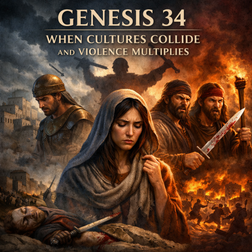
Genesis 34: When Cultures Collide and Violence Multiplies

What happens when two very different worlds collide? When one man’s desire meets a family’s covenantal values, tragedy can follow—and anger can spiral out of control. In Genesis 34, we see a story of violation, revenge, and the high cost of misplaced justice. In this episode, we explore the shocking story of Dinah, the daughter of Jacob, and Shechem, the son of Hamor. Shechem’s act of taking Dinah and lying with her was a serious violation, yet in his culture, marriage could have “fixed” the offense. Jacob’s sons, however, viewed the situation through a covenantal lens: sex outside God’s design was defilement, and the honor of their family had been violated. We unpack the cultural clash: Shechem and Hamor treated sex as transactional, a way to cement alliances. Jacob’s sons understood sex as sacred, covenantal, and tied to God’s order. Their response, however, escalated the violence rather than healing it. By deceiving the men of Shechem into circumcision and then slaughtering them, Simeon and Levi multiplied the tragedy. Nothing could undo Dinah’s violation, and the aftermath left blood on both sides, echoing Lamech’s boast in Genesis 4:24 about excessive revenge. Through this chapter, we learn that righteous anger is not the same as retaliation. Misplaced vengeance only deepens harm and compounds sin. Genesis 34 is a stark reminder that violation and revenge are both serious, and that God’s people are called to live differently—upholding justice while avoiding the destructive cycle of violence. Join us as we unpack the moral, spiritual, and cultural lessons of Genesis 34, exploring how God’s covenant shapes our understanding of sex, honor, and justice. Reflect with us on the tragedy of this story and the hope of God’s wisdom that calls us to mercy, restraint, and faithfulness even in the face of wrong. Call to Action: Subscribe to In the Garden and listen wherever you get your podcasts. Reflect on Genesis 34 in your personal study this week: How can God’s covenant guide your response to injustice, anger, and the brokenness of the world? Share your thoughts with us on the Monahans Bible Connection Facebook Page. Scriptures referenced: Genesis 34, Genesis 4:24

Genesis 33: From Sojourner to Settler

What happens when a wanderer finally puts down roots? In Genesis 33, Jacob’s simple land purchase marks a powerful shift—from sojourner living on promise alone to steward participating in God’s unfolding plan. In this episode, we explore the practical and spiritual meaning behind Jacob’s decision to buy land in Shechem after years of wandering. For generations, Abraham, Isaac, and Jacob lived as foreigners in the land God promised them—dwelling in tents, moving with the seasons, and trusting God daily for provision. But Jacob does something new: he establishes a permanent place. This wasn’t just about stability or comfort. It was an act of faith. We’ll look at how owning land transformed Jacob’s role from survivor to steward, from waiting on God’s promise to actively living within it. We’ll also reflect on the tension between dependence and security, and how settling can both mature faith and test it. Finally, we connect Jacob’s story to the life of Jesus—the ultimate sojourner who owned nothing on earth yet secured an eternal inheritance for us—and what it means for believers today to live as both pilgrims and heirs of God’s kingdom. Key themes & keywords: Genesis 33, Jacob buys land, sojourner vs settler, biblical faith, God’s promises, stewardship, inheritance, pilgrims in the Bible, Old Testament theology, Christian discipleship, kingdom of God, Abraham Isaac Jacob, spiritual growth 👉 Call to Action: If this episode encouraged you, be sure to follow the podcast, share it with a friend, and leave a review to help others discover God’s story. Join us as we continue walking through Genesis and uncovering how every movement points us closer to Jesus. Scripture References in This Episode: Genesis 33:18–19 Hebrews 11:13–16 Matthew 8:20 1 Peter 2:11 Ephesians 2:19
5 de 10