the londontop

the londontop

por thelondontop
Temporada 1
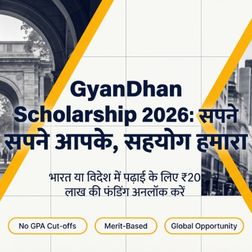
GyanDhan Scholarship 2026
the GyanDhan Scholarship 2026, a test-based financial aid program designed to assist students pursuing undergraduate and postgraduate degrees in India or abroad. Unlike traditional grants, this scholarship disregards prior academic scores or GPA, instead selecting eight winners based on a 60-minute online proctored aptitude test covering logical reasoning and verbal ability. Each recipient receives ₹2,50,000, with specific allocations for STEM, business, and technology fields to address the rising costs of international and domestic education. Beyond its own flagship award, the documentation describes a broader ecosystem of global fellowships, specialized cybersecurity grants, and collaborative funding options like the Prodigy Finance-GyanDhan Scholarship. GyanDhan also provides a suite of AI-powered preparation tools, such as admit predictors and SOP reviewers, to help applicants navigate the complexities of education financing. The materials emphasize a shift toward meritocratic, fintech-led solutions that prioritize cognitive potential and professional ambition over historical academic pedigree.
The science influencers going viral on TikTok to fight misinformation !
scientific experts are becoming influencers to combat the widespread growth of online misinformation. These creators use strategic engagement tactics, such as relatability and emotional storytelling, to reach audiences who are often targeted by anti-science rhetoric. By addressing topics like climate change and healthcare, professionals like "Doctor Mike" and Simon Clark aim to "pre-bunk" myths before they take root. Despite facing challenges like algorithmic bias and online harassment, these experts leverage their credentials to provide peer-reviewed evidence in digital spaces. Organizations like the World Health Organization are also beginning to support these efforts to ensure accurate information can compete with viral falsehoods. Through these diverse methods, the scientific community is working to reclaim trust in an increasingly complex information landscape

Why Should Anyone Live in New York City
These sources examine the multifaceted economic and cultural landscape of New York City, highlighting its status as a global hub of innovation and ethnic diversity. Detailed reports explore the creative economy, which encompasses industries like fashion, film, and the arts, while others analyze the city’s economic resilience and shifting job market following the pandemic. Practical guides provide insight into the high cost of living and the distinct culinary offerings found across the five boroughs, particularly in the diverse neighborhoods of Queens. Additionally, the texts outline essential services and benefits for residents and visitors, such as the IDNYC program and various startup incubators. Collectively, the documents portray a city that remains extraordinarily expensive yet uniquely appealing due to its rich history of immigration and constant urban reinvention. Overall, the collection serves as a comprehensive overview of the financial, social, and cultural forces that define modern life in New York.
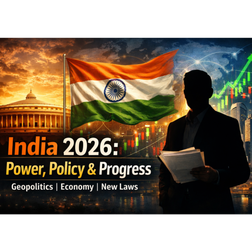
India’s 2026 Hard Reset and Caste Census
These reports provide a comprehensive overview of India’s geopolitical, economic, and legislative landscape in early 2026. A major focus is Operation Sindoor, a precise military campaign launched in May 2025 to dismantle terror infrastructure following a massacre in Pahalgam. Domestically, the government introduced the Union Budget 2026-27, which emphasizes semiconductor missions and infrastructure despite facing sharp criticism from opposition leaders like Rahul Gandhi. Legislative milestones include the Waqf (Amendment) Act to increase property transparency and the implementation of the Bharatiya Nyaya Sanhita, which has facilitated rapid sentencing in heinous crimes. Economic data highlights a Free Trade Agreement with the EU and a strengthening digital economy, though tensions persist regarding trade terms with the United States. Furthermore, the documents detail cooperative federalism initiatives through NITI Aayog and upcoming constitutional challenges regarding the 2026 delimitation exercise.
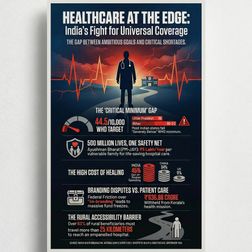
India’s Empty Hospitals and Empty Wallets
comprehensive overview of India’s geopolitical, economic, and legislative landscape in early 2026. A major focus is Operation Sindoor, a precise military campaign launched in May 2025 to dismantle terror infrastructure following a massacre in Pahalgam. Domestically, the government introduced the Union Budget 2026-27, which emphasizes semiconductor missions and infrastructure despite facing sharp criticism from opposition leaders like Rahul Gandhi. Legislative milestones include the Waqf (Amendment) Act to increase property transparency and the implementation of the Bharatiya Nyaya Sanhita, which has facilitated rapid sentencing in heinous crimes. Economic data highlights a Free Trade Agreement with the EU and a strengthening digital economy, though tensions persist regarding trade terms with the United States. Furthermore, the documents detail cooperative federalism initiatives through NITI Aayog and upcoming constitutional challenges regarding the 2026 delimitation exercise.
ek mukta
ek mukta
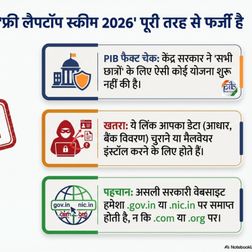
फ्री_लैपटॉप_योजना_की_असली_हकीकत
PMMVY_से_गर्भवती_महिलाओं_को_नकद_सहायता
NPS_अटल_पेंशन_या_मानधन_कौन_सी_चुनें
Epstein files reveal deeper ties to scientists than previously known
The publication of over 3.5 million pages of internal records by the Department of Justice in early 2026, mandated by the Epstein Files Transparency Act of 2025, has provided a granular diagnostic view of the systemic infiltration of global scientific institutions by Jeffrey Epstein. These disclosures transcend the sensationalism of earlier tranches, revealing a sophisticated operational framework where financial capital was converted into intellectual legitimacy, and academic prestige was leveraged to facilitate visa fraud, reputation laundering, and the subversion of scientific integrity. The scale of this interaction, characterized by the journal Nature as "deeper than previously known" and "unheard of" in its extent, suggests that Epstein’s involvement in the scientific community was not merely a philanthropic hobby but a calculated mechanism for "status capture". By embedding himself within the upper echelons of Harvard, MIT, Yale, and Stanford, Epstein secured a protective layer of institutional credibility that persisted for over a decade after his 2008 conviction for sex crimes.
1 de 2